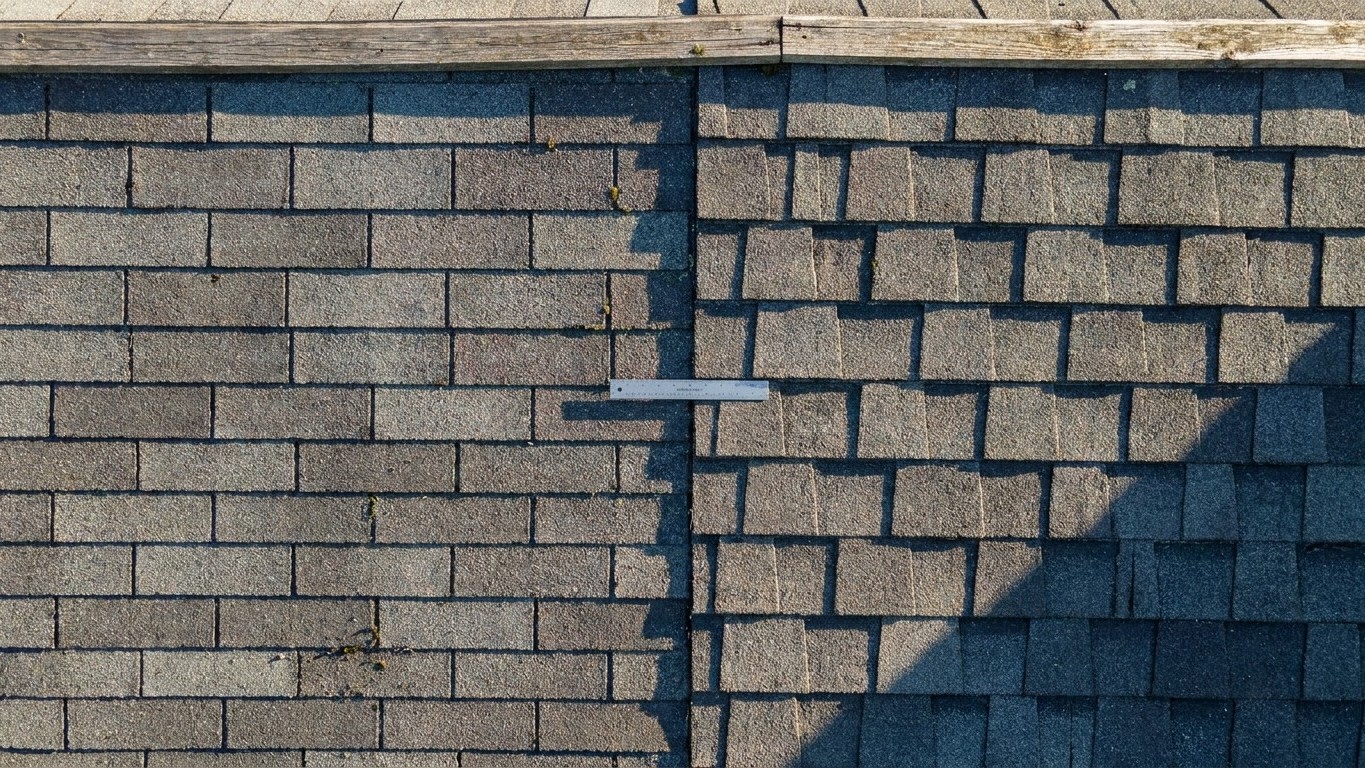

Three-tab and architectural shingles can look nearly identical from the curb, but they’re built differently, and that difference shows up the moment wind, hail, or sun starts working on the roof. Three-tab is a single flat layer cut into equal tabs. Architectural (also called laminated or dimensional) shingles use two or more layers bonded together, creating a thicker, uneven surface. That construction difference drives almost everything else: how the roof looks, how it handles weather, and how it ages.
What is actually happening
The thing to understand here is the layering. A three-tab shingle is one flat piece of material, asphalt-coated and topped with granules, cut into three even tabs so it reads as a uniform grid on the roof. Every tab is the same size, the same thickness, the same shape. That uniformity is exactly what makes it easy to spot from a distance: the pattern is grid-like, almost mechanical, with straight repeating lines running across each course.
An architectural shingle starts from a different premise. Instead of one layer, the manufacturer laminates two or more layers of asphalt-coated material together, then cuts the top layer into irregular shapes before bonding it to a base layer. The result is a shingle with a raised, dimensional texture instead of a flat one. Seen from the ground, it reads less like a grid and more like a shadowed, textured surface, closer to what wood shakes or slate look like.
That layering changes how the roof behaves under stress, not just how it looks. A flat, single-layer shingle has less mass and less overlap holding each tab down, so wind has an easier time getting underneath an edge and working it loose. A laminated shingle is thicker where it matters most: at the tab edges and along the exposed bottom layer, where wind and hail actually make contact. More layers bonded together means more resistance to that first gust getting a grip, and more material absorbing the impact of hail before it reaches the mat underneath.
Granule loss follows a similar logic. Both types shed granules over time as the asphalt coating weathers, but a single flat layer has less asphalt volume to protect before the mat itself is exposed. A laminated shingle has two layers of asphalt and granules stacked, so surface wear has to work through more material before it becomes a structural problem rather than a cosmetic one.
None of this means one product is universally correct and the other is a mistake. It means the two respond differently to the same weather event, and that difference is worth understanding before assuming a roof problem is the same regardless of which type is overhead.
What you can see without climbing
Most of what a shingle roof is doing can be observed without ever setting a foot on it. The routine has two stages: a look from the ground, then a look from inside the attic.
- Scan from the ground with binoculars or a phone camera zoomed in. Look for tabs that are lifted, curled, or missing outright. On a three-tab roof, missing pieces show up as gaps in an otherwise even grid, easy to spot because the pattern is so regular. On an architectural roof, look instead for patches that look flatter or lighter than the surrounding texture, since a missing laminated shingle disrupts the shadow pattern rather than leaving an obvious blank square.
- Check for granule loss and discoloration. Dark streaks running down from the ridge usually point to algae growth rather than damage, but bald patches where the surface looks smoother and shinier than the rest of the roof suggest the protective granule layer has worn through in that spot.
- Look at valleys and edges. These are the places water concentrates, and they’re often the first places a shingle shows curling, cracking, or separation from the layer beneath it. Zoom in on any valley where two roof planes meet.
- Move to the attic with a flashlight, ideally in daylight. Turn off the attic light and look for pinpricks or larger patches of daylight coming through the roof deck. Any visible daylight means there’s a gap somewhere in the shingle or underlayment above.
- Check the rafters and sheathing for staining. Water that has been getting in leaves a trail: brown or gray streaks running down a rafter, dark rings on the underside of the deck, or discoloration that spreads outward from a single point.
- Feel the Insulation. Damp or compressed insulation, especially near a stain, confirms water has been reaching the attic space rather than just threatening to.
Done together, these six checks are genuinely sufficient for a homeowner to know whether something needs professional attention. They don’t require a ladder, a roof walk, or any tool beyond a flashlight and a working phone camera.
What it costs to leave it
A missing or lifted shingle rarely causes damage the day it happens. What it does is remove a layer of protection, and every subsequent rain, snowmelt, or wind-driven storm gets a slightly easier path to the roof deck underneath.
The first material to get wet is the underlayment, the felt or synthetic barrier installed beneath the shingles. It’s designed to handle occasional moisture, but it’s not designed to be a long-term primary defense. Once shingles above it are compromised, water starts reaching the wood decking itself, and plywood or OSB sheathing absorbs moisture in a way asphalt never does. Repeated wetting and drying cycles cause the wood to swell, soften, and eventually delaminate or rot, first at the surface, then through the panel.
From there, the path continues downward. Rafters and trusses can pick up staining and, if exposure continues, softening at the point of contact. Insulation loses its effectiveness once it’s damp, since compressed, wet insulation traps far less air than dry insulation and stops doing its job even after it dries out partially. If the leak is slow and persistent rather than a single dramatic event, moisture can sit in these layers long enough for mold to take hold, particularly in attic spaces with limited airflow.
Ceiling drywall is usually the last place damage becomes visible to someone standing inside the house, showing up as a yellow-brown stain or a soft, sagging patch. By the time that stain appears on a bedroom ceiling, the water has typically already traveled through shingle, underlayment, decking, and insulation to get there. The visible sign inside the house is the end of a chain, not the beginning of one.
None of this happens on a fixed schedule. It depends on the size of the gap, the frequency and intensity of storms, the ventilation of the attic space, and the slope of the roof. What’s consistent is the direction: undetected damage moves from the outer layer inward, and each layer it reaches is more expensive and more disruptive to repair than the one before it.
If the damage follows a specific storm, an insurance claim may be relevant. The homeowner’s policy governs what’s covered, how damage needs to be documented, and what the filing window looks like, and all of that varies by policy and by state. Photographing the damage as soon as it’s noticed, from the ground, and keeping a record of the date it was first observed, gives an adjuster something concrete to work from regardless of what the policy ultimately covers.
What is not a householder job
Everything described above, the ground scan, the attic check, the photographs, can be done safely by almost anyone. What comes after that, physically getting onto the roof to confirm or repair what’s been observed, is a different category of task, and it’s worth being plain about where that line sits.
Anything above a single-story roof is not a householder job. The fall risk and the difficulty of safely setting up a ladder both increase sharply once a second story is involved, and the margin for error on a first attempt is thin. A roof that’s wet, mossy, steep, or frosted is also off-limits regardless of height, because all four conditions reduce footing in ways that aren’t obvious until weight is already on the surface. And any repair that requires both hands free while standing on a sloped surface, holding a shingle in place while nailing it, for instance, removes the one hand a person would otherwise use to catch themselves.
These aren’t arbitrary cutoffs. They reflect the fact that most roofing falls happen not during long, planned jobs but during short ones: a quick look, a small fix, a five-minute job that turns into a slip. The observation routine above exists precisely so that “quick look” never has to happen on the roof itself.
When the ground and attic checks turn up something that needs a closer look, the next step is a proper inspection rather than a DIY climb. Our roof inspection checklist walks through what a thorough inspection covers and what to ask for in a written report. If repair or replacement is on the table, the guide to hiring a roofer covers how to vet a contractor, what documentation to expect, and what questions separate a solid estimate from a rushed one.
Common questions
Can I mix three-tab and architectural shingles on the same roof?
Physically, patching one type into a section of the other is possible, but it usually creates a visible difference in texture and shadow line, since the two products aren’t built to the same profile. Most roofers treat a full section or slope as the smallest unit worth matching, rather than patching individual shingles across types.
Do architectural shingles need a different underlayment?
The underlayment choice depends more on climate, roof slope, and local building code than on which shingle type sits above it. A roofer or the shingle manufacturer’s own installation specification is the right source for that decision on a specific roof, not a general rule.
Why does my roof have dark streaks but no visible damage?
Dark streaking is most often algae growth, which feeds on the limestone filler in some granule coatings and shows up as black or greenish-brown streaks running down from the ridge. It’s a cosmetic and biological issue rather than a sign the shingle itself has failed, though it’s worth checking the same area for granule loss while it’s already being inspected from the ground.
How do I know if a missing shingle is urgent or can wait?
Check the attic the same day, if possible, using the daylight and staining checks described above. If there’s no visible light through the deck and no staining on the nearby rafters, the gap likely hasn’t reached the point of active water intrusion yet, but it should still be flagged for a professional inspection rather than left indefinitely.