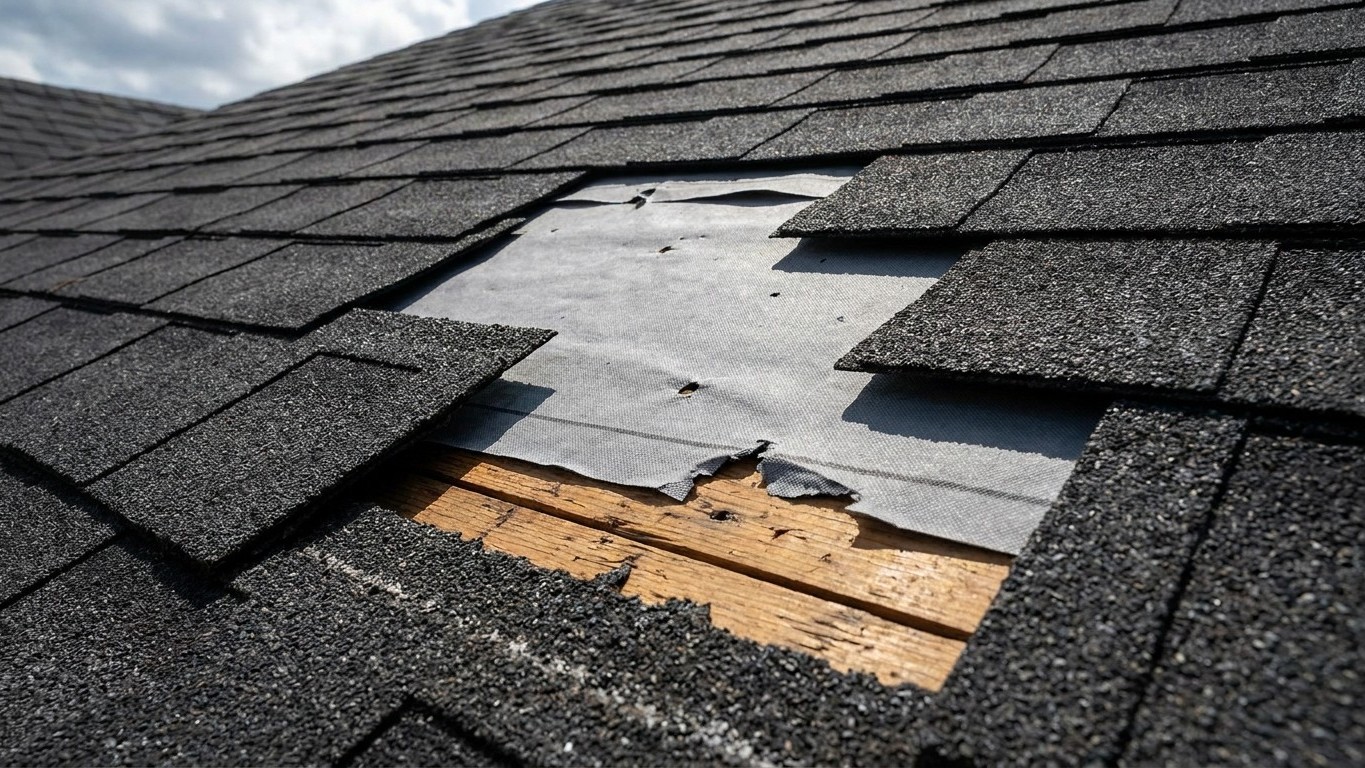

A missing shingle after a storm isn’t automatically an emergency, but it isn’t nothing either. The right response depends on what’s underneath the gap: if the underlayment is intact, you likely have days to arrange a repair. If the deck is bare and exposed to rain, that same gap can let water in within a single storm cycle. The difference matters more than the missing shingle itself.
What is actually happening
A shingle is only one layer of a roof’s defense. Underneath it sits a water-resistant barrier, usually a synthetic or felt underlayment, nailed directly to the wood deck. That underlayment is designed as a backup: it’s built to shed water even when the shingle above it is gone. So the first thing to understand is that a missing shingle doesn’t automatically mean an open roof. It means one layer of protection is gone, and the question is whether the layer beneath it is still doing its job.
Wind rarely takes a shingle cleanly. More often it lifts a corner, breaks the sealant strip that bonds one shingle to the one below it, and tears the shingle along a line of nails. What’s left behind is sometimes just the shingle body missing, with the underlayment still stretched tight and dry. Other times, the tear pulls up a section of underlayment with it, or the nails themselves rip through the decking and leave small punctures. Those punctures are the real risk, because they’re easy to miss from a distance and they let water track sideways under still-intact shingles nearby.
Why the deck condition changes everything
An older deck that has already absorbed moisture over past seasons behaves differently from a newer one. Wood that’s been damp before swells and shrinks, which loosens the grip nails have on it, which in turn makes future shingles more likely to lift in the next storm. This is why one missing shingle after a storm sometimes turns into three or four missing after the next one, on the exact same slope. It isn’t bad luck. It’s a deck that’s been weakened in a spot the homeowner never went looking at.
None of this is a reason to panic. It’s a reason to look, in a specific order: first at what’s visible, then at what’s underneath. A missing shingle over sound, dry decking with intact underlayment is a repair job on a normal schedule. A missing shingle over a deck that’s already showing sag, discoloration, or a soft feel when the roofer walks it is a different conversation entirely, and it’s one best had with a professional who can assess the wood itself rather than guessing from the shingle count.
What you can see without climbing
Most of what you need to know about a missing shingle can be gathered without ever touching a ladder. The routine has two stages: one from the ground, one from the attic.
- Scan the roof from the ground. Walk the perimeter of the house and use binoculars or a phone camera zoomed in fully, photographing each slope in sections. Look for shingles that are missing outright, shingles that are curled up at a corner, and granules collecting in the gutters or at the base of downspouts, which usually signal a shingle nearing failure even before it tears loose.
- Check valleys and edges first. These are the spots wind attacks hardest, so scan them before the flat field of the roof. A missing shingle at a valley or along a ridge line is more urgent than the same gap in the middle of a slope, because those spots Concentrate water flow.
- Note the pattern, not just the count. One missing shingle in isolation reads differently than several missing in a line, which often means a whole row lost its seal at once and the wind is now working on the row above it too.
- Go up to the attic with a flashlight, in daylight. Turn off the attic light and look at the roof deck from underneath. Any pinpoint of daylight coming through the wood is a hole, no matter how small it looks from inside.
- Look at the rafters and sheathing for staining. Brown or gray streaks running down a rafter, or dark rings on the underside of the decking, mean water has already found a path in, even if there’s no active drip on the day you check.
- Press the Insulation, don’t just look at it. Damp insulation often looks dry on the surface but feels cold and heavy when touched. That dampness is frequently the first sign of a leak that hasn’t yet reached the ceiling below.
This two-part check, ground first, attic second, is genuinely enough to decide your next move. If the attic is dry and the missing shingle is isolated, you have room to schedule a repair. If you see daylight, staining, or damp insulation, that’s the signal to call for an inspection rather than wait.
What it costs to leave it
Water doesn’t need much of an opening to cause damage, and it rarely announces itself right away. A small gap left over a winter or a rainy stretch tends to follow a fairly consistent path: it wets the underlayment first, then the decking beneath it, then the top of the insulation, and only after all three stages does it typically show up as a stain on the ceiling drywall below. By the time a homeowner sees a brown ring on the ceiling, the water has usually already been moving through the structure for a while.
The wood deck is the part that suffers first and worst. Plywood or oriented strand board that stays damp starts to lose its stiffness before it shows any visible rot, which means a roofer stepping onto that section can feel it flex or spring under their weight before the wood looks obviously bad. Left long enough, that softened deck stops holding nails securely, and that’s exactly the condition described earlier that makes the next storm pull off even more shingles.
Insulation is the second casualty, and it’s a quieter one. Wet insulation loses much of its ability to slow heat transfer, so a homeowner sometimes notices higher heating or cooling bills in the affected room before they notice any visible sign of a leak. Because insulation sits flat and rarely gets checked, this stage can run on for a long stretch without anyone connecting the dots between a missing shingle from a storm months back and a room that never quite holds temperature anymore.
Mold is the consequence that tends to worry people most, and it doesn’t require standing water to get started. It needs sustained dampness and a food source, and damp wood or damp insulation in a dark attic provides both. Mold growth in an attic space is often smelled before it’s seen, a musty note noticeable when you first open the attic hatch, well before any visible patch appears on wood or drywall.
None of this happens on a fixed schedule you can circle on a calendar, because it depends on rainfall, attic ventilation, and how exposed the gap is. What’s consistent is the order: underlayment, then deck, then insulation, then visible ceiling staining, then mold risk. A missing shingle addressed while it’s still just a missing shingle interrupts that chain at the cheapest possible point.
What is not a householder job
Some of this work is reasonable to do yourself. Ground and attic inspection, as described above, is genuinely safe and something almost anyone can manage. Getting onto the roof itself to fix what you find is a different matter, and for a meaningful share of homes, it’s simply not worth attempting.
Anything above a single story is the first clear line. Falls from that height are far more likely to cause serious injury than falls from a single-story roof, and the margin for a slip is much smaller once you’re standing two or three stories up with no one immediately nearby. A wet, mossy, steep, or frosted surface is the second line, and it applies regardless of the height, because those conditions remove the footing a repair actually requires. Moss in particular holds moisture and turns even a moderate slope into something closer to walking on ice. A third line is any repair that needs both hands occupied while you’re standing on a slope, since that’s exactly the moment when a gust or a slipped foot leaves you with nothing to catch yourself.
It isn’t worth pushing past any of these lines to save the cost of a service call. A roofer working the surface regularly has harness anchors, roof-rated footwear, and a working sense of which sections of deck will hold their weight, none of which a homeowner going up once a year has any way to judge. The safer version of this job is the one described in the earlier section: do the looking from the ground and the attic, get the photos and the notes, and hand the climbing part to someone equipped for it.
If what you saw during the ground and attic check raises any doubt, a full roof inspection is the next step, and it’s worth reading through what that process actually involves before you call anyone out. When it’s time to bring someone in for the repair itself, the guide on hiring a roofer covers what to ask and what a fair estimate should include. One more point worth keeping in mind through all of this: if the missing shingles followed a documented storm, your insurance policy is the document that governs what’s covered and what documentation it requires, and that’s worth checking before repairs begin, not after.
Common questions
Is one missing shingle urgent?
Not usually, if your attic check shows a dry deck with no daylight, staining, or damp insulation underneath it. It becomes urgent when any of those signs are present, or when rain is forecast before you can get it covered.
Can I temporarily cover a missing shingle myself?
Ground-level and attic-level checks are the safe part of this job. Actually covering or repairing the gap means being on the roof, which falls under the same restrictions covered above: not above a single story, not on a wet or steep surface, and not alone.
How do I know if water has already gotten into the structure?
Check the attic with a flashlight in daylight for pinpoints of light through the deck, look at rafters for brown or gray staining, and press on the insulation to feel for dampness rather than just looking at it.
Does homeowners insurance cover storm-related missing shingles?
That depends on your specific policy, so the policy document itself is the source to check, along with any documentation requirements it sets out. Photograph the damage from the ground as soon as you notice it, since that record supports whatever process your insurer requires.