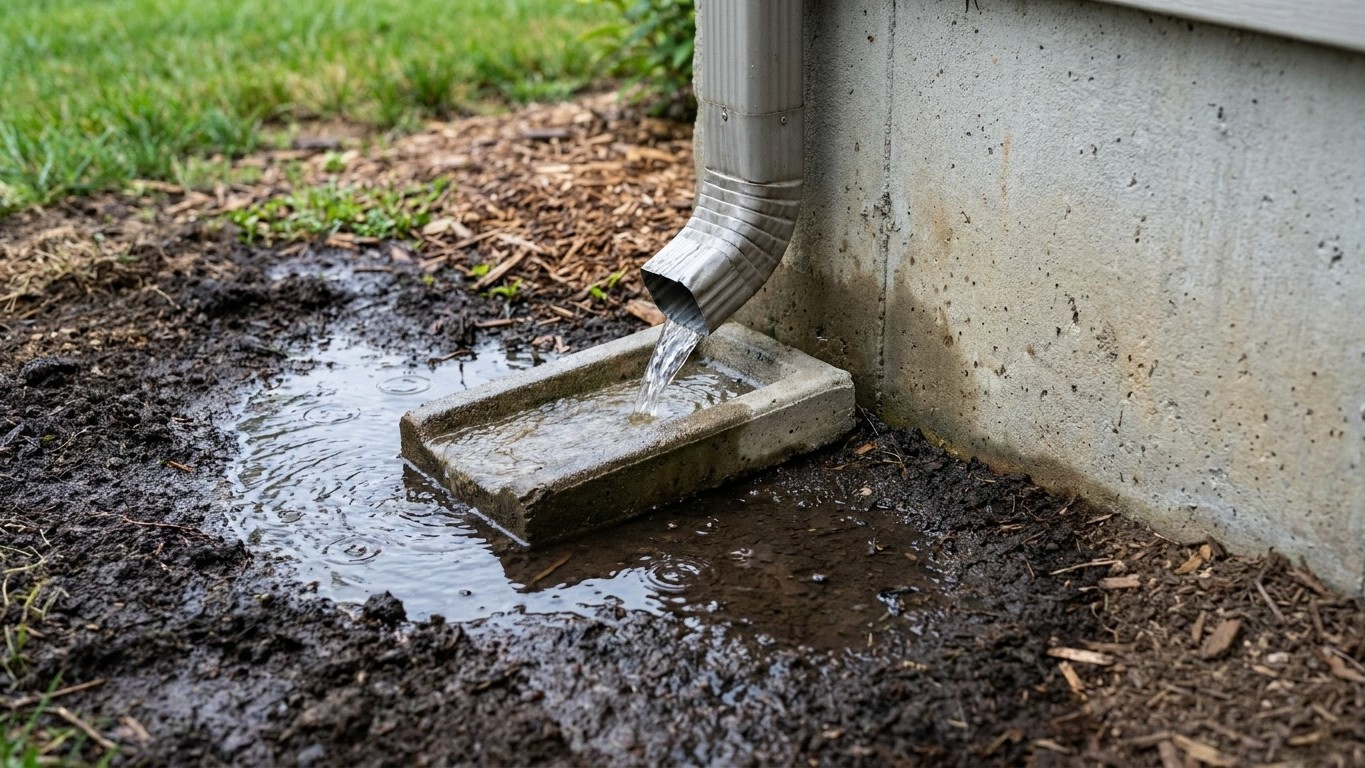

The honest answer is that a downspout is only doing its job if the water leaves the building’s footprint entirely. Plenty of downspouts just dump water a foot or two from the wall, right where a splash block or a short elbow happens to point. That’s not drainage. That’s relocation, and the foundation still gets soaked, storm after storm, whether the gutter above it is clean or not.
What is actually happening

A gutter system has exactly two jobs: catch water off the roof edge, then hand it off to a downspout that carries it somewhere the house won’t feel it. Most people stop thinking about the system right at that handoff. But that’s precisely where the failure usually starts, because the downspout’s discharge point, not the gutter itself, decides whether water helps the yard or attacks the foundation.
Picture the base of a typical downspout. If it ends in a short splash block sitting flush against the foundation wall, every storm sends gallons of water straight into the soil inches from the house. That soil doesn’t drain instantly. It absorbs, saturates, and holds moisture against the concrete or block foundation for as long as it takes to dry out between rains. In clay-heavy soil, that drying takes a while. In sandy soil, it’s faster, but the water still has to go somewhere in the meantime, and “somewhere” often means sideways, toward the foundation footing.
Saturated soil next to a foundation behaves differently than dry soil. It swells. It expands and contracts with freeze-thaw cycles in colder climates. It creates hydrostatic pressure against basement walls, the kind of steady push that eventually finds a crack, a joint, or a porous patch of concrete to seep through. None of this requires a storm of biblical proportions. Ordinary rain, repeated often enough, against soil that never gets a chance to fully drain, is enough to start the process.
There’s also a slower, quieter version of the same problem: buried downspout extensions that run underground to a discharge point out in the yard. These work well when they’re clear, but they’re also invisible, which means a clog from silt, roots, or a collapsed section can go unnoticed for a long stretch. The water then backs up, finds the path of least resistance, and that path is frequently back up toward the surface near the foundation, right where the buried line started.
The mechanism to keep in mind is simple: distance and drainage capacity at the discharge point matter more than anything happening higher up in the gutter run. A perfectly clean gutter feeding a downspout that dumps water against the wall is still a drainage failure, just a well-disguised one.
What you can see without climbing
Most of the useful information about downspout drainage is visible from solid ground or from inside the attic, no ladder required. A short, deliberate walk-around tells you more than a rushed climb ever would.
- Start at ground level, at each downspout base. Use binoculars or the zoomed-in camera on a phone to check the discharge point itself. Is there a splash block, an extension, or a buried pipe? Does the ground around it slope away from the house, or does it sit flat, or worse, tilt back toward the foundation? Look for dark soil staining, moss growth, or a small eroded channel in the mulch or grass, all signs that water is landing there repeatedly and pooling before it moves on.
- Check the siding and foundation wall directly above and beside each downspout. Efflorescence (that chalky white residue on masonry), peeling paint, or a persistent damp patch on siding are signs that water is splashing back onto the wall instead of clearing it. A phone camera zoomed in from a few feet away usually catches this detail better than the naked eye standing at a distance.
- Walk the full perimeter after the next rain, not before it. Standing water more than a few feet from a downspout, especially water that lingers for hours rather than soaking in, points to poor grading or a blocked underground extension.
- Head to the attic with a flashlight, on a dry day. Look for daylight coming through the roof deck, dark or discolored streaks on the rafters and sheathing, and Insulation that feels damp or looks matted down and stained. These aren’t downspout problems specifically, but they tell you whether water intrusion from any source, including a backed-up gutter or downspout overflow, has already reached the structure.
This routine takes less time than most people expect, and it’s genuinely sufficient for a first assessment. Nothing here requires standing on the roof or even setting foot on a ladder rung. If any of these checks turns up something concerning, that’s the point to bring in someone qualified rather than to keep investigating from higher up.
What it costs to leave it
Nobody notices downspout drainage until something else goes wrong first. That’s the pattern worth understanding: the downspout itself rarely fails in a way you’d catch immediately. The damage shows up somewhere else, later, and by the time it’s obvious, the fix is usually bigger than the drainage problem that caused it.
Start with the mulch bed or lawn edge right under a poorly draining downspout. Repeated soaking erodes soil, washes mulch into the yard, and can create a small trench right where the water lands. That part is cosmetic and easy to fix. The real cost shows up underground, where saturated soil sits against the foundation wall for extended stretches. In a basement, that pressure and moisture can work through hairline cracks that were already there but dormant, turning a dry basement into one with a damp corner, then a musty smell, then visible efflorescence on the block wall.
Wood framing near grade is particularly vulnerable. A sill plate or the bottom of a wall stud sitting in chronically damp soil conditions starts to soften and rot from the inside, which is exactly why this kind of damage often goes unnoticed until a contractor opens up a wall for an unrelated repair and finds soft, discolored wood. Mold follows moisture reliably, and a basement or crawlspace with a persistent damp problem from downspout runoff is a prime candidate for it, especially in a space with limited ventilation.
Concrete flatwork tells its own story. A patio slab, a walkway, or a driveway apron near a downspout discharge point that stays saturated can heave or settle unevenly as the soil beneath it swells and contracts. That shows up as a trip hazard or a visible crack line long after the drainage issue that caused it started.
None of this happens on a predictable schedule. Soil type, rainfall pattern, grading, and the specific foundation material all change how fast a problem becomes visible. What’s consistent is the direction: small, ignorable issues near the downspout base eventually become structural or moisture problems that cost more to fix and are harder to trace back to their actual cause.
What is not a householder job
Ground-level and attic checks cover most of what a homeowner needs to know about downspout drainage, and that’s by design. What happens next, if a problem shows up, is a different matter, and the line here is worth stating plainly rather than leaving it vague.
Anything above a single story is not a reasonable DIY task, full stop. That includes clearing a clogged gutter feeding a downspout, Inspecting a discharge point that happens to sit near a second-floor roofline, or reaching a downspout elbow that’s only accessible from a steep pitch. The math on ladder falls doesn’t favor confidence; a moment of overreach is all it takes.
Surface conditions matter as much as height. A roof or ladder setup that’s wet, mossy, steep, or frosted removes any margin for error, even for someone experienced. Moss in particular holds moisture and turns a normally walkable surface into something closer to ice underfoot. If a repair requires both hands to manage a tool or a section of downspout while standing on a slope, that’s a two-person, properly equipped job, not a solo weekend project.
None of this means every downspout issue needs a professional. Ground-level fixes like repositioning a splash block, adding a longer extension, or regrading soil away from the foundation are well within reach for most homeowners. The line is drawn at height and footing, not at the concept of drainage itself.
For a fuller walkthrough of what to check before deciding whether a problem needs professional attention, the ground-level roof inspection guide covers the process in more depth. And when a downspout or gutter issue does turn out to need someone on the roof, the page on hiring a roofer walks through what to ask before agreeing to any repair.
Common questions
How far should a downspout discharge water from the foundation?
There’s no single verified figure that applies to every house, since soil type and grading vary. The practical check is simpler: water should visibly move away from the foundation and not pool or soak in within a few feet of the wall.
Can a downspout drainage problem cause a basement leak by itself?
It can contribute directly, since saturated soil against a foundation wall creates hydrostatic pressure that finds existing cracks or weak joints. It’s rarely the sole cause of a major leak, but it’s often the condition that turns a minor crack into an active one.
Is a buried downspout extension better than a splash block?
It moves the discharge point further away, which helps, but buried lines can clog silently since they’re out of sight. A visible splash block or above-ground extension is easier to inspect, even if it doesn’t carry water as far.
Does homeowners insurance cover foundation damage from downspout drainage?
Coverage depends entirely on the specific policy and the state it was written in, and gradual water damage from poor drainage is often treated differently than sudden storm damage. The policy language governs, and Documenting the condition with dated photos matters if a claim ever becomes necessary.