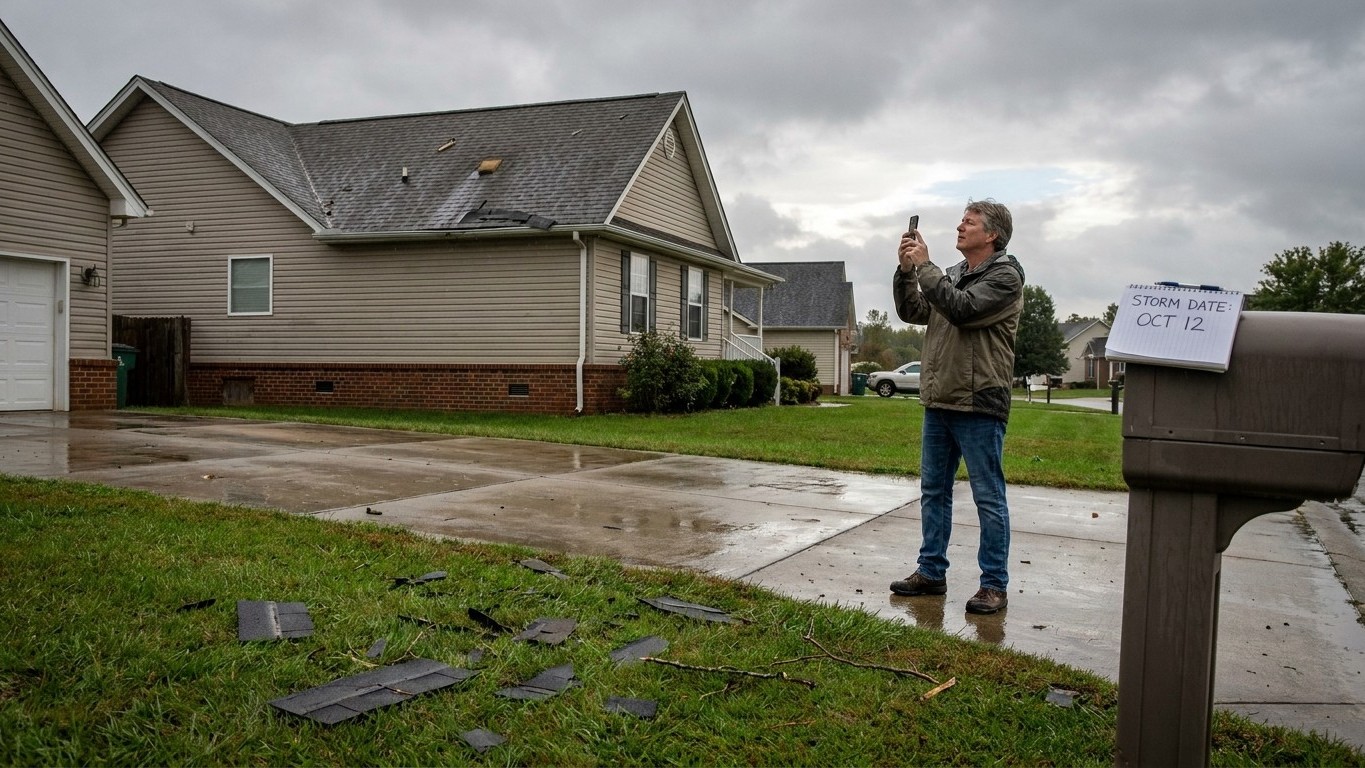

The days right after a storm decide how a roof claim plays out and how much damage stays hidden. Before any repair conversation starts, the roof needs a record: dated photos from the ground, a note of when the storm hit, and a look inside the attic. That record is what an insurer, a roofer, or you six months from now will actually rely on.
What is actually happening
A roof that took a hit during a storm doesn’t announce the damage right away. Wind can lift shingles just enough to break their seal without tearing them off. Hail can bruise a shingle’s surface without punching through it. Both leave a roof that looks fine from the driveway but is already compromised where water can get in. That gap between “looks fine” and “is fine” is exactly why documentation comes before repair.
The mechanism to understand is simple: an insurance claim, and any later dispute about what caused what, rests on being able to show the roof’s condition close to the moment of the storm. A photo taken the day after a hailstorm carries more weight than a description written from memory two weeks later. This is not about mistrust of insurers or roofers. It’s about the fact that roofs change fast once wind and water start working on a weak spot, and nobody benefits from a fuzzy timeline.
So the first useful step isn’t climbing up to inspect anything. It’s writing down the date of the storm, then taking photographs from the ground of anything visible: missing shingles on the driveway or lawn, dented gutters, debris in the yard, granules collecting near downspouts. None of this requires a ladder. A phone camera zoomed in, or a pair of binoculars, captures more than most people expect.
The insurance side matters here too, though the specifics depend entirely on the policy. Every homeowner’s or landlord’s policy handles storm damage differently: some have separate wind/hail deductibles, some set their own reporting windows, some require an adjuster’s visit before any repair starts. None of that can be generalized safely. What can be said is that the policy document governs the process, and that the documentation gathered in the first days is what supports whatever claim gets filed under it. Call the insurer, ask what they need, and keep every photo and note from before that call as well as after.
A written record doesn’t need to be elaborate. A few lines noting the storm date, what’s visible from the ground, and whether anything changed inside the house (a new stain on a ceiling, for instance) is enough to anchor the rest of the process. That record becomes the baseline everything else gets compared to.
What you can see without climbing
A full picture of storm damage can be built without ever touching a ladder. The routine works in two stages: an exterior scan from solid ground, then an interior check from inside the attic.
- Scan the roofline from the ground. Walk the perimeter of the house and look up using binoculars or a phone camera zoomed all the way in. Look for shingles that are curled, lifted, cracked, or missing outright. Look at valleys (where two roof slopes meet) for anything that looks displaced. Check the ridge line for gaps. Note anything that looks dented or discolored, especially on the sun-facing slopes.
- Check gutters and downspouts. Still from the ground, look at what’s collected in the gutters: granules (the gritty coating on shingles) washing off in bulk after a storm is a sign of surface damage. Dents in metal gutters or downspouts often mean hail large enough to also affect the roof.
- Look at flashing and vents from a distance. The metal or rubber pieces around chimneys, vents, and skylights are common failure points. From the ground with zoom, check if any piece looks bent, lifted, or missing.
- Go into the attic with a flashlight. This is the most reliable check available without climbing, because it shows what the roof is actually doing on the inside. Turn off the attic light if there is one and look for any point of daylight coming through the roof deck (the wood layer under the shingles). Daylight means an opening, however small.
- Look at the rafters and sheathing. Water stains on the wood, dark streaks, or a musty smell point to moisture getting in somewhere above. Even without an active leak, staining tells you water has been through at some point.
- Feel and look at the insulation. Damp, matted, or discolored insulation is one of the clearest signs of a leak, and it’s often visible well before a stain shows up on the ceiling below.
Done together, these steps cover almost everything a homeowner needs to know before deciding whether to call for a professional look. None of it requires standing on the roof itself.
What it costs to leave it
Roof damage left unaddressed doesn’t stay the same size. A lifted shingle that seems minor becomes the entry point for water during the next rain, and once water gets under the shingle layer, it travels. It moves along the roof deck, follows the path of least resistance through nail holes or seams, and shows up somewhere other than directly below the original opening. That’s why a ceiling stain in one room can trace back to a damaged spot several feet away on the roof.
Once water reaches the wood roof deck, the wood absorbs it. Repeated wetting and drying weakens that wood over time, and it can eventually soften to the point of sagging or losing its ability to hold fasteners. Insulation soaks up water too, and wet insulation stops doing its job, which shows up later as higher energy bills or uneven temperatures in the rooms below. In the meantime, damp wood and damp insulation together create the exact conditions mold needs to establish itself, particularly in an attic that doesn’t get much air movement.
None of this happens on a fixed schedule. It depends on how much water gets in, how often it rains after the initial damage, how well the attic is ventilated, and how the house is built. A small opening in a dry climate might sit quietly for a long stretch before causing a visible problem. The same opening in a wet region, or ahead of a rainy season, can turn into a ceiling stain far faster. That variability is exactly why the smart move is checking sooner rather than waiting to see if a stain appears.
The financial angle matters just as much as the physical one. Insurance policies generally expect damage to be reported and documented within some window, and delays can complicate a claim regardless of whether the damage itself gets worse. A small, promptly reported issue is usually simpler to resolve than the same issue reported months later, once it’s tangled up with unrelated wear or new damage from a second storm. Waiting doesn’t just risk the roof. It risks the claim built on top of it.
The practical takeaway is that the ground-and-attic check described above isn’t a one-time task after a single storm. It’s worth repeating after any notable weather event, because catching a small opening early is what keeps it small.
What is not a householder job
Everything described so far can be done safely from the ground or from inside the attic. Getting onto the roof itself is a different matter, and it’s worth being blunt about it: it is not worth the risk, and it is not necessary to answer the question of whether there’s damage.
A few situations rule out a homeowner going up entirely, no exceptions. Anything above a single storey puts a fall at a height that causes serious injury, not a minor one. Any surface that is wet, mossy, steep, or frosted changes footing in ways that are hard to judge from experience alone, and roofing material offers very little grip even when it looks dry. Any task that requires both hands free while standing on a sloped surface, like adjusting flashing or replacing a shingle, removes the ability to catch a fall or hold on to anything. These aren’t edge cases. They cover most of what actually needs doing on a damaged roof.
The instinct to go take a closer look after spotting something concerning from the ground is understandable, but it’s exactly the moment to stop and call instead. A professional roof inspection covers the same ground a homeowner would want to check, plus the parts that genuinely require training and the right equipment to assess safely: the condition of flashing up close, the state of fasteners, the soundness of the deck underfoot. That inspection is the next step once the ground-and-attic documentation is done, not a substitute for it.
If the inspection confirms damage that needs fixing, that’s also not a homeowner project for anything beyond a very minor, ground-level task. Roof repair involves working at height, on an unstable surface, often with materials that are heavier or more awkward than they look. Finding a roofer who can assess the damage, quote the work, and coordinate with the insurance claim if there is one is the practical next move, and it’s worth taking the time to vet who does that work rather than hiring the first person who knocks on the door after a storm, since storm damage tends to attract crews with uneven track records.
The short version: document from the ground and the attic, get a professional inspection, and let a qualified roofer handle anything above that. Nothing about the roof itself requires a homeowner to be standing on it.
Common questions
How soon after a storm should the roof be checked?
As soon as it’s safe to go outside and the storm has fully passed. Ground and attic checks don’t depend on the roof having dried out first, and doing them promptly means the photos and notes are as close as possible to the moment of the storm.
Is it necessary to call the insurer before checking the roof?
No. The ground and attic checks, along with photos and notes, can happen first. That documentation is what supports the call to the insurer, so having it ready before the call tends to make that conversation more straightforward.
What if nothing looks wrong from the ground or the attic?
It’s worth repeating the check after the next few rains, since some damage only becomes visible once water has had a few chances to work through a small opening. A professional inspection is also a reasonable step if the storm was severe, even without visible signs.
Can a homeowner use a drone to check the roof instead of climbing?
A drone can add another angle to the ground-based photos and is a reasonable option where available, but it doesn’t replace the attic check, which is where a lot of the real information about leaks and moisture actually shows up.