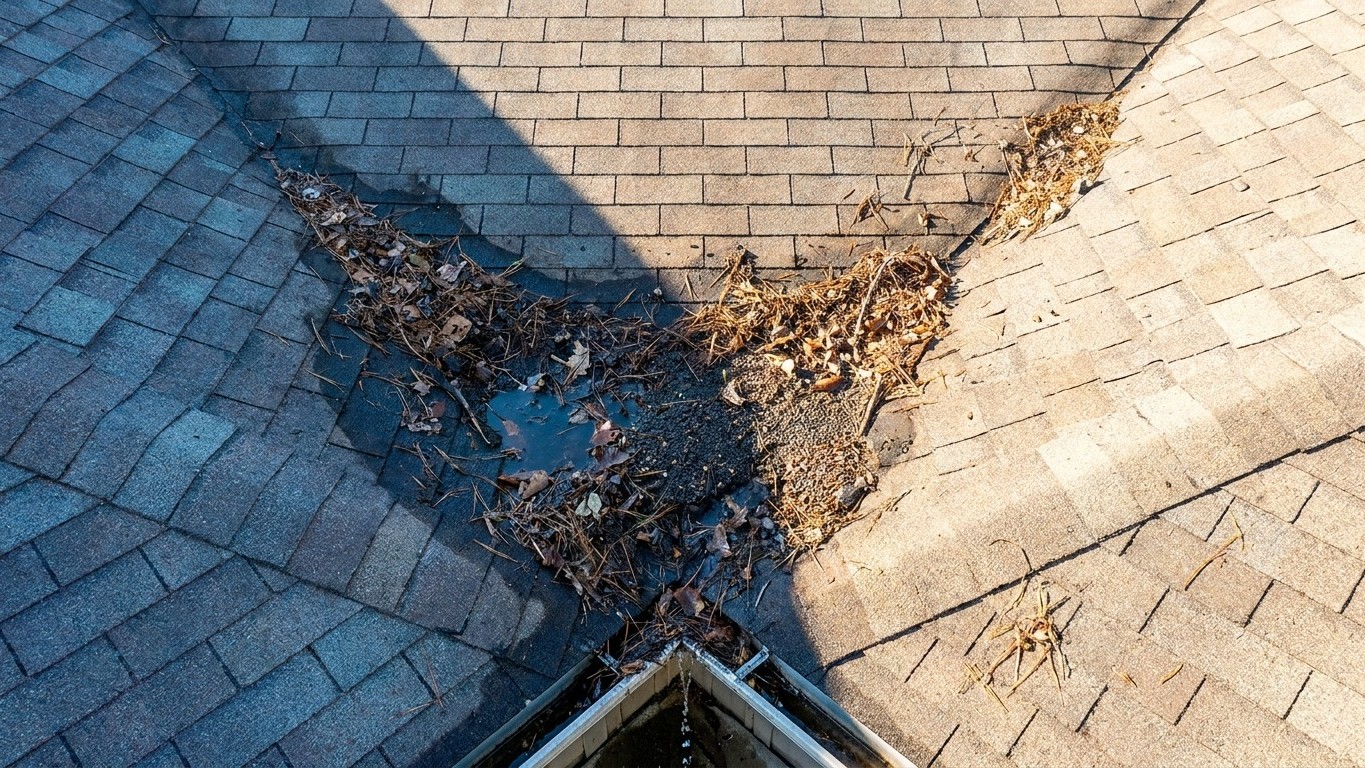

A valley is the V-shaped seam where two roof planes meet, and it’s built to move water fast. When it works, you never think about it. When it doesn’t, the leak often shows up nowhere near the valley itself, which is exactly why so many homeowners miss the real cause until a ceiling stain forces the question.
What is actually happening
Picture two roof slopes tilted toward each other like an open book laid face-down. The crease between them is the valley, and it collects the runoff from both sides at once. A section of roof that normally sheds water from one plane suddenly has to handle double the volume, concentrated into a channel a fraction of the width of either slope. That’s the basic math of why valleys fail more often than flat field areas: more water, less room, and a seam where two different roof systems have to line up perfectly.
The debris problem follows the same logic. Wind doesn’t just blow leaves and pine needles across a roof, it funnels them toward the low point, the same way water finds the drain in a sink. A valley acts like a natural catch basin. Grit from asphalt shingles, seed pods, moss fragments, small branches, all of it migrates downhill and settles where the two slopes converge. Over time that debris doesn’t just sit there looking untidy. It dams the channel, forcing water sideways under the shingle edges instead of straight down toward the gutter.
Why shade changes everything
Valleys facing north, or shaded by a chimney, dormer, or overhanging tree, dry out slower than the rest of the roof after every rain. The sun that would normally bake off moisture on an open slope barely reaches that crease for part of the day, sometimes not at all in winter. That extended dampness is exactly what moss and algae need to establish themselves, and once organic growth takes hold, it holds water against the roofing material even longer, a cycle that feeds itself. A valley that stays damp for hours after the rest of the roof has dried isn’t unusual. It’s the design working as intended, but it’s also the reason valleys need more attention than flat sections.
There’s also a structural mismatch to consider. Two roof planes meeting at a valley were often built at slightly different times, or by different crews, or using flashing details that don’t quite match on either side. Water is patient and finds the smallest gap, whether that’s a nail placed too close to the centerline, a seam in the underlayment, or shingles cut at a slightly wrong angle. None of this requires a dramatic storm to matter. Ordinary rain, repeated over ordinary weeks, is enough to expose a weak point that a casual glance from the ground would never catch.
What you can see without climbing
Most valley problems announce themselves before anyone needs a ladder. The trick is knowing where to look and in what order, checking from outside first and then confirming from inside the attic.
- Scan from the ground with binoculars or a zoomed phone camera. Stand back far enough to see the whole valley line, not just the bottom near the gutter. Look for a buildup of dark grit, leaves, or moss sitting in the channel, and for any spot where the shingle edges along the valley look lifted, curled, or uneven compared to the rest of the roof.
- Check the color and texture of the valley strip itself. A valley that looks noticeably darker, greener, or shinier than the surrounding shingles is holding moisture longer than it should. Streaking that runs down from the valley toward the eave, rather than staying contained within it, suggests water is already finding a path outside the intended channel.
- Look at the gutter and downspout directly below the valley. A pile of granules, sand-like grit, or shingle fragments collecting there is a sign of erosion happening upstream, and it’s often visible from a driveway without any special equipment.
- Move to the attic with a flashlight, ideally after or during a rain. Aim the beam along the rafters and the underside of the roof deck directly beneath where the valley sits. Any pinpoint of daylight showing through the deck is a direct sign of a gap in the roofing material above.
- Run your hand or a flashlight beam across the insulation near that same spot. Damp, matted, or discolored insulation, along with dark staining on the wood rafters or sheathing, points to water intrusion that’s been happening for a while, even if no drip is currently visible.
This routine takes fifteen minutes and answers the question that matters most: is there evidence of a problem, and does it warrant a closer professional look? A homeowner who does this check twice a year, plus once after any severe storm, will almost always catch a valley issue while it’s still a small, visible clue rather than a ceiling stain.
What it costs to leave it
A valley leak rarely stays contained to the roof. Water that slips past a compromised valley follows gravity and the path of least resistance, which usually means it travels along the underside of the roof deck before it ever drips somewhere visible. By the time a stain appears on a bedroom ceiling, the moisture has often already been moving through rafters, insulation, and framing for a stretch of time nobody was aware of.
The first material affected is almost always the roof deck itself, the plywood or OSB sheathing that the shingles are nailed to. Wood that stays damp repeatedly, even without ever being fully soaked, starts to soften and lose its structural integrity. That softening doesn’t announce itself with a sound or a smell right away. It shows up later as a slightly spongy feel underfoot if someone does eventually walk that section, or as sagging visible from inside the attic.
Insulation is next in line, and it’s the more expensive problem in practical terms. Wet insulation loses most of its ability to resist heat transfer, meaning the room below works harder to stay warm in winter and cool in summer, quietly inflating energy bills long before anyone connects the dots to a roof leak. Fiberglass batts that get soaked repeatedly also tend to compress and mat down, which means even after they eventually dry, they don’t perform the way they did when installed.
Framing members, the actual rafters and any connected trusses, are the last stage and the one that turns a repair into a renovation. Wood exposed to repeated moisture cycles, wetting and partial drying over and over, is vulnerable to rot and to fungal growth that weakens the wood fiber itself. Mold is a companion issue rather than a separate one. Once framing or insulation stays damp long enough, mold colonies can establish in wall cavities or attic spaces, and remediation at that point becomes a different, larger project than fixing a valley.
None of this happens on a fixed schedule. A minor gap in a valley might sit mostly harmless through several light rains, then cause visible damage after one heavy, wind-driven storm pushes water sideways instead of straight down. That’s precisely why the ground-and-attic check described above matters: it catches the problem while it’s still isolated to the roof assembly, before it becomes a drywall, insulation, and framing repair all at once.
What is not a householder job
Everything described so far, the ground scan, the attic check, the gutter inspection, is meant to be done without ever getting on the roof. That line is deliberate, and it’s worth stating plainly rather than leaving it implied.
Anything above a single story is not a do-it-yourself inspection task. A fall from a second-story roof or higher carries a real risk of serious injury, and the visibility gained by climbing up rarely adds much beyond what binoculars and an attic flashlight already reveal. The same applies to any roof surface that’s wet, mossy, steep, or frosted, conditions that dramatically increase the chance of a slip regardless of experience or footwear. Moss in particular is deceptive: it looks like solid ground until weight is applied, at which point it behaves more like a wet bar of soap over hard decking.
Any task that requires both hands occupied while standing on a sloped surface, clearing debris from a valley, resetting a shingle, applying sealant, also falls outside reasonable homeowner territory. Roofers who do this work regularly use harnesses, roof jacks, and footwear designed for pitched surfaces, along with training in how to move safely across a slope. That combination of equipment and practice is what makes the difference between a routine repair and an emergency room visit.
If the ground-and-attic check turns up any of the warning signs described earlier, granule buildup, daylight through the deck, damp insulation, staining on rafters, the next step is a professional inspection, not a personal climb. A closer look at what that inspection should cover is laid out on the roof inspection page, and guidance on choosing and vetting a roofing contractor is covered on the hiring a roofer page. If the damage appears storm-related, hail or wind, keep in mind that any insurance claim will be governed by the specific policy in force, and that photos and dated notes from the ground-and-attic check become useful documentation regardless of how the claim proceeds.
Common questions
Can a valley leak without any visible damage on the roof surface?
Yes. Water sometimes enters through a small gap in the flashing or underlayment beneath the shingles, meaning the surface can look intact from the ground while moisture is already reaching the deck. That’s why the attic check, looking for daylight through the deck or staining on rafters, matters as much as the exterior scan.
Is moss in a valley always a sign of a leak?
Not necessarily, but it’s always worth noting. Moss indicates prolonged moisture, which is common in shaded valleys even on a perfectly sound roof. It becomes a concern when combined with lifted shingle edges, granule buildup in the gutter below, or any sign of moisture inside the attic.
Why does debris collect in valleys more than on flat roof sections?
Two slopes drain into one channel, so both water and windborne debris, leaves, needles, grit, get funneled toward that low point. A flat section of roof only has to shed what falls on it directly, while a valley collects the runoff and debris from both adjoining planes.
What should be photographed before calling a roofer about a valley issue?
Wide shots of the whole valley line from the ground, close-ups (zoomed, not climbed) of any discoloration or lifted shingles, a shot of the gutter and downspout beneath the valley, and any attic photos showing staining, damp insulation, or visible light through the deck. These give a roofer a clear starting point before they arrive.