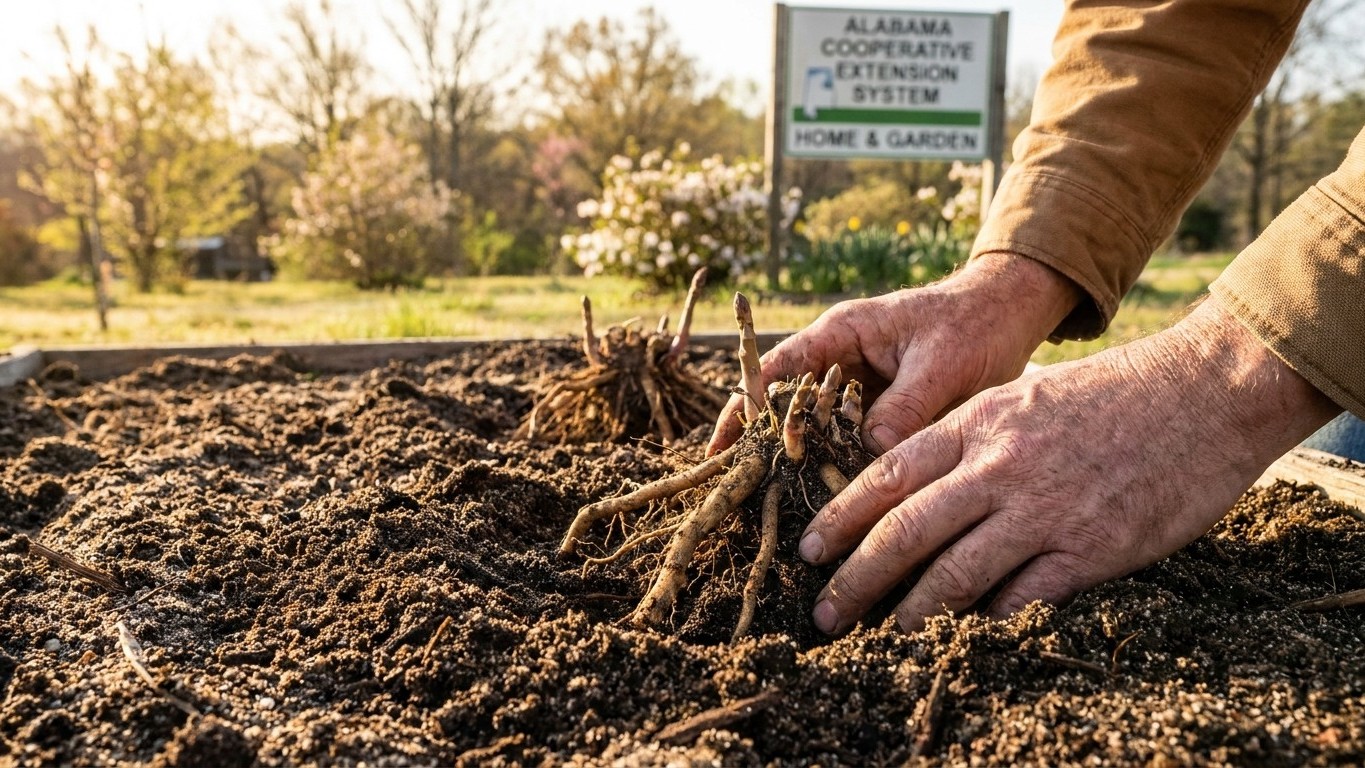

Asparagus crowns go into Saskatchewan ground in early spring, once the soil can be worked and the risk of a hard freeze has mostly passed, timed around the province’s mean last frost. The bed itself only asks for one thing: soil that drains. Get that right and the same planting keeps producing spears for a decade or more.
The short answer
An asparagus bed planted this spring will still be feeding a household in ten to fifteen years. That is not a rough guess, it is how the crop behaves once it is established, and it is the reason the single soil requirement matters so much: the crop needs ground that drains, because a spot that stays soggy for one season stays soggy for all fifteen.
Saskatchewan’s most common mapped soil is a Chernozem, the dark, organic-rich prairie soil found across roughly 68 percent of the province’s agricultural surface, according to Agriculture and Agri-Food Canada’s Canadian Soil Information Service. Where it dominates, the texture runs loam to silt, close to 43 percent sand, 22 percent clay and 35 percent silt, with organic matter around 4 percent and a median surface pH near 6.8. Classified under the Canadian System of Soil Classification, this profile is well drained. On paper, that is a reasonable starting point for a bed meant to sit undisturbed for a decade and a half.
Why the state soil is a starting point, not a verdict
That figure describes the province’s dominant profile, not any one backyard. Solonetzic soils, the second most common order mapped in Saskatchewan, tend to hold water differently, and plenty of individual lots sit on low spots, filled ground, or pockets of heavier clay that behave nothing like the median. A builder’s backfill or a low corner of a yard can drain poorly even where the surrounding district is classed well drained.
The practical test is simple: dig a hole about a foot deep, fill it with water, and watch how long it takes to disappear. If water still sits there after several hours, that spot is not the one for a fifteen-year crop. A raised bed, built up eight to ten inches with amended soil, solves the problem without abandoning the site. Once a suitable spot is confirmed, crowns go into furrows about 8 inches deep. There is no harvest at all in the first year; picking starts in year 3, running about four weeks, then six weeks the following year, then eight. The rule for stopping each season is not a date on a calendar, it is a look at the spears: once most of them run thinner than a pencil, harvest ends for the year. The furrow itself is not filled in all at once, it is backfilled gradually, about two inches every other month across the season.
Will the summer here water it for you?
Asparagus in its first two years wants 1 to 2 inches of water every other week; once established, from year 3 on, that eases to roughly every three weeks. Saskatoon’s climate normals give a clear picture of how far local rain gets toward that on its own.
- The bed’s demand during establishment: across a twelve-week summer, a schedule of 1-2 inches every other week works out to roughly six waterings, somewhere between 6 and 12 inches total.
- What summer actually delivers: Environment and Climate Change Canada’s 1981-2010 normals for Saskatoon Diefenbaker Int’l A put June, July and August rainfall at 2.59, 2.38 and 1.68 inches, about 6.6 inches for the whole season.
- Where the gap sits: at the low end of the bed’s want, rainfall roughly matches it; at the high end, the shortfall runs close to half. Rain in this region rarely arrives as gentle, soaking showers spread evenly through the week, it tends to come as thunderstorms, and a good share of that runs off rather than soaking down to the crowns.
- August is the tightest month: at 1.68 inches, it is the driest of the three, yet the plant’s own schedule still calls for at least one full watering somewhere in those four weeks.
- The practical move: plan on supplemental watering through both establishment years, with August as the month most likely to need a hose regardless of how the earlier summer went. Once the plant is mature and the schedule eases to every three weeks, the gap narrows but does not disappear.
- The number that actually settles it: a rain gauge on the specific plot. Normals describe what the region usually gets at one reference station, not what fell on any particular yard this season.
When to put the crowns in
Crowns go in early spring, as soon as the ground can be worked, into that 8-inch furrow. In Saskatchewan, the useful anchor for timing is the mean last spring frost at the Saskatoon SRC station, around May 18, according to Environment and Climate Change Canada’s Canadian Climate Normals for 1981-2010.
That word “around” is doing real work. A mean date is a midpoint, not a guarantee: in one year out of two, frost arrives after it, sometimes well after. Treat May 18 as the center of a window rather than a green light on the calendar, and hold off if a cold snap is forecast even into late May. The figure also comes from a single station; districts north of Saskatoon or at higher elevation typically run behind it, so a gardener farther from that reference point should expect the safe planting window to open later, not earlier.
The source used for this crop’s timing, Utah State University Extension, covers the crown method in detail: crowns into furrows, early spring, no harvest until the third year. It does not detail a seed-starting route the way it does crowns. Some gardeners do start asparagus from seed instead, but that path runs on its own separate timeline, and everything in this guide, from the furrow depth to the multi-year harvest schedule, describes the crown method specifically. For most home gardeners in Saskatchewan, buying crowns and getting them into the ground once the soil is workable near that mid-May window remains the more direct route to a bed that starts producing in year 3.
Common questions
Can I plant asparagus in Saskatchewan clay soil?
Only if it drains. The province’s dominant Chernozem profile is classed well drained and runs loam to silt rather than heavy clay, but individual yards vary, and Solonetzic soils, the second most common order mapped here, can behave very differently. Dig a test hole and fill it with water before committing a fifteen-year bed to any one spot; if it drains slowly, build up rather than dig in.
How long before I can harvest asparagus after planting crowns?
Not until year 3. The first two seasons are entirely for root establishment, with no spears cut at all. Year 3 brings about four weeks of harvest, year 4 about six weeks, and year 5 about eight weeks, with each season ending once most spears come up thinner than a pencil rather than on a fixed date.
Which asparagus variety should I plant in Saskatchewan?
Utah State University Extension names four: Jersey Giant and Jersey Knight, both all-male, and UC 157 F1 and Purple Passion, both male and female. The source identifies them only by that trait, it does not publish flavor, yield or a reason to prefer one over another for this region, so there is no verified basis here for ranking them.
What if a late frost hits after I plant asparagus crowns?
Because May 18 is a mean rather than a safe cutoff, a late frost after planting is not unusual in roughly half of all years at that reference station. Newly planted crowns sit below soil level in the furrow, which offers some buffer, but young emerging spears are more exposed; watching the local forecast through late May matters more than treating any single date as final.