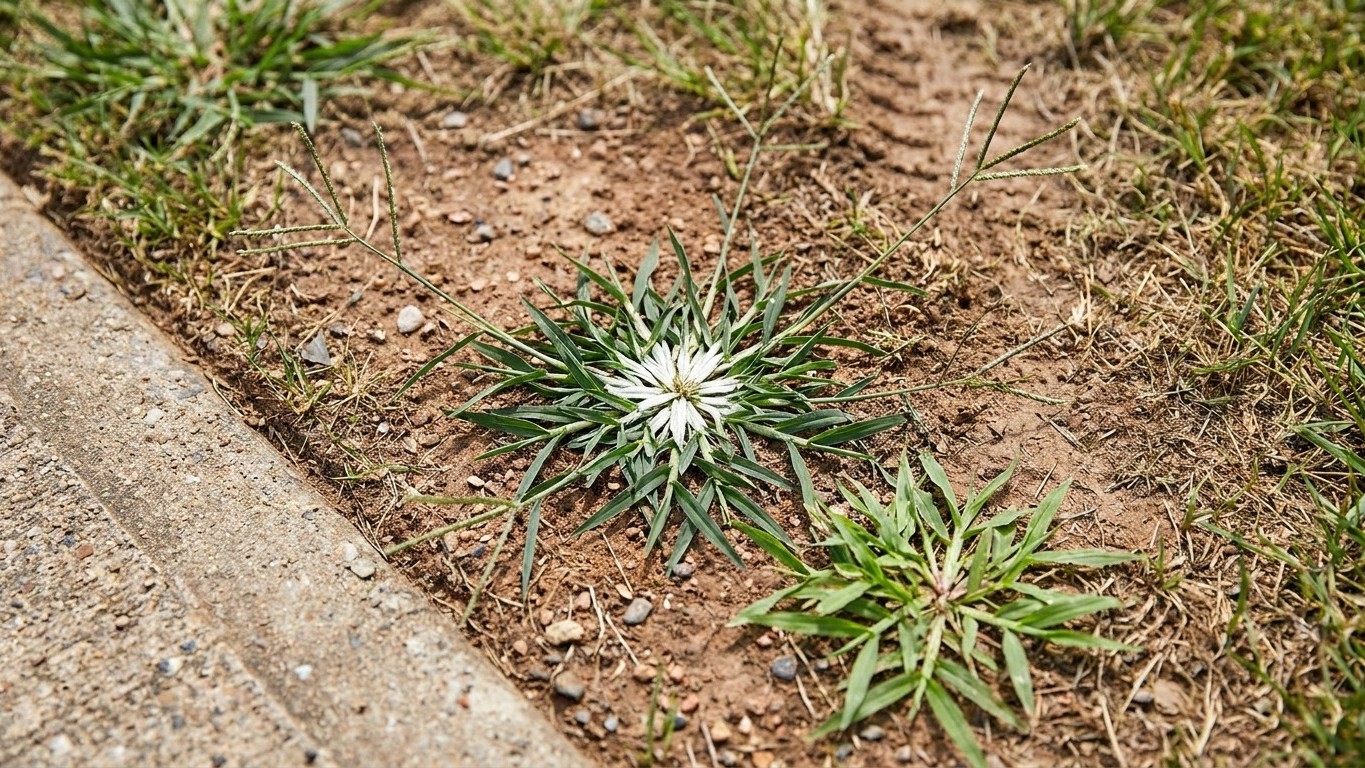

Most Saskatchewan lawns do best at 2 to 3 inches. That range fits Kentucky bluegrass and fine fescues. Tall fescue wants 3 to 3.5 inches, while perennial ryegrass and rough bluegrass sit lower, at 1.5 to 2.5 inches. Those numbers are not interchangeable, so work out which grass you actually have before you set the deck. Raise it in summer heat, never take off more than a third of the blade at once, and keep mowing in fall until growth stops.
The mowing height for Saskatchewan lawns
Height by species
Height matters because a blade is a solar panel. The more leaf you leave, the more energy the plant makes, and the deeper and thicker the roots it can support. Taller turf also shades the soil, which keeps weed seeds from germinating and slows evaporation. Species that grow upright and coarse, like tall fescue, need that extra leaf. Low, dense growers like perennial ryegrass tolerate a shorter cut.
| Grass | Mowing height |
|---|---|
| Tall Fescue | 3 to 3.5 inches |
| Kentucky Bluegrass | 2 to 3 inches |
| Fine Fescues | 2 to 3 inches |
| Perennial Ryegrass | 1.5 to 2.5 inches |
| Rough Bluegrass | 1.5 to 2.5 inches |
The gap between the top and bottom of that table is real. Cut tall fescue at 1.5 inches and you scalp it. Let a ryegrass lawn grow to 3.5 inches and it lies over, mats and invites disease.
Mixed lawns and unknown grass
Most home lawns are blends, and many contain a bit of everything. If yours is mostly bluegrass and fine fescue, mow at 2 to 3 inches. If ryegrass is in the mix, the overlap of all these ranges is 2 to 2.5 inches. When you truly cannot tell what is growing, 3 inches is safe for bluegrass, fine fescue and tall fescue, which is a good reason to start there.
Why warm-season grasses are not on the list
Bermudagrass, zoysia and their relatives are left out for a reason. They grow best in sustained heat and go dormant and brown when it cools. Between an average last spring frost of May 18 and an average first fall frost of September 18 (Saskatoon figures, so about four months), they would spend most of the year brown, then face a long prairie winter. The five species above are cool-season grasses, and they are the ones that hold here.
Raising the deck when the heat comes
August is the driest summer month in Saskatoon, at 43 mm (1.68 inches), after 66 mm (2.59 inches) in June and 60 mm (2.38 inches) in July. That adds up to 168 mm (6.6 inches) across the three summer months, out of 353 mm (13.9 inches) for the year. These are Environment and Climate Change Canada normals for the Saskatoon Diefenbaker airport station, covering 1981-2010. They describe what the region can usually expect, not a forecast, and not your yard.
Rain is not the whole story
A summer total reads differently depending on two things. The first is soil. An inch of rain drains through sand within the day, while clay may hold it for a week, so a sandy lawn can look parched in a month that on paper was fine. The second is heat. On days at or above 32°C (90°F), evaporation outruns the rain gauge, and a single thunderstorm tends to run off hard ground rather than soak in. A cheap rain gauge on your own plot settles the question better than any normal.
What the mower should do about it
The cheapest drought tool you own is the height adjustment. In midsummer, move to the upper end of your species’ range: 3 inches for bluegrass and fine fescue, 2.5 inches for ryegrass and rough bluegrass, 3.5 inches for tall fescue. The extra blade shades the crown and the soil, and the grass keeps more leaf working while growth slows. Many Saskatchewan lawns that go straw-colored in August were cut too short in July.
Dormancy is not death. A cool-season lawn that browns in a dry spell is often resting and will green up when rain returns. Mowing a dormant lawn at low height, though, stresses it more than the drought does. If it is not growing, there is little to cut, so let it rest and keep the deck high when you do mow.
The one-third rule, and why it is not arbitrary
Take off no more than a third of the blade in a single mowing. Gardeners repeat it without explanation, so it sounds like folklore. It is closer to arithmetic about the plant’s budget.
What a heavy cut does
Every cut removes leaf, and leaf is how grass feeds itself. A drastic cut forces the plant to draw on stored reserves to regrow, and root growth slows or stops while it does. Scalping also exposes soil that was shaded a day earlier, and bare, sun-baked ground is where weeds start. A lawn that is cut sensibly every week keeps its roots; one that is cut hard every third week gradually loses them.
Turning the rule into a schedule
Work backward from the target height. If you want 3 inches, mow when the grass reaches 4.5 inches. For a 2-inch lawn, the trigger is 3 inches. Perennial ryegrass held at 1.5 inches should be cut at about 2.25 inches, and tall fescue held at 3.5 inches is fine until roughly 5.25 inches. Measure with a ruler once, so you can judge it by eye afterward.
June is when this bites. It is the wettest month of the summer at 66 mm (2.59 inches), and growth surges. A week away can leave you with grass well past the limit. Do not cut it all down in one pass. Mow at a high setting, wait three or four days, then lower the deck toward your target. Clippings from regular mowing disappear into the turf, but a heavy windrow after a long gap smothers the grass beneath it and needs raking.
The first and last cut of the year
The average last spring frost at the Saskatoon SRC station is May 18, and the average first fall frost is September 18. Both come from Environment and Climate Change Canada’s 1981-2010 normals. They are mean dates, so in one year out of two the frost lands later than the figure. Treat them as the middle of a window, never as a safe date.
Starting in spring
Do not mow to a calendar date. Start when the lawn has dried out, is actually growing and has put on enough height to justify a cut. For the first mowing, set the deck at the upper end of your species’ range, since the grass is still recovering from winter. Rake off matted leaves first if snow mold left any. Over the following weeks, you can ease down toward the middle of the range.
The Saskatoon figure is also one station. Northern and upland districts run weeks behind it, so a gardener in the north of the province should watch their own grass rather than borrow a date from the city.
Finishing in fall
With today being October 10, the average first frost has already passed in Saskatoon, but lawns often keep growing a while after it. Keep mowing as long as the grass grows, on the same weekly or ten-day rhythm. For the final cut, stay within your species’ range and go to the lower half of it. Long blades that go under snow can mat and invite snow mold. Do not scalp, though, since short turf into winter has little reserve.
For the full routine across all seasons, see Mowing a Lawn. If you garden across a provincial line, the neighbouring page on How High to Mow a Lawn in Alberta covers that climate, and How High to Mow a Lawn in Kentucky shows how much the answer moves in a warmer one. For local guidance on lawn and turf, the Government of Saskatchewan’s agriculture pages are a starting point.
Common questions
What is the best mowing height for a Saskatchewan lawn?
It depends on the grass. Kentucky bluegrass and fine fescues take 2 to 3 inches, tall fescue takes 3 to 3.5 inches, and perennial ryegrass and rough bluegrass take 1.5 to 2.5 inches. If you are unsure of your species, 3 inches is a safe start for the first three.
Should I mow shorter in spring to help the lawn green up?
No. Cutting low at the first mowing removes leaf from grass that is still recovering. Start at the upper end of your range and ease down over a few weeks.
Can I grow Bermudagrass or zoysia in Saskatchewan?
It is a poor bet. Warm-season grasses need long stretches of heat and go brown when it cools. With an average frost-free stretch of only about four months at Saskatoon, they would spend most of the year dormant and then face a prairie winter.
How often should I mow in summer?
Whenever the grass reaches a third above your target height. In June, when growth is strongest, that can mean weekly. In a dry August it may mean every ten days or less, and a dormant lawn needs no mowing at all.