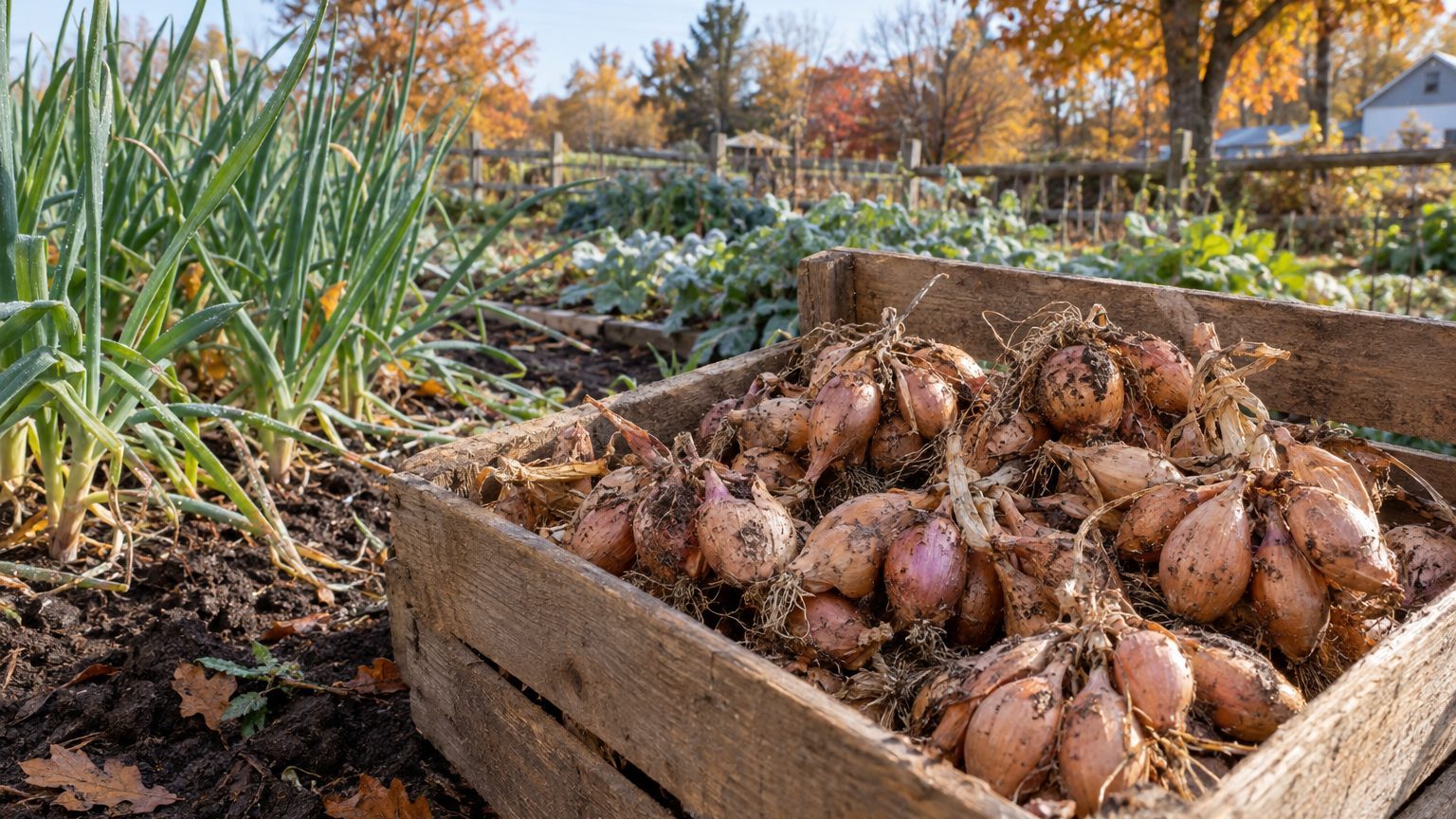

For Saskatchewan, pick shallots by type, not by catalog name: early-to-mid maturing multiplier shallots grown from sets or bulbs, planted in fall where winters allow or in the first workable days of spring. Seed-grown types need a longer runway than the frost-free window usually offers. This page has no Saskatchewan variety trial results, so it names no cultivars.
The short answer for Saskatchewan
Frost dates, read correctly
At the Saskatoon SRC station, the last spring frost falls on average on May 18, and the first fall frost on average on September 18 (Environment and Climate Change Canada, Canadian Climate Normals 1981-2010). Both are mean dates. In one year out of two, the last spring frost comes later than May 18. In half the years, the first fall frost arrives earlier than September 18. Treat each date as the midpoint of a window, not a safe line. Between the two sits roughly 123 days on paper, and the real number swings from year to year.
Shallots shrug off light spring frost, which is why spring planting here is about soil, not about May 18. What the window limits is how long the plant has to size up and cure. A type that needs most of a long season will not finish in Saskatchewan’s. Ones that bulb up early, and can be lifted and dried before September weather turns, fit the numbers. For the bigger picture on the crop, see Growing Shallots in Saskatchewan.
The decision by type
| Type | Fit for Saskatchewan | Main risk |
|---|---|---|
| Set or bulb-grown, early-to-mid maturing, planted in fall | Strong choice, with mulch and snow cover | Winter loss in a bare, open bed |
| Same type, planted in early spring | Safest default | Smaller bulbs if planting slips late |
| Seed-grown, started indoors | Workable for experienced growers | A tight window to finish and cure |
| Seed-grown, sown directly outdoors | Poor fit | Not enough season |
Exact planting dates belong on a separate page: When to Plant Shallots in Saskatchewan.
What will not work here
Slow types and shortcuts
Long-season shallots are the first casualty. A type that wants a long, warm run before it bulbs and cures will still be putting on size when late summer cools. Seed sown straight into the garden fails for the same reason, because the seedlings begin from nothing and use up weeks the window cannot spare. Starting seed indoors recovers some of that time, but it adds hardening off and transplanting to a calendar that already has little slack.
Trusting May 18 is the quieter mistake. Because half of all years see a later last frost, indoor-started transplants set out on that date without hardening off can take a hit. Sets and bulbs planted early are far more forgiving, since they sit underground until the soil wakes up.
Winter and the fall-planting trap
The mean daily minimum of the coldest month at the Saskatoon reference station is -20.7 °C (-5.3 °F). An average of nightly lows hides the worst nights, which run colder still. Fall-planted shallots can handle that only when they are mulched and sitting under reliable snow. In an exposed bed that blows bare, they can heave or die. Planting too early in fall causes a different problem: green shoots poke up before freeze-up and burn back. The goal is roots, not tops.
Types bred for mild-winter regions are another poor bet. A bulb that thrives in a warm climate may have no cold tolerance worth trusting at these temperatures, so a bargain bag of unknown origin is a gamble.
One limit of this page: it has no rainfall or summer heat figures for Saskatchewan, so it will not say how often to water. Check your own beds instead of borrowing a schedule from another climate.
What changes across Saskatchewan
Saskatchewan is not one garden. The Canadian plant hardiness zone for the reference city is 3a, from Natural Resources Canada’s plant hardiness data (1991-2020 normals). That figure is the reference city’s alone. The province stretches far north and south of it, so there is no single zone and no single answer. This page holds only the one zone value and cannot give you the full spread.
Name the system whenever you use the number: it is a Canadian zone, not a USDA zone. It is built from seven climate variables, while USDA uses one. Natural Resources Canada says there are no simple conversions between the two, and that Canadian zone 4a overlaps nine USDA zones, from 3a to 7a. Do not swap a Canadian 3a for a US 3a when reading a seed catalog.
Also remember the frost dates above come from one station, and 1981-2010 normals are older than the 1991-2020 normals used for US figures on this site. Northern and upland districts run weeks behind Saskatoon. A grower there should lean toward spring planting of early maturing sets, mulch fall plantings more heavily, and treat any frost-free count as optimistic. Growers in warmer southern districts may have more room, but should confirm that before betting a whole bed on it.
To find your own zone, use the Canada’s Plant Hardiness Site map, and look up your own municipality. Do not assume the zone you remember from a neighbor.
Where to check this for your own county
Saskatchewan has rural municipalities rather than counties, but the idea holds. Start with the Government of Saskatchewan’s agriculture pages, the provincial agriculture service. Look for two things: a planting calendar for your own area, and any list of varieties trialled near you. Pay attention to who ran the trial and where, since a result from one part of the province may not travel.
This page does not have a Saskatchewan shallot calendar from a provincial source, and it will not borrow one from a neighboring jurisdiction. The calendar sources it does hold cover other crops, and a lawn calendar tells you nothing about shallots. If the provincial site lacks a shallot-specific page, check the guidance for garlic and onions, which are close relatives, and ask staff directly.
A local recommendation beats a provincial one, and this page is the provincial one. It is built on one station’s normals and one reference zone. If your area’s calendar or trial list disagrees with anything here, go with theirs.
Checking this against your own garden
Your own observations outrank every date on this page. Three are worth watching, and none needs a tool.
- Soil warmth by feel. Once the ground is thawed, squeeze a handful. If it crumbles and no longer feels icy, it is workable. If it packs into a wet ball, wait. The south side of a house usually reaches this point first, and a low corner that stays cold tells you where frost pools.
- The first green shoots. Note when fall-planted shallots, or your first spring plantings, push up. If shoots appear days earlier in one bed than another, you have mapped a warmer microclimate, and that bed is the place for your earliest planting.
- When the tops fall. Leaning, yellowing tops in summer mark the end of bulb growth. Write down the date each year. After a few seasons, that note will say more about your plot than any normal from a distant station.
Keep a simple log of these dates. It costs nothing, and it makes the calendar yours.
Common questions
Can I grow shallots from seed in Saskatchewan?
You can, but it is the harder route. Seed-grown shallots need more of the season than set-grown ones, and the roughly 123 days between the mean spring and fall frost dates leaves little margin. If you try it, start seed indoors and expect a tight finish.
Should I plant in fall or spring?
Spring is the safer default. Fall planting can work with mulch and dependable snow cover, but a bare, windy bed risks loss. Dates are on the planting calendar page.
Will shallots survive a Saskatchewan winter?
Hardy types can, if mulched. The mean daily minimum of the coldest month at Saskatoon is -20.7 °C, and real nights go colder. This page has no trial data on survival rates, so test a small batch before committing a full bed.
Which named variety is best?
This page cannot name one. It has no Saskatchewan variety trial data, and naming a cultivar without it would be a guess. Choose by type, then ask local growers and the provincial agriculture service what has performed near you. A seed supplier’s days-to-maturity figure, compared against your own frost window, is a useful filter.