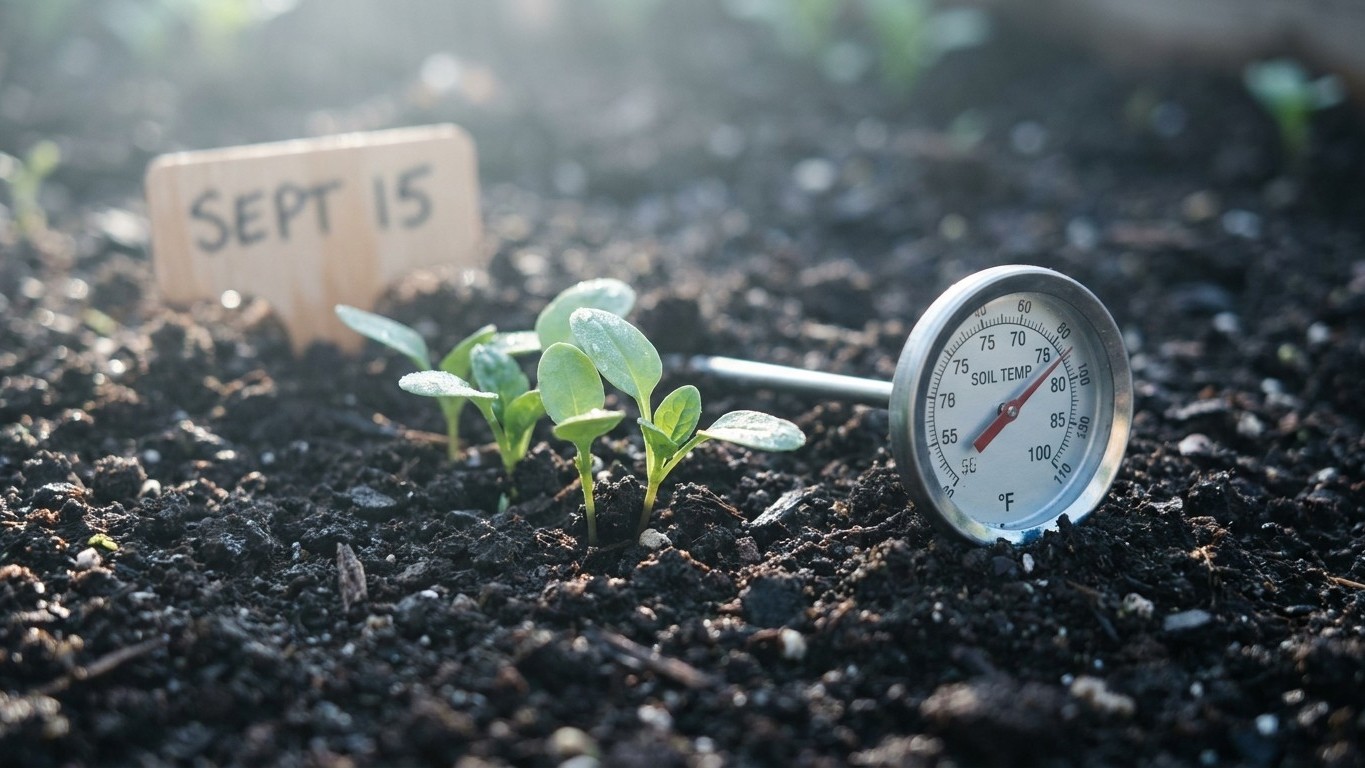

Sow autumn spinach in Saskatchewan roughly between the first week of July and the very end of July, timed 50 to 75 days before a realistic harvest date around the average first fall frost of September 18. That window opens only once soil temperatures ease back from their midsummer peak, since spinach seed germinates poorly once soil runs above 80°F.
The short answer
Saskatoon holds 16 hours and 31 minutes of daylight on the longest day of the year. That single figure explains more about spinach timing here than any thermometer reading. Spinach bolts under long days as much as under warm ones, so as the calendar pushes toward the solstice, the plant reads the lengthening daylight as a signal to stop making leaves and start throwing up a flower stalk. This is a completely different rule from the one governing long-day onions, where extended daylight builds the bulb. For spinach, long days work against the gardener, not for them.
That distinction matters in Saskatchewan because the province’s summer heat load is genuinely mild. The reference station at Saskatoon averages 0.0 days a year at 90°F or hotter. Most Prairie gardeners would guess that a cool summer buys extra weeks of leafy growth before bolting sets in. It does not, at least not on its own. Day length keeps climbing whether or not the mercury cooperates, and by the time the solstice arrives, the plant is under bolting pressure regardless of how comfortable the air feels at ground level.
So the honest way to frame the constraint is this: in Saskatchewan, day length is doing most of the damage, and heat is a secondary pressure that happens to arrive at the same time. A grower in a hotter province might blame scorching afternoons for a spinach patch running to seed in June. A Saskatchewan grower with the same bolted plants is watching the effect of daylight hours climbing past what the crop tolerates, with the near-total absence of 90°F days doing little to offset it.
This is also why spinach never gets a true summer slot on the Prairies. There is no stretch between spring and fall where daylight stays short enough and temperatures stay under the 75°F growth ceiling long enough to keep the crop productive. The plant needs to be sown, grown, and harvested either before the days get too long in spring, or after they have shortened again in late summer and fall. Everything in between belongs to other vegetables.
How long the spring window really is
- Start from the average last spring frost at Saskatoon, which lands on May 18. This is a mean date from Environment and Climate Change Canada’s 1981-2010 climate normals, not a guaranteed cutoff. In one year out of two, frost arrives later than May 18, so treat it as a midpoint, not a promise.
- Sow spinach seed two to three weeks before that average frost date, which places the practical sowing window between about April 27 and May 4 for a Saskatoon-area garden. Gardeners in northern or upland parts of the province should expect this window to slide later, since a single station never represents an entire province.
- Track the 75°F ceiling once seedlings are up. Growth stops being good above that temperature, and the same number marks where leaves start turning bitter. Early in spring this ceiling is rarely a problem; the risk grows as May turns into June.
- Watch daylight climb in parallel. Even without a run of 90°F afternoons, the days lengthen steadily toward the June solstice value of 16 hours 31 minutes, and that lengthening alone pushes the plant toward flowering.
- Add it up: roughly five to six weeks of dependable spinach growth, running from a late-April sowing to somewhere around early-to-mid June, before the combined pressure of longer days and warmer air ends the spring crop’s usefulness.
The autumn crop, and when the soil lets you sow
Autumn spinach in Saskatchewan runs into two separate obstacles, and they sit at opposite ends of the calendar. One blocks the start of the window. The other closes it.
Soil still too warm to germinate
Spinach seed germinates poorly once soil temperature climbs above 80°F, according to Utah State University Extension. Saskatoon’s air rarely reaches extreme heat, with an average of 0.0 days a year hitting 90°F, but soil in full midsummer sun can still sit warm enough through July to slow or stop germination even when the air feels mild. That means the autumn sowing window does not simply open on a fixed calendar date. It opens once soil has cooled back down from its summer peak, which in most Saskatchewan gardens starts to happen as the days shorten through late July and into August.
The frost that ends the season
The other boundary is the average first fall frost, which lands on September 18 at the Saskatoon station, again drawn from Environment and Climate Change Canada’s 1981-2010 normals. Like the spring frost date, this is a mean, not a guarantee. Frost has arrived earlier than September 18 in roughly half of the years on record, so a harvest plan built right up against that date carries real risk in a colder-than-average year.
Working backward 50 to 75 days from a September 18 harvest target puts the sowing window between roughly July 5 and July 30. Combine that with the need for soil to have cooled below the 80°F germination ceiling, and the realistic sowing period narrows to mid-to-late July for most Saskatchewan gardens, with early August still workable if the harvest goal shifts a little later into the fall.
No days-to-maturity figure is published for spinach by the source behind these numbers, so the 50-to-75-day count is the only planning tool available, and it should be treated as a range to sow within rather than a single date. The source names four spinach varieties commonly grown for these conditions, Bloomsdale, Melody, Teton, and Olympia, but publishes no germination speed, maturity length, or bolt-resistance data for any of them.
Common questions
Why doesn’t Saskatchewan’s cooler summer let me sow spinach later into June?
Because bolting is triggered by day length as much as by heat. Saskatoon’s mild heat load, with an average of 0.0 days a year at 90°F, doesn’t offset the effect of daylight climbing toward 16 hours 31 minutes at the solstice. The plant flowers on the calendar, not just on the thermometer.
How reliable is the September 18 average frost date for timing an autumn crop?
It’s a mean drawn from the Saskatoon SRC station’s 1981-2010 climate normals, meaning frost falls later than September 18 in about half the years recorded and earlier in the other half. Treat it as a midpoint for backing out a 50-to-75-day sowing window, not as a safe deadline, and build in a margin if your harvest goal sits close to that date.
Which spinach varieties do best in Saskatchewan gardens?
Four varieties are commonly named for these growing conditions: Bloomsdale, Melody, Teton, and Olympia. No published data compares their germination speed, days to maturity, or bolt resistance, so choosing among them comes down to seed availability rather than documented performance differences.
Can I speed up autumn germination by watering to cool the soil?
The source behind the germination figures identifies 80°F soil temperature as the threshold above which germination drops, but it does not address watering as a cooling technique. The safer approach is to wait for soil to cool naturally as day length shortens through late July, rather than relying on an unproven workaround.