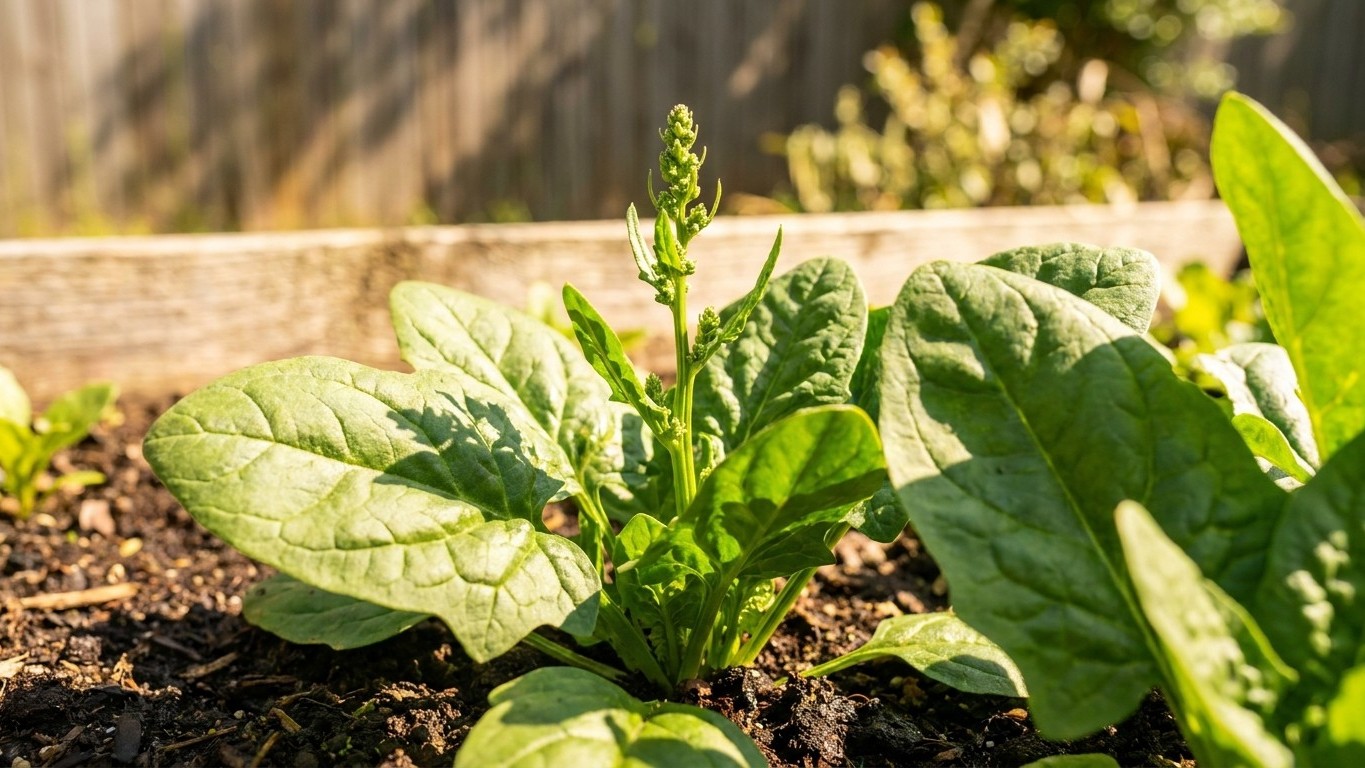

Two things eat spinach’s season in Saskatchewan: the length of the summer day and the heat. Neither is an insect, and no row cover fixes either one. Both squeeze the crop from opposite ends of the year. Spring gives a short run before long days and warmth trigger flowering. Autumn gives a sowing window that opens only once the soil cools, and it closes with the first frost.
The short answer
On the longest day of the year, Saskatoon gets 16 h 31 of daylight. That figure is calculated from the latitude of the reference city using the standard sunset formula. It uses the geometric horizon, so real daylight runs about seven minutes longer. It matters because spinach flowers in response to long days as well as warmth. Once it flowers, the leaves turn bitter and the plant puts its energy into a seed stalk.
So a cool summer does not buy extra weeks. A cloudy, mild July can keep the thermometer down, but the sky still delivers the long days, and long days alone are enough to push spinach toward bolting. Gardeners in milder places sometimes assume cool weather means a long season. Here, the day length cancels much of that benefit.
The limit in Saskatchewan is both day length and heat. Spinach grows best where temperatures stay at or below 75 F (about 24 °C). That one number carries two consequences. Above it, growth is no longer good, and the leaves also tend to turn bitter. It is a ceiling on the plant’s comfort, not a date on the calendar.
Heat counts for the province are modest. Saskatoon Diefenbaker Int’l A, the airport station used here, averages 13.1 days a year above 30 °C. It averages 4.98 days a year reaching 32 °C. Those are counts of extreme days, and spinach does not wait for extremes. A pleasant afternoon at 26 or 27 °C is already past its limit. Airport stations also sit outside the city and can read warmer or cooler than the neighbourhoods around them, so treat these as a reference point, not a forecast for your yard.
Frost dates frame the rest. The average last spring frost at the Saskatoon SRC station is May 18, and the average first fall frost is September 18. These are means from Environment and Climate Change Canada, and in one year out of two the frost lands later. Think of each as the middle of a window, never a safe date. Northern and upland districts run weeks behind this station, and Canadian normals use an older reference period than the US figures.
Put those pieces together and the pattern is clear. Spring is short and bounded by long days and warmth. Autumn is a second chance, but only if you sow when the ground allows. The longer Growing Spinach in Saskatchewan guide covers the whole season. This page sticks to the clock.
How long the spring window really is
The rule of thumb is to sow spinach two to three weeks before the last spring frost. Counting from the May 18 average, that is roughly April 27 to May 4, assuming the ground has thawed and can be worked. Here is how the weeks add up in practice:
- Start the clock at sowing. The earliest sensible sowing is late April, and the later end of the range is the first days of May. If spring runs late, the start moves with it, because May 18 is only the midpoint and half of years bring frost later.
- Run it to the longest day. The solstice falls around June 21. From April 27, that is about eight weeks. From May 4, it is about seven. That is the outer limit, because 16 h 31 of daylight is the day length at which the long-day trigger is strongest.
- Subtract the days the plant is not happy. Days stretch long well before the solstice, and afternoons climb past 75 F (about 24 °C) earlier than the hottest part of summer. The published figures here do not give the date when that ceiling is typically crossed, so I will not invent one. What the arithmetic does show is that the usable spring is a matter of weeks, not months, and shorter than the seven to eight weeks above.
- Plan the harvest early. The source publishes no days-to-maturity for spinach, so there is no number to count forward from sowing. The practical approach is to harvest young and often, and to treat anything still standing in June as borrowed time.
A later sowing does not make up for a late start, and that is the part most people miss. Sow in mid-May and the seedlings meet the same lengthening days and warming afternoons, just with less time to grow in between. The calendar closes at the other end regardless of when you opened it.
The question of bolting, and what you can do about it, has its own page: Will Spinach Bolt Early in Saskatchewan?. The takeaway for planning is simpler. Get seed in the ground the first week the soil can be worked, and do not expect the plants to hold past the start of summer.
The autumn crop, and when the soil lets you sow
Autumn is where spinach comes back into its own, and where gardeners most often trip. The rule from Utah State University Extension is to plant 50 to 75 days before the date you want to harvest. That is a planting guideline, not a days-to-maturity figure, because the source publishes none. Two obstacles stand between that guideline and a July sowing.
The soil is too warm to germinate
Seed germination drops above 80 F soil (about 27 °C). The block here is warmth, not cold, and it is easy to get backwards. When you sow in July, the air may feel fine in the evening, but the top inch of a bare bed can hold heat long after sundown. Germination suffers, and the seedlings that do come up face the same long days that bolt spring crops.
The window opens when the soil falls below that threshold, not on a fixed date. The published figures here do not include soil temperatures for Saskatoon, so the only reliable check is a thermometer pressed into the seed bed. Shade, a thick watered mulch, and sowing in the late afternoon are general ways to cool a bed down, though none of them replaces checking.
The frost that ends the season
Count back from a realistic harvest date. The first fall frost averages September 18 at the Saskatoon SRC station, and half of years it arrives later. If you treat that average as the end of the season, which is the cautious way to plan, 75 days before it is about July 5 and 50 days before it is about July 30. That gives a sowing window of roughly the first week of July to the end of the month.
It is a narrow window, and it lands in the warmest stretch of the year, which is exactly where the soil problem bites. The later end of the range tends to have cooler soil but less time before frost. The earlier end gives more growing days but hotter ground. How well a given planting handles that first frost is not something the figures here settle, so the count above anchors to the average date as a conservative stopping point.
For a full walk through the dates and the soil check, see When to Sow Autumn Spinach in Saskatchewan. Keep in mind that a northern or upland garden sits weeks behind the Saskatoon station, so shift every date in this section earlier.
Common questions
Does a cool summer let spinach grow all season in Saskatchewan?
No. Long days alone trigger flowering, and the longest day here brings 16 h 31 of daylight. A cool summer keeps the heat down, which helps with bitterness, but it does not remove the day-length trigger. That is why the limit is both day length and heat.
Can I trust May 18 and September 18 as safe dates?
No. They are average dates for the Saskatoon SRC station, so in one year out of two the frost falls later than each one. Treat them as the middle of a window. Northern and upland districts run weeks behind that station.
Which variety handles Saskatchewan best?
The source names four varieties: Bloomsdale, Melody, Teton and Olympia. It gives no data about any of them, so there is nothing published to say which one resists bolting better or does well in a short season. Any claim about one of them would be a guess.
How long does harvested spinach keep?
Spinach is a two-week crop at best. UC Davis Postharvest says the best storage is 32°F with 95 to 98 percent relative humidity, and that spinach “will not maintain good quality for more than 2 weeks.” Treat that as a ceiling, not a plan. At 41 to 50°F, the range of a typical fridge door, wilting, yellowing and decay set in faster. Keep it at the back of the bottom shelf, where it is coldest. Details are on the UC Davis spinach fact sheet.