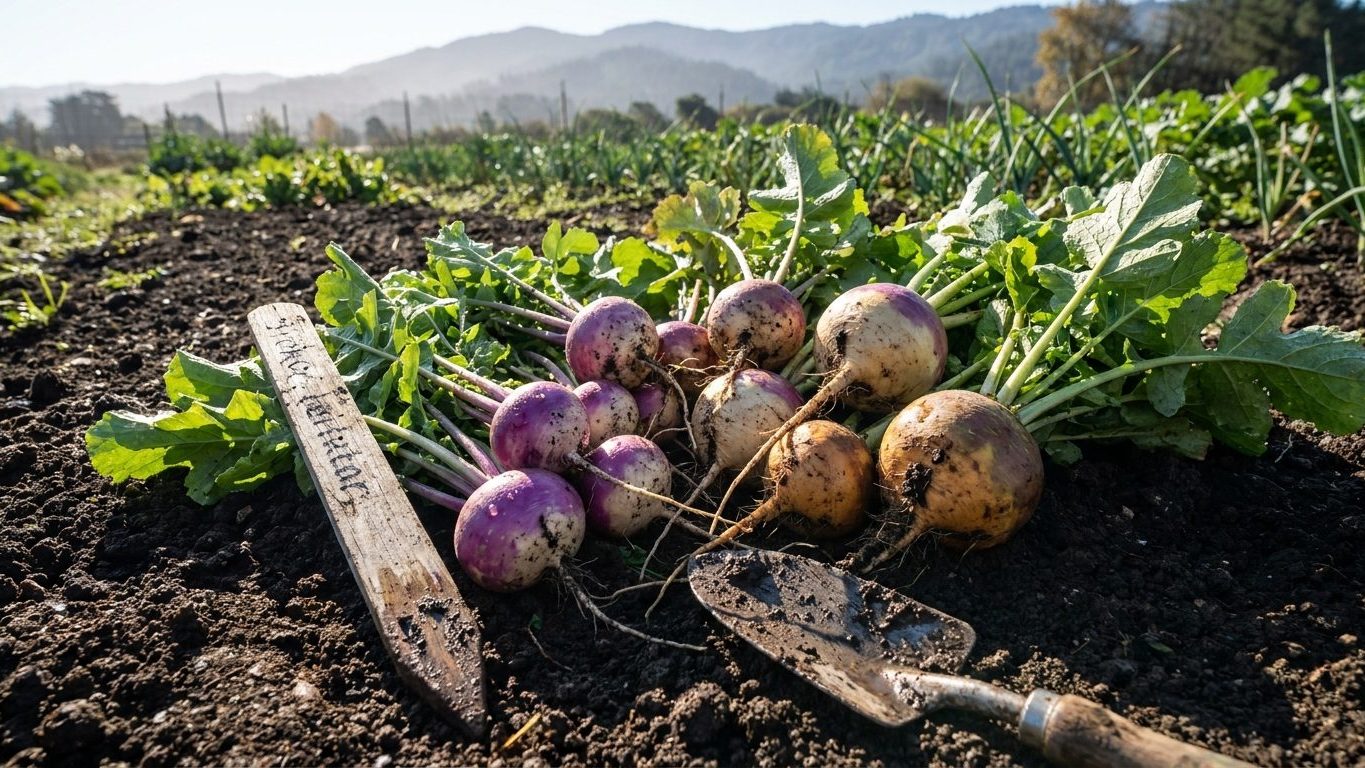

Choose by speed. Saskatoon averages about 123 days between its mean last spring frost (May 18) and mean first fall frost (September 18). That is enough for quick salad turnips, comfortable for storage turnips, and workable but tight for rutabaga, which needs an early sowing and a packet that promises maturity well inside the season.
The short answer for Saskatchewan
Those two dates come from Environment and Climate Change Canada’s 1981-2010 normals for the Saskatoon SRC station. They are averages, and a mean date is not a safe date. In one year out of two, the last spring frost lands after May 18, and in one year out of two the first fall frost arrives before September 18. Read them as the midpoints of a window, not the edges of a guarantee. The station is also one point on a very large province, and northern and upland districts run weeks behind it.
Within that window the decision comes down to type. Turnips shrug off light frost, so they do not wait for May 18 to pass. Rutabaga does the opposite job: it needs the whole season to swell a large root, so every week lost in spring comes out of the harvest.
| Type | Typical packet maturity | Fit for Saskatchewan | Best use |
|---|---|---|---|
| Quick salad turnip | Roughly 40 to 60 days | Dependable, and allows a second sowing for fall | Eaten fresh, small roots |
| Storage or main-crop turnip | Roughly 60 to 80 days | Good, with an early sowing | Fall harvest, short cellar storage |
| Rutabaga | Roughly 90 days or more | Workable only if sown early and chosen for the shortest maturity | Long storage, winter roasting |
The day counts are the ranges commonly printed on seed packets, not figures from the climate data. Packet days usually run from transplanting or from thinning, so treat them as optimistic. When you compare two varieties of the same type, pick the one with fewer days. If you want exact sowing dates to work backward from the frost window, When to Sow Turnips in Saskatchewan covers that.
What will not work here
The slowest rutabaga fails first. A packet listing 100 days or more, sown in early June because the garden got busy, has to dodge a fall frost that arrives before September 18 in half of all years. Rutabaga tolerates light frost, so it will not die, but the root stops filling when growth does. A beet-sized rutabaga is a lot of effort for a modest return.
Late sowings of any storage type run into the same wall. Counting back from the mean fall frost, a crop sown in the second half of June has under three months left at best, and cool nights slow growth well before the frost itself. Salad turnips can still make it, which is why they are the only type worth sowing late.
Leaving roots in the ground over winter does not work either. The mean daily minimum of the coldest month at Saskatoon is -20.7 °C (-5.3 °F). That is a monthly average of the nightly lows, so individual nights are colder, and an unprotected turnip or rutabaga in frozen soil will not be there in spring. Lift the roots in fall. A gardener coming from a milder state and expecting to harvest in January will be disappointed.
Advice written for milder places also fails here. Recommendations that assume a long, warm season, such as a leisurely midsummer sowing for a November harvest, rest on frost dates Saskatchewan does not have. Check the date range behind any variety list before you trust it.
One thing this page cannot rule on is summer water. It has no rainfall or summer heat figures for Saskatchewan, so it does not say how often to irrigate. Turnips and rutabaga both crack, turn woody, or bitter when moisture swings between drought and soaking, so even watering matters, but the amount depends on your soil and your summer.
What changes across Saskatchewan
Saskatoon sits in Canadian hardiness zone 3a, according to Natural Resources Canada’s 1991-2020 map. That is the zone of the reference city, not of the province. It is also not a USDA zone. The Canadian system weighs seven climate variables, the USDA system weighs one, and NRCan states there are no simple conversions between them. A US gardener should not read “3a” as USDA 3a.
This page has the zone for Saskatoon only, and no single answer covers a province this large. The south and the north differ in season length by weeks, and higher ground runs cooler than the nearby plains. To see where your own town falls, use the Canada’s Plant Hardiness Site map and search by municipality. Do not guess from a neighbor’s garden two districts over.
The shift for readers in the north or on upland ground is simple. Move one step faster on every type. Choose the shortest-maturity rutabaga you can find, or skip rutabaga and grow a storage turnip, which stores less long but finishes sooner. Sow the moment the soil can be worked instead of waiting for May 18 to pass, since turnips take light frost. In the shortest-season spots, salad turnips are the safest crop and a second sowing in midsummer is the most reliable fall harvest.
Readers well south of Saskatoon, if their frost window is longer, can hold a rutabaga to a more generous schedule. The principle is the same either way: line up the packet days against your own window, with some margin for a cold year. The broader picture for both crops is in Growing Turnips and Rutabaga in Saskatchewan.
Where to check this for your own county
The province is the wrong scale for a final decision, and this page is a provincial one. A county or rural municipality recommendation beats it every time, because local advisers know your frost pockets, your soil type, and which varieties actually finished in your area.
Start with the Government of Saskatchewan’s agriculture pages for farmers and ranchers, which is the provincial agriculture entry point in the facts behind this article. I have not confirmed that it carries a turnip-specific calendar, so look there for two things in particular:
- A planting calendar built for your area, with spring and fall frost dates stated as probabilities rather than single dates
- Variety trial results from nearby, ideally listing days to maturity and storage performance for rutabaga and turnips
If the provincial pages do not have those, a local garden club, a regional seed supplier, or a municipal office will usually know what has worked nearby. Be careful with US sources. Many American calendars use 1991-2020 climate normals, while the Saskatoon figures here cover 1981-2010. The two periods are not interchangeable, and the zone systems certainly are not.
Ask any source the same question this page raised: what is the date range, and is it an average or a probability? A calendar that gives one date with no range is hiding the half of years it fails.
Checking this against your own garden
Your own observation outranks every date above. Three things are worth watching, and none needs equipment.
Soil warmth by feel. In spring, push a hand into the bed. If the soil is cold enough to ache and clumps into wet, sticky lumps, wait. If it crumbles and feels merely cool, turnips can go in. A bed that warms days ahead of the one next to it is your early spot, and a bed that stays cold is where you put the later crops.
First true leaves. The first pair of leaves on a seedling are seed leaves, and the second set, the true leaves, shows the plant is established. Note the date they appear. It tells you how fast your garden is actually running compared with the packet’s claims, and it is the right moment to thin.
Where frost shows first in fall. Walk the yard on the first frosty morning and see which tender plants blacken and which low corners whiten while higher ground stays clear. That map is your microclimate. Roots in the frost pocket have less time, and roots near a south wall have more.
Write the dates down for a couple of seasons. They will beat any average, because they describe your plot and not a station in Saskatoon.
Common questions
Can I grow rutabaga in Saskatchewan?
Yes, with conditions. Sow early, choose the shortest-maturity type you can find, and expect to harvest before the ground freezes hard. In shorter-season northern or upland areas, a storage turnip is the safer choice.
Is May 18 a safe sowing date for turnips?
It is the average last spring frost at the Saskatoon SRC station, so half of years see frost after it. Turnips tolerate light frost, so you can sow earlier, once the soil is workable.
Can turnips or rutabaga stay in the ground over winter?
Not reliably. The coldest month’s mean daily minimum at Saskatoon is -20.7 °C (-5.3 °F), and nights go colder. Lift the roots in the fall and store them.
Which hardiness zone am I in?
This page only has Canadian zone 3a for Saskatoon, not for your town. Look up your own municipality on the Canada’s Plant Hardiness Site map, and do not treat the number as a USDA zone.