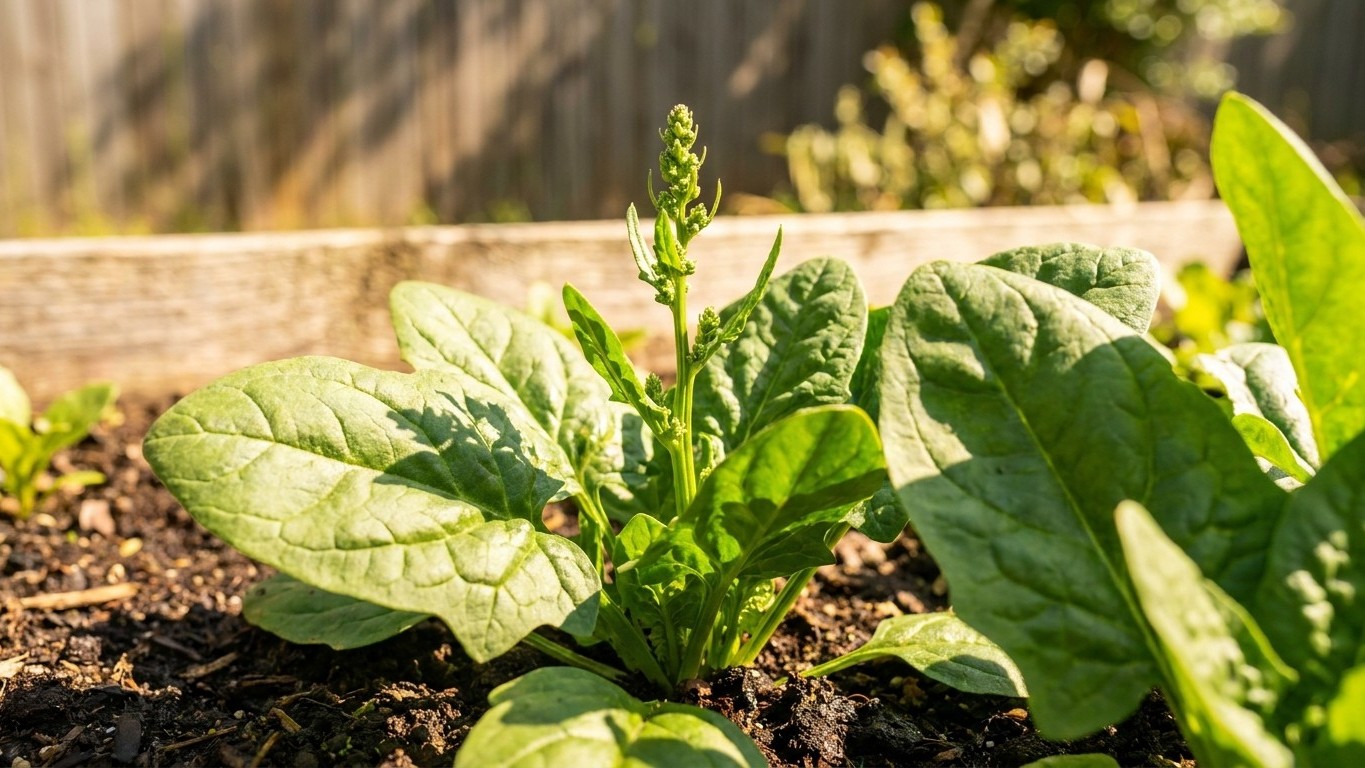

Yes, spinach bolts early in South Carolina, and the reason is a double squeeze rather than a single cause. The state’s long summer days push spinach toward flowering all on their own, and the heat that follows on their heels finishes the job. Growers here aren’t fighting one clock. They’re fighting two, and both are set against them at the same time of year.
The short answer
On the longest day of the year, the Charleston area sees 14 hours and 10 minutes of daylight. That number matters far more than most gardeners realize, because spinach reads day length the way a thermostat reads temperature: past a certain threshold, it flips a switch. Long days, not just warm ones, trigger the hormonal shift that sends a spinach plant from producing leaves to throwing up a flower stalk. A cool, cloudy stretch in June won’t undo that signal. The plant is responding to how much light it’s getting each day, and in South Carolina, that number climbs high enough, early enough, to start the process well before summer heat even arrives.
That’s the part people miss. They assume a mild summer buys them time. It doesn’t, because day length keeps climbing on a fixed schedule no matter what the thermometer says. So the honest answer to whether South Carolina’s climate limits spinach is: both mechanisms are working against the crop, and they arrive close together. Day length starts pushing the plant toward bolting as spring lengthens toward the solstice. Heat then piles on, since spinach’s own growth ceiling sits at 75 degrees Fahrenheit, a threshold South Carolina spring crosses early and often. Once temperatures push past that ceiling, growth quality drops and the leaves that do form turn bitter, which is the same 75-degree line doing two jobs: capping growth and ruining flavor at once.
Charleston-area summers average 55.1 days a year at 90 degrees or hotter. That’s not a stray hot week. That’s a heat load that builds fast once spring turns the corner, and it means the stretch of weather mild enough for spinach is genuinely short here, not just theoretically short. Day length sets the outer boundary. Heat closes in from the other side. A gardener trying to stretch a spring spinach bed into May in South Carolina is fighting both forces at once, and neither one cares that the other hasn’t finished yet.
None of this means spinach is a poor fit for South Carolina gardens. It means the crop has to be treated as a short-season specialist here, planted early, harvested young, and replanted in autumn rather than nursed through summer. Everything below is about how to work inside that reality instead of against it.
How long the spring window really is
- Start with the sowing rule. Utah State University Extension advises sowing spinach 2 to 3 weeks before the last expected frost. In South Carolina, NOAA’s 1991-2020 climate normals put the last spring frost, at the 30 to 70 percent probability band, between February 28 and March 17 at the reference station. Counting back 2 to 3 weeks lands sowing in the second half of February for most of the state, sometimes earlier on the coast, where the peninsula around Charleston runs milder than the airport station used for these normals.
- Mark the point where growth stops being good. Spinach performs best where temperatures stay under 75 degrees Fahrenheit. That’s not a hard-kill line, it’s the point where leaf quality, growth rate, and flavor all start to slide, and where the day-length trigger described above starts finding company from the heat side too.
- Add in the Upstate difference. Inland and upstate South Carolina runs several weeks tighter at both ends of the frost calendar than the coastal reference station, which shortens the workable window further for gardeners away from the coast, even though the same day-length ceiling applies statewide since day length doesn’t change with elevation the way frost dates do.
- Total the usable stretch. Sowing in late February, with quality growth realistically holding only until the 75-degree ceiling and the lengthening days catch up with the crop, leaves South Carolina gardeners a spring spinach season best measured in weeks, not months. It’s a narrow window, and it closes from two directions rather than one, which is exactly why the timing matters more here than in states where only heat, or only day length, is the limiting factor.
Where this leaves spring planning
The practical takeaway is to treat late winter, not spring, as spinach season in South Carolina. Sowing as soon as the soil can be worked in February, rather than waiting for what feels like reliable spring weather, buys the crop the most growing time before both clocks start working against it.
The autumn crop, and when the soil lets you sow
Fall is where South Carolina spinach usually performs better than spring, since the day-length trigger is working in reverse, shortening rather than lengthening as the season goes on. But autumn sowing has its own obstacle, and it isn’t the cold everyone assumes it is.
Soil too warm to germinate
Utah State University Extension notes that spinach seed germination is reduced once soil temperature climbs above 80 degrees Fahrenheit. In South Carolina, late summer soil routinely sits above that mark well after air temperatures have started to feel like fall. That means the practical start of the autumn spinach window isn’t a calendar date, it’s whichever week the soil actually cools below that threshold, and in a state that logs 55.1 days a year at 90 degrees or hotter, that cooldown often comes later than gardeners expect. Waiting a stretch, checking soil temperature directly rather than trusting the feel of the air, is the more reliable approach than sowing by habit in early September.
The frost that ends the season
NOAA’s 1991-2020 climate normals put the first fall frost, again in the 30 to 70 percent probability band, between November 20 and December 5 at the reference station, with the Upstate running tighter and the Charleston peninsula milder still. Utah State University Extension’s guidance for fall crops is to plant 50 to 75 days before the date you want to harvest. Counting back from a harvest window that lands inside the November 20 to December 5 frost period puts sowing roughly in early September through mid-October, depending on how close to frost a gardener is comfortable harvesting. That overlaps neatly with the point where soil temperature has usually dropped out of germination-blocking territory, which is why the fall crop tends to be the more forgiving of the two South Carolina spinach seasons, even though it still runs on a tight, source-defined 50-to-75-day countdown rather than an open-ended one.
Four varieties commonly discussed for home gardens are Bloomsdale, Melody, Teton, and Olympia, though no yield, days-to-maturity, or bolt-resistance data for any of them is published in the source used here.
Common questions
Does shade slow down spinach bolting in South Carolina?
The mechanism described here is day length, which shade over a bed doesn’t change, since the plant is responding to hours of daylight, not light intensity. Shade may modestly ease the heat side of the equation by keeping soil and leaf temperature a little lower, but it won’t stop the day-length trigger from arriving on schedule.
Is the Upstate meaningfully better for spinach than the coast?
The frost dates run several weeks tighter in the Upstate at both ends of the year compared with the coastal reference station, which changes the calendar for sowing and harvest. Day length itself doesn’t shift with the state’s modest range of latitude, so the core bolting trigger applies about the same statewide.
Can spinach be grown through a South Carolina summer at all?
The two limiting factors described here, long days and heat above the 75-degree growth ceiling, both fall squarely inside the South Carolina summer, which is why the crop is treated as a spring-and-fall specialist rather than a season-long planting in this climate.
Why does the source treat 80 degrees soil temperature as a planting rule rather than a calendar date?
Because soil temperature, not the date on the calendar, determines whether spinach seed will germinate reliably, and South Carolina’s late-summer soil can stay above that 80-degree threshold well past the point where the air itself feels cool enough for fall planting.