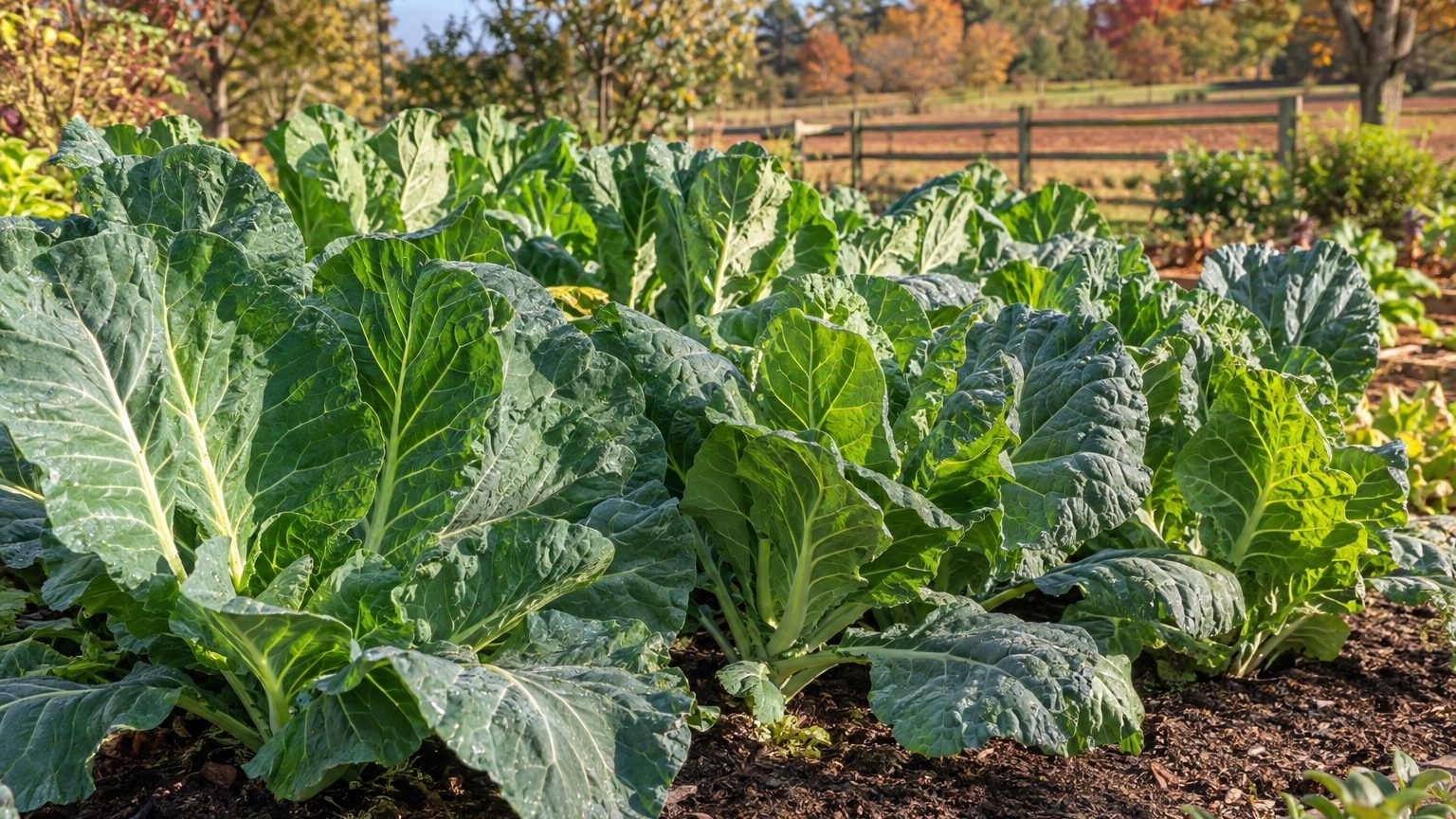

For most South Carolina gardens, the best collard is a non-heading, open-leaf type such as Georgia Southern or Vates, planted for fall and cut through winter. The state’s long frost-free stretch gives these plants months to grow, and its mild winters keep them producing. Mustard, turnip greens and kale fill in around them. Which one wins depends less on the seed packet than on when the plant goes in the ground.
The short answer for South Carolina
Choose an open-leaf collard and time it to mature after summer heat breaks, because the long season is your advantage and the summer in the middle of it is your limit. At the Charleston airport station, the NOAA 1991-2020 Climate Normals put the last spring 32°F freeze between February 28 and March 17. The first fall freeze falls between November 20 to December 5 (NOAA NCEI station data).
Both ranges are the 30-70% probability band for a 32°F freeze. They are not promises. In a given year, a freeze can arrive earlier or later than the band, and the band says nothing about how hard it will be. The gap between the two ranges is roughly eight to nine months, which is a lot of runway for a crop that shrugs off frost.
Winter is mild too. The mean daily minimum of the coldest month at the Charleston reference is 38.9°F, above freezing on an average night. Collards do not go dormant in that kind of cold, so in the Lowcountry they behave like a winter crop you can harvest, not one you tuck away. The exact sowing dates are laid out on When to Plant Collards in South Carolina, and the broader growing basics are in Growing Collards in South Carolina.
Which type suits which garden
Variety names change between seed catalogs, so think in types first. The table compares the main choices on the same two criteria.
| Type | Where it shines in South Carolina | Main risk |
|---|---|---|
| Open-leaf, non-heading (Georgia Southern, Vates) | Fall through early spring harvest, picking leaves over many weeks | Bolting if a spring planting meets early heat |
| Heading or cabbage-type (Morris Heading) | Cool stretches of fall and winter, when a loose head can form | Slower to reward you, and unhappy in heat |
| Smooth, glossy-leaf types (Green Glaze) | Gardeners who want a tidy, easy-to-wash leaf | Same heat limits as other collards |
| Mustard and turnip greens | Quick harvests in the cool shoulders of the season | Bolt faster than collards once warm weather arrives |
Georgia Southern is the old standby with big, broad leaves. Vates is a more compact, upright plant that many home growers like for tighter beds. Neither is wrong. Match the plant’s size to your bed and the harvest style to your kitchen.
Greens worth growing alongside
Kale, mustard and turnips share the same fall window and the same tolerance for cold. Mustard and turnip greens grow fast, so they make a good first harvest while collards are still bulking up. That gives you something to pick in the weeks before the collards hit stride.
What will not work here
A spring crop sown late is the most common failure. The last-freeze band ends on March 17 at the airport station, and anything set out well after March 17 has only a short run before South Carolina heat arrives. Collards planted in that squeeze tend to bolt, turn bitter and attract aphids before they give you a real harvest. They are a cool-weather crop, and a Lowcountry summer is not that.
Slow types planted late
Heading types and the biggest heirloom collards need weeks of steady cool weather to fill out. If you sow them in late summer with the idea of catching up, the shortening days of late fall work against you, and a transplant set out near the first-freeze band has little time to size up. Frost will not kill it, but a small plant gives small leaves. Fall crops need to be established well before the November 20 to December 5 window arrives, not started as it closes.
The 38.9°F coldest-month figure is worth reading correctly. It is a Charleston reference, not a statewide number, and it tells you that hard winter kill is not the threat on the coast. It does not tell you the Upstate is the same, where nights run colder and the growing window is several weeks tighter at both ends.
Weekly watering and tight spacing
Sandy coastal soils drain fast. A gardener who waters deeply once a week and calls it done will see stressed, tough leaves in a warm September, when fall transplants are trying to establish. Young plants need moisture that stays steady, especially in the first weeks. Heavy clay, common in the Piedmont and Upstate, has the opposite problem, holding water and inviting root rot if you overdo it.
Humidity punishes crowding. South Carolina air stays damp through early fall, and plants packed shoulder to shoulder stay wet after every rain and dew. That is where leaf spot, aphids and cabbage loopers settle in. Give each plant room for air to move, and pick lower leaves as you go so the base stays open.
One more trap: trusting a frost date as a guarantee. Because the airport figures are a 30-70% band, a freeze after mid-March or before late November is a normal outcome in some years. Collards handle that. Tender seedlings from a greenhouse, set out without hardening off, may not.
What changes across South Carolina
There is no single answer for the whole state. The USDA Plant Hardiness Zone Map (2023, built on 1991-2020 normals) places South Carolina anywhere from 7a-9a. That is a spread of three full zones between the mountain foothills and the coast, and the difference shows up in how you schedule a crop.
A three-zone spread
The zone system uses one variable, the average annual extreme minimum temperature. It says nothing about summer heat, humidity or frost dates. So a zone number is useful for judging whether a perennial survives, and only a rough guide for a fast annual crop like collards. Look up your own location on the USDA map rather than assuming; a few miles and a few hundred feet of elevation can change the answer.
The dates on this page come from a Charleston station. Peninsular Charleston is milder than even the airport. Upstate South Carolina runs several weeks tighter at both ends: the last spring freeze comes later, and the first fall freeze comes earlier.
What to shift in the Upstate and at the coast
In the Upstate, move the fall planting earlier. Your first freeze arrives before the Charleston band, so plants need a head start to reach size before cold slows them down. Spring planting shifts later for the same reason. Winter harvest is still possible in many years, but expect plants to pause during colder stretches.
On the coast and the peninsula, you have more slack. Later fall plantings still make usable leaves, and harvest can run nearly continuously through winter. The trade-off is that heat lingers longer into early fall, so watering and pest scouting matter more in September than they do farther inland.
Where to check this for your own county
A county recommendation beats a state one, and this page is the state one. Your local office knows your soils, your elevation and which varieties have actually been tried near you. Start at clemson.edu/extension, the Clemson Cooperative Extension service, which is South Carolina’s land-grant extension network.
Two things are worth looking for there. First, a local planting calendar for fall and spring vegetables in your county, which will be tuned to your area’s frost timing better than any airport station. Second, any variety trials or recommended lists for collards and other greens, so you can see which cultivars did well in conditions like yours.
A caution about calendars. The Clemson calendars this page has read are the HGIC maintenance calendars for lawn grasses: bermudagrass, zoysiagrass, centipedegrass and St. Augustinegrass. They are written for turf, and they do not schedule collards. This page does not have a Clemson collard-specific calendar, so ask your county office or search the Home & Garden Information Center at hgic.clemson.edu for vegetable guidance directly.
If you call or email a county agent, give them three details: the town or ZIP code, whether the bed is sandy or clay, and whether you are planting for fall or spring. That is enough for a useful answer, and often the agent will know something no website does, like which cultivar a nearby gardener has grown for years.
Checking this against your own garden
Your own yard outranks every date here. A low spot near a fence can freeze a week earlier than a sunny bed against the house, and no station can see that. Three things are worth watching, and none needs equipment.
- Soil feel: Push your hand into the bed in the morning. In fall, soil that is still warm and crumbly means seedlings will germinate quickly and settle in; cold, sodden soil in spring means wait. Soil that stays wet for days tells you drainage is poor and spacing matters more.
- First true leaves: Seedlings show their first pair of true leaves, the ones that look like a real collard leaf, after the rounded seed leaves. That is your cue to transplant or thin. If it takes much longer than a seed packet suggests, your bed runs cool or shaded.
- Your own first frost: Note the first morning of frost on your lawn or beds and compare it with the November 20 to December 5 range. If yours comes earlier, you live in a cold pocket and should plant sooner next year.
Keep a scrap of paper or a note on your phone, and write down the date of your first frost each year. Two or three seasons of your own numbers will tell you more than any average, and they will show whether you belong closer to the coastal dates or the Upstate ones.
Common questions
Can collards survive a South Carolina winter?
Yes, in most years. The Charleston reference shows a coldest-month mean minimum of 38.9°F, and collards handle frost well. The Upstate runs colder and tighter, so growth may stall there during cold spells, but plants often recover when it warms.
What is the best collard variety for a beginner?
An open-leaf, non-heading type such as Georgia Southern or Vates. You pick leaves as they mature instead of waiting for a head to form, which forgives mistakes with timing.
Are collards the same as other Southern greens?
No. Collards, mustard, turnip greens and kale are related but different crops. Collards are the slowest and most durable. Mustard and turnip greens grow faster and bolt sooner in warm weather.
Do I need to plant in spring or fall?
Fall is the stronger choice in South Carolina because plants mature as heat fades. Spring can work, but the window between the last freeze band (February 28 to March 17 at the airport station) and hot weather is short, so start early.