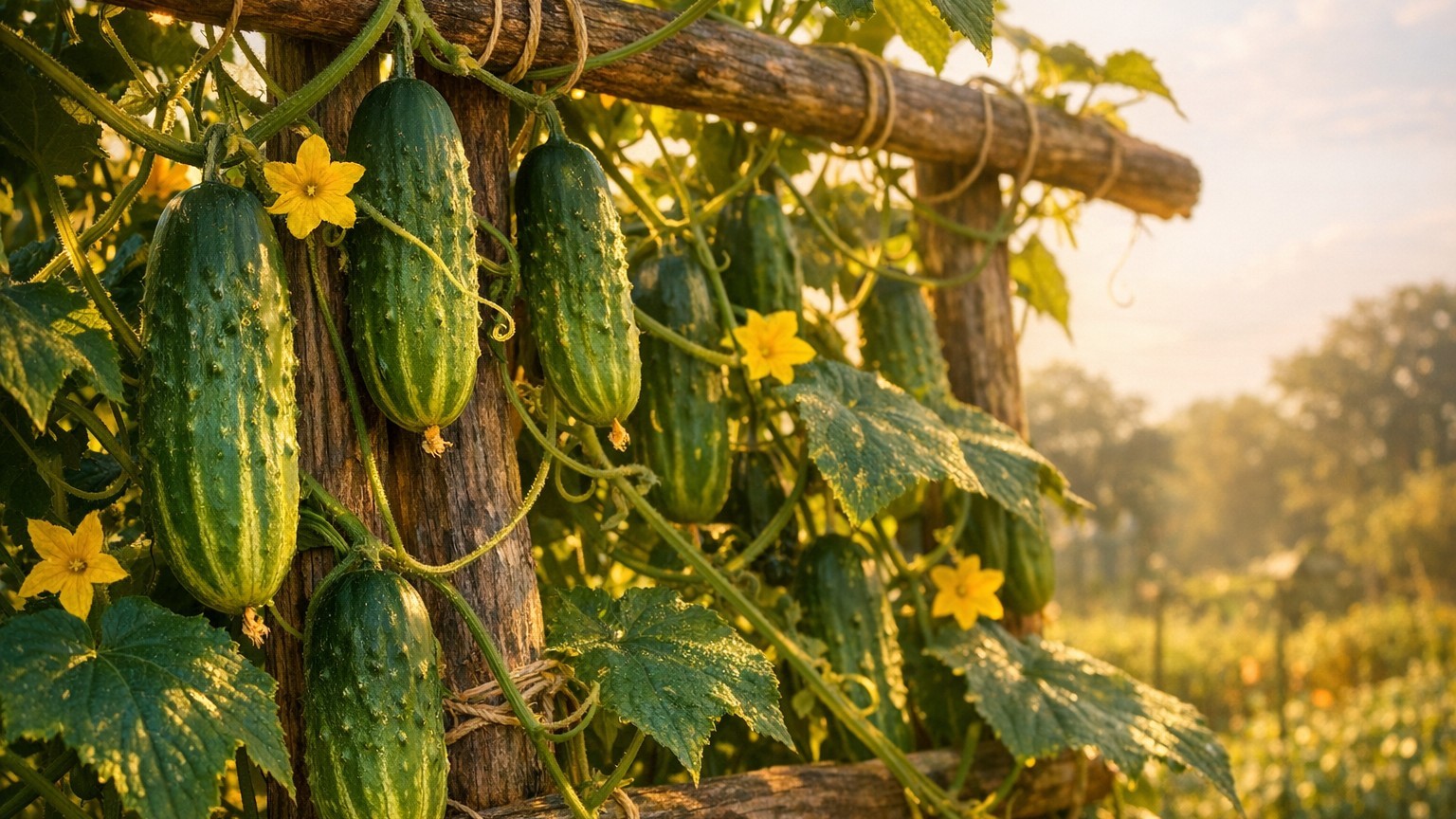

South Carolina’s long frost-free stretch and heavy midsummer heat point growers toward heat-tolerant, disease-resistant types rather than any single named cucumber. Bush and compact pickling types suit small beds and quick turnover, vining slicers reward a trellis, and burpless or parthenocarpic types shrug off the humidity that turns other plants bitter or diseased by July.
The short answer for South Carolina
The decision here starts with the calendar, not the seed catalog. A frost-free window running from roughly late February through early March at the earliest to late November or early December at the latest gives most of the state eight to nine months of growing season. That is long enough for two full cucumber crops in a single year, but only if the plant type matches what happens in between: 55.1 days a year at or above 90°F, concentrated squarely in the middle of that window. A cucumber that stalls or turns bitter under sustained heat wastes the second half of the season, and a cucumber bred for a short, mild summer never gets the chance to show what it can do here.
That is why South Carolina gardeners tend to sort cucumbers by type rather than by variety name first. Bush and compact pickling types work well for an early spring planting, since they mature fast and clear space before the worst of the heat arrives. Vining slicing types reward the extra room and a trellis, both for the longer harvest window and for the airflow that matters once humidity builds. Burpless and parthenocarpic types, which set fruit without relying on consistent bee activity, tend to hold up better through the stretch of erratic pollination and heat stress that hits mid-to-late summer.
| Type | Growth habit | Space needed | Where it fits the SC calendar |
|---|---|---|---|
| Pickling | Often bush or compact vine | Small footprint, containers possible | Early spring planting, quick harvest before peak heat |
| Slicing | Vining | Trellis or wide rows | Full-season crop, benefits from the longer frost-free window |
| Burpless / parthenocarpic | Usually vining | Trellis recommended | Holds fruit set through erratic pollinator activity and humid heat |
None of this replaces a variety name. Clemson Cooperative Extension trials cucumber varieties by category and publishes results by region, and that is where a specific name belongs, matched to a specific county rather than to the state as a whole.
What will not work here

Long-season European greenhouse cucumber types, bred for cool, mild summers with little heat stress, run into trouble fast once the thermometer holds above 90°F for weeks at a stretch. South Carolina averages 55.1 such days a year, and a plant that was never selected for that load tends to stop setting fruit, drop blossoms, or turn bitter right when a Southern gardener expects the harvest to peak.
Watering on a weekly schedule fails here for a different reason. Summer rainfall averages about 19.8 inches across June, July and August, but it does not arrive evenly. June is the driest summer month at 6.21 inches, and even the wetter months, July at 6.6 inches and August at 6.97 inches, tend to land as single thunderstorms rather than steady soaking rain. Combined with 55.1 days of 90°F-plus heat driving evaporation, a lot of that rain runs off before it reaches the root zone. A cucumber bed watered once a week on that schedule is running dry for days at a time during the hottest stretch of the year, right when the plant needs the most consistent moisture to avoid bitter or misshapen fruit.
Tight spacing on the ground is the third common failure. South Carolina’s humidity, paired with that same summer rainfall pattern, creates ideal conditions for powdery mildew and downy mildew on cucumber leaves that stay wet or shaded too long. Vines sprawled close together with no airflow hold moisture on the foliage well after a storm has passed, and mildew can move through a planting in days once it starts. A trellis, or at minimum wider spacing between plants, is less a preference here than a defense against the specific humidity load this state carries through summer.
Finally, planting once in spring and calling it done leaves the fall window on the table. With first fall frost not arriving until November 20 to December 5 in most of the state, there is real time for a second planting in late summer, timed to mature before the cold arrives. Skipping that second round is not a mistake exactly, but it is unclaimed harvest given the length of the frost-free season here.
What changes across South Carolina
South Carolina spans USDA Hardiness Zones 7a to 9a, a range built on one measurement: the average annual extreme minimum temperature. That is nearly two full zones of difference inside a single state, and it means there is no single planting date that works from the mountains to the coast.
The frost dates cited for this page (last spring frost February 28 to March 17, first fall frost November 20 to December 5) come from a coastal reference station near Charleston, and the underlying data carries an explicit caution: peninsular Charleston runs milder than even that airport station, while Upstate South Carolina runs several weeks tighter at both ends of the season. A gardener working land near the coast can often push a spring planting earlier than the state-level dates suggest, and stretch a fall crop later into that November-December window. A gardener in the Upstate, working inside a shorter season and a colder hardiness zone, should treat those same dates as optimistic and shift both plantings inward, later in spring and earlier in fall, to avoid a late freeze or an early one catching young plants unprotected.
Elevation compounds this inside the Upstate itself. Land that sits higher in the Blue Ridge foothills cools faster at night than land in the Piedmont just a few miles away, which is part of why the state’s hardiness zone range runs as wide as it does. None of this is something a state-level page can resolve for an individual garden. The zone map itself, not a written description, is the tool built to answer that question for a specific piece of land.
Where to check this for your own county
Clemson Cooperative Extension is the source built to close the gap this page cannot close on its own. A state-level article can describe types and seasonal patterns, but only a county-level extension resource can say which specific cucumber varieties performed well in trials run close to where a reader actually gardens, under the soil, humidity and frost timing of that particular county rather than an average drawn across the whole state.
Clemson’s Home and Garden Information Center publishes its guidance the same way it handles other crops and plants: as individual factsheets, organized by species or category rather than one blanket document per state. That structure means a search on the HGIC site for cucumber variety trials or a vegetable planting calendar will turn up guidance written for South Carolina conditions specifically, with named varieties Clemson has actually tested, something this page has deliberately avoided doing since it cannot verify which cultivars are currently recommended for any single county.
The rule worth keeping in mind: a county recommendation beats a state one every time, because it accounts for local frost timing, local soil, and local disease pressure that a state-wide page can only describe in general terms. This page has given the mechanism, the types, and the reasons behind them. The extension office gives the names.
Checking this against your own garden
Every date on this page is a normal drawn from decades of weather records, and a reader’s own garden will still tell them more than any calendar. Three things worth watching, all readable without any special equipment:
- Soil warmth by feel. Cucumber seed germinates poorly in cold soil regardless of what the calendar says. Pressing a hand into the top few inches of bed soil and finding it consistently warm, not just on a sunny afternoon but in the morning too, is a better signal that the ground has caught up to spring than any date range.
- The first flush of male flowers. Cucumbers typically produce male flowers before female ones, and a burst of male blooms with no fruit-bearing female flowers yet is normal, not a failure. It signals the plant is building toward fruit set, and it is worth watching for female flowers, the ones with a tiny swollen cucumber shape behind the petals, in the days that follow.
- The first true leaves. The rounded seed leaves that appear first are not the plant settling in. The first true leaves, the ones with the jagged cucumber-vine shape, mark the point where the plant has actually established itself in that specific spot of ground, under that specific garden’s drainage, sun exposure and soil.
Together, these three signals describe a microclimate no weather station captures: the particular combination of sun, drainage and soil in one bed, on one property, in one county of a state that spans two hardiness zones and a month-wide spread in frost timing from coast to mountains.