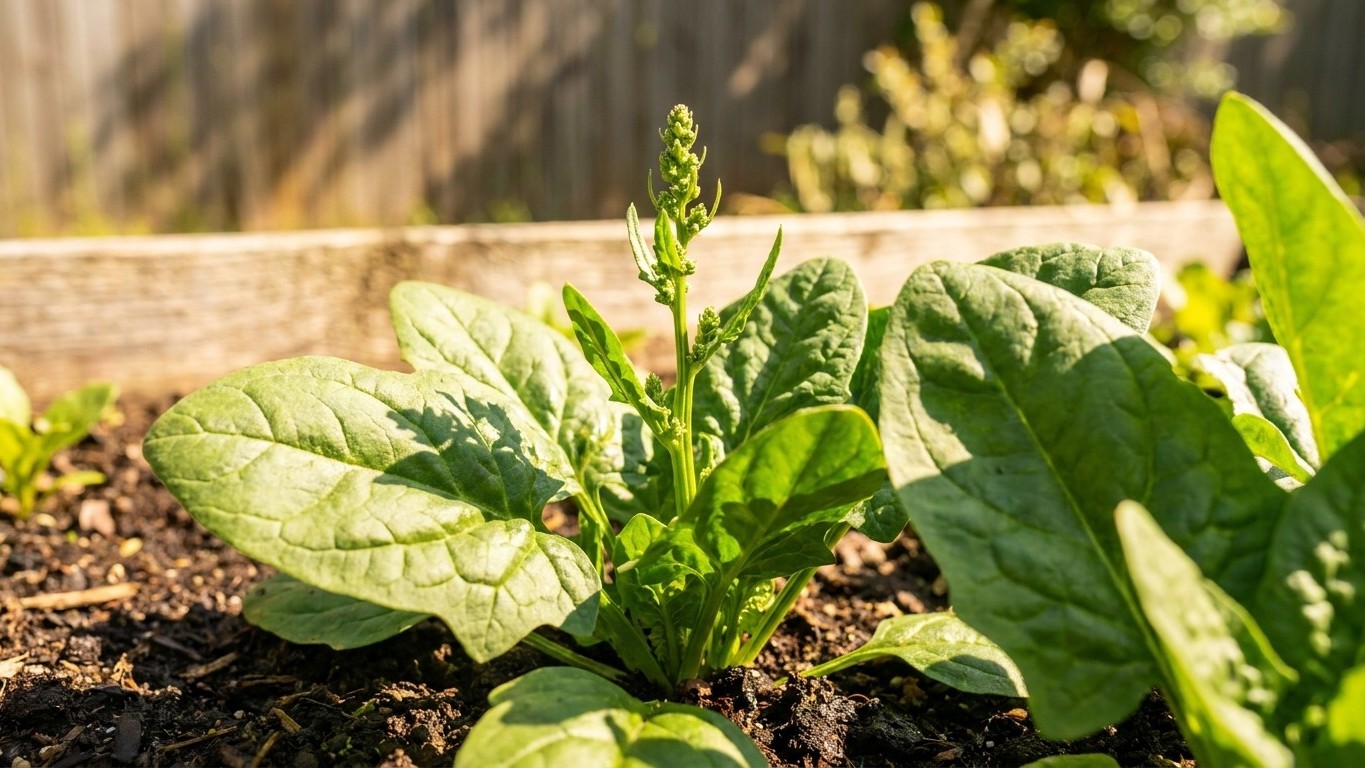

In South Carolina, what eats a spinach crop is the calendar. In spring, lengthening days and rising heat push plants to flower and turn the leaves bitter. In early autumn, soil that is still too warm stops seed from sprouting, and the first frost sets the deadline. Here is each squeeze with the dates the NOAA climate normals support, so you can sow inside the gap instead of guessing.
The short answer
The longest day of the year in Charleston, the reference city for these numbers, delivers 14 h 10 of daylight. That figure matters because spinach flowers in response to long days. Warmth speeds the process, but long days alone are enough to trigger it. So a cool summer here would not buy you extra weeks of leaves, and neither would a cool spring afternoon in late May. Utah State University Extension, the authority behind this page’s growing limits, says spinach bolts during long days and warm temperatures.
The limit in South Carolina is both day length and heat. Neither one covers for the other.
Day length is fixed by latitude. You can’t shade it, mulch it or water it away, and the source I’m using publishes no hour threshold for spinach, so I won’t invent one. What it does say is that long days and warmth together bring on flowering. By the time the sun is up for more than 14 hours, you want the crop already in the kitchen. The Will Spinach Bolt Early in South Carolina? page covers what an early bolt looks like and how to react.
Heat is the second blade, and here it is the sharper one. Spinach grows best where temperatures do not exceed 75 F. That number carries two consequences at once: growth slows past it, and the leaves turn bitter past it. Charleston’s normals record 55.1 days a year reaching 90 F or more. That is nearly eight full weeks of 90 F days spread across the warm months, a long way above a ceiling of 75 F. Spring in the Lowcountry doesn’t ease into summer; it hands you off.
Frost dates frame the two ends of the season. The last spring freeze falls between February 28 and March 17, and the first fall freeze between November 20 and December 5. Both ranges come from NOAA NCEI climate normals for the Charleston airport station (the 30 to 70 percent probability band), and peninsular Charleston runs milder than that station. Upstate South Carolina runs several weeks tighter at both ends, so an Upstate gardener should shift every date below accordingly.
A note on the title. If you were hoping for a list of insects, this page doesn’t have one. The sourced facts here are about timing, and timing is what decides whether the crop reaches the table. For the full growing picture, start with Growing Spinach in South Carolina.
How long the spring window really is
Spring sowing starts 2 to 3 weeks before the last frost. Growth stops being good above 75 F. Everything between those two events is your usable spring, and in South Carolina the arithmetic goes like this.
- Find your last-frost range. For the Charleston reference station it runs from February 28 to March 17. If you garden inland or in the Upstate, your range sits later, and the normals here don’t give a figure for your county.
- Count back 2 to 3 weeks. From February 28, three weeks back is February 7. From March 17, two weeks back is March 3. That makes the sowing window roughly February 7 to March 3, about three and a half weeks wide, and the early end is only for the gardener whose spot sits at the mild end of the range.
- Watch for the first week of 75 F highs. This is a temperature, never a calendar date. The normals used here don’t date when daily highs cross it, so the sourced facts can’t give you a closing date. A weather app’s ten-day forecast can. Once highs stay near or above 75 F, growth is no longer good and bitterness is on its way.
- Count the weeks in between. From your sowing day to that first run of 75 F highs is your crop’s real window. A seed in the ground on February 7 gets more weeks than one sown on March 3, and each week lost at the front comes straight off a window that closes at the back.
The practical takeaway is that spinach here is a race against a closing door, and the door closes fast. A state that sees 55.1 days at 90 F or more doesn’t linger in the 70s. My read is to sow at the early end of your range, accept some risk of a cold snap, and skip the “I’ll wait for a nice warm weekend” instinct. The warm weekend is the problem.
Variety choice might help, but the data to prove it isn’t published. Utah State University Extension names four varieties (Bloomsdale, Melody, Teton and Olympia) and gives no data about any of them, so I can’t tell you which resists bolting or heat better. Treat any claim of that kind with suspicion unless it comes with a source.
The autumn crop, and when the soil lets you sow
Autumn works backward from the frost. Utah State University Extension says to plant 50 to 75 days before the date you want to harvest. The source publishes no days-to-maturity figure for spinach, so that planting rule is the only count there is.
Soil that is still too warm
Seed germination is reduced when soil sits above 80 F. After a South Carolina summer, the top inch of a garden bed can hold that warmth long after the nights start to feel pleasant. So the autumn obstacle is warm soil, not cold. The window opens when the soil falls below 80 F, and you can check with a soil thermometer pushed in about an inch. The normals here don’t publish a date when that happens, so the thermometer is the better guide than the calendar. Sowing early to “get ahead” just wastes seed in ground that won’t sprout it well. Our guide to When to Sow Autumn Spinach in South Carolina goes deeper on the soil side.
The frost that ends the season
The first fall freeze lands between November 20 and December 5 at the Charleston reference station, and earlier in the Upstate. For planning purposes, treat that range as your harvest deadline. Then count back 50 to 75 days:
- From November 20, that points to a sowing between September 6 (75 days back) and October 1 (50 days back).
- From December 5, it points to a sowing between September 21 (75 days back) and October 16 (50 days back).
Put the two ranges side by side and the coastal sowing zone stretches from early September to mid-October. But September’s soil is where the warm-soil rule bites, so the early dates only work if the bed has cooled below 80 F. Treat the later dates as the realistic ones, and if you are reading this in early October, the back half of that range is still open on the coast. Inland and Upstate readers, whose frost comes earlier, have less room and should count back from their own frost date.
Common questions
Are insects the main reason spinach fails here?
The facts behind this page cover timing, not pests, so I can’t rank insects against heat. What the sources do show is that heat, day length and warm soil can end a crop without any insect involved. For local pest identification, your county Clemson Extension office is the better source.
Will a cool summer save my spinach?
No. Long days alone can make spinach flower, and Charleston reaches 14 h 10 of daylight on its longest day. A cool spell lowers one trigger and leaves the other untouched.
Which variety should I plant?
Utah State University Extension names Bloomsdale, Melody, Teton and Olympia. It publishes no data on any of them, so I can’t say which handles South Carolina heat or bolts later.
How long does harvested spinach keep?
UC Davis Postharvest lists the optimum at 32 F and 95 to 98 percent relative humidity, and says spinach will not maintain good quality for more than 2 weeks. That is a ceiling, not a plan. At the 41 to 50 F that a fridge door actually holds, it yellows in days, so keep it at the back of the bottom shelf, away from the door.