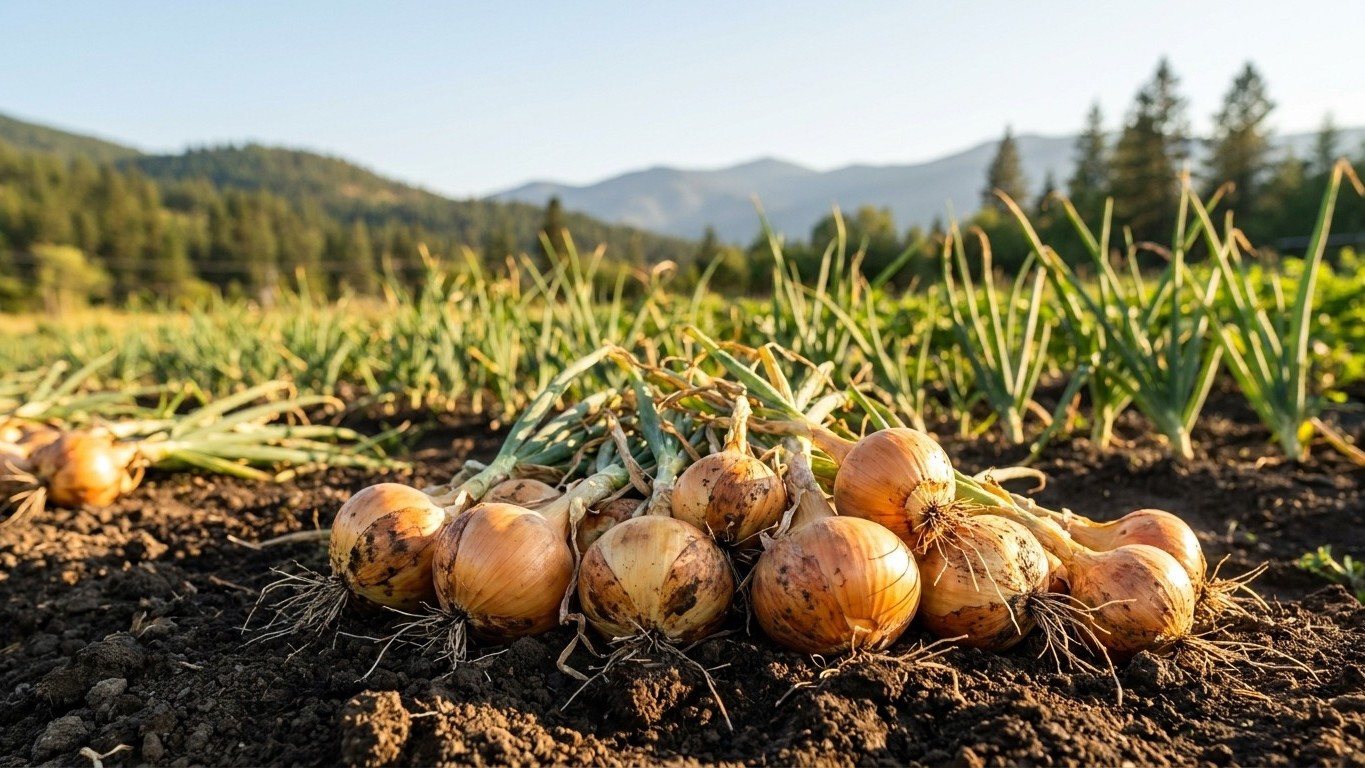

Lift onions when most of the tops have flopped over and the necks have gone soft, on a dry day. Then cure them. Spread the bulbs in a warm, shaded spot with good airflow until the necks are tight and the skins feel papery. Only cured bulbs go into storage. An onion that skips curing rots from the neck down long before winter is over.
Keeping them, and for how long
Clemson Cooperative Extension’s Home & Garden Information Center states the target this way: “Ideal conditions are between 45 °F and 55 °F, and 50 to 60 percent humidity.” If you write one line on a card and tape it where you store the crop, make it this: 45 °F to 55 °F, with 50 to 60 percent humidity. Onions want dry air. Carrots, beets and other roots want the opposite, which is why one cellar can’t hold both well. Set for the carrots, the onions sprout and go soft. Set for the onions, the carrots shrivel.
Curing comes before any of this. Bulbs go into storage only when the neck is tight, with no moisture left when you squeeze it, and the outer skins rustle. Fresh from the ground, an onion carries a wet neck that acts as an open door for rot. Curing seals that door. Humid or cool fall weather slows the process, so pull the bulbs under a roof, such as a porch, a barn aisle or a garage with the door open, if rain is in the forecast.
How long will cured onions keep?
Any duration you hear is a ceiling under ideal conditions. Pungent storage onions grown in a northern garden can feed a household into March, but only when the bulbs went in sound, the temperature held steady and the air stayed dry. A nicked bulb, a neck that never closed or a warm spell in the pantry shortens that. Sort hard at the start. Bulbs with thick, green necks, bruises or insect scarring go to the kitchen first. The pests described in What Eats Onion in South Dakota, and When often leave the kind of damage that invites rot.
Why does day length change how well onions keep?
Onions start making a bulb in response to day length. Sioux Falls sits at 43.59 degrees north and gets 15 h 15 of daylight on the longest day of the year. Clemson Cooperative Extension notes that short-day varieties begin bulbing at about 12 hours of daylight. That is early at this latitude, so they stop growing leaves sooner and finish small. Long-day varieties wait for 14 to 16 hours, a threshold Sioux Falls clears easily. A gardener in the far north of the state gets even longer days, and one in the far south gets slightly shorter ones, so check your own latitude if you live near either edge.
Day length lines up with keeping quality. Short-day types run sweeter, and long-day types keep longer. The bite of an onion comes from volatile sulfur compounds, and those same compounds protect the bulb in storage. A sweet variety carries fewer of them. University of Missouri Extension puts it flatly: “As a rule, ‘sweet’ onions do not store as well as the more pungent types.” Eat the sweet ones in the first weeks after harvest and save the sharp ones for winter. Don’t count on a sweet onion to last until spring. For picks that suit local day length, see The Best Onion Varieties for South Dakota, or start from the overview at Onions in South Dakota.
Where in the house that actually is
A 45 °F to 55 °F window with 50 to 60 percent humidity doesn’t match any standard room. The kitchen refrigerator runs colder than the bottom of that range, and its crisper drawers hold moisture. Onions kept there soften and pick up odors. A heated living space sits above 55 °F all winter, so bulbs in a pantry cabinet next to the stove or a closet in the main house sprout early and dry out. A garage is the worst of the common choices in this state. It can drift through the range in autumn, then drop well below freezing in winter. A frozen onion turns to mush when it thaws, and you often won’t notice until you cut into it.
The room that comes closest is usually a cool, unfinished part of the house. Think of a basement corner away from the furnace, an enclosed porch in a mild fall, or a spare room with the heat vent closed. Basements are often damp, though, and humidity above 60 percent invites mold on the skins. A basement that’s fine for potatoes and carrots may be too wet for onions. A corner near a dehumidifier or a window that vents dry air often works better than the middle of the floor.
Guessing is the usual mistake, and it is easy to avoid. Put a min/max thermometer and a small hygrometer in the spot for about a week before you move the crop in, and include a cold night in the test if you can. If you skip that check, you may lose much of the crop by midwinter to a spot that looked fine in autumn. The thermometer shows the swings your hand can’t feel, and the hygrometer tells you whether the air is dry enough.
Once you’ve found a spot, give the bulbs room. Mesh bags, slatted crates, open baskets and hung braids all let air move. Sealed plastic bins trap moisture. Keep layers shallow, and keep onions away from damp potatoes and from any produce that is going soft. Check the stored crop every few weeks and pull anything with a soft spot or a sprouting top, since one bad bulb can spread rot to its neighbors.
Common questions
How do I know it’s time to lift onions?
Watch the tops. When the leaves begin to yellow and fall over on their own, and the necks have gone soft and floppy, the bulbs have stopped growing. Wait until most of the row has fallen, then choose a dry day. Loosen the soil with a fork so you don’t nick the bulbs, and lift them rather than pulling. Don’t bend the tops over by hand to speed things up, because that can leave the neck thick and wet. Where the weather turns wet, it is better to lift a little early than to leave bulbs sitting in soggy soil.
How do I cure onions if the fall is rainy?
Move them under cover. A covered porch, a garage with the door open or a shed with a fan all work if the air is dry and moving. Spread the bulbs in a single layer on screens, slatted shelves or newspaper, with the tops still attached. Keep them out of direct sun, which can scald the skins. Cure until the neck is dry and tight and the outer skins feel like paper. Wet weather stretches the time it takes, so judge by those signs, not by a calendar.
Should I trim the tops and wash the bulbs before storing?
Don’t wash them. Water on the skins brings rot, and the skins protect the bulb. Once the neck is fully dry, trim the tops and brush off loose soil with a dry hand or soft brush. Roots can be trimmed close to the base. If you want to braid the crop, do it while the tops are still flexible, before they dry fully, and hang the braids in the cool, dry spot.
What should I do with onions that have thick necks?
Thick, green necks that stay moist after curing are slow to seal, so those bulbs are poor keepers. The same goes for any onion that sent up a flower stalk, because the center stays hollow and soft. Use these bulbs first, within a few weeks, and set them apart from the rest of the crop so any rot doesn’t spread. A bulb that has been sliced or bruised while lifting belongs in this group too.