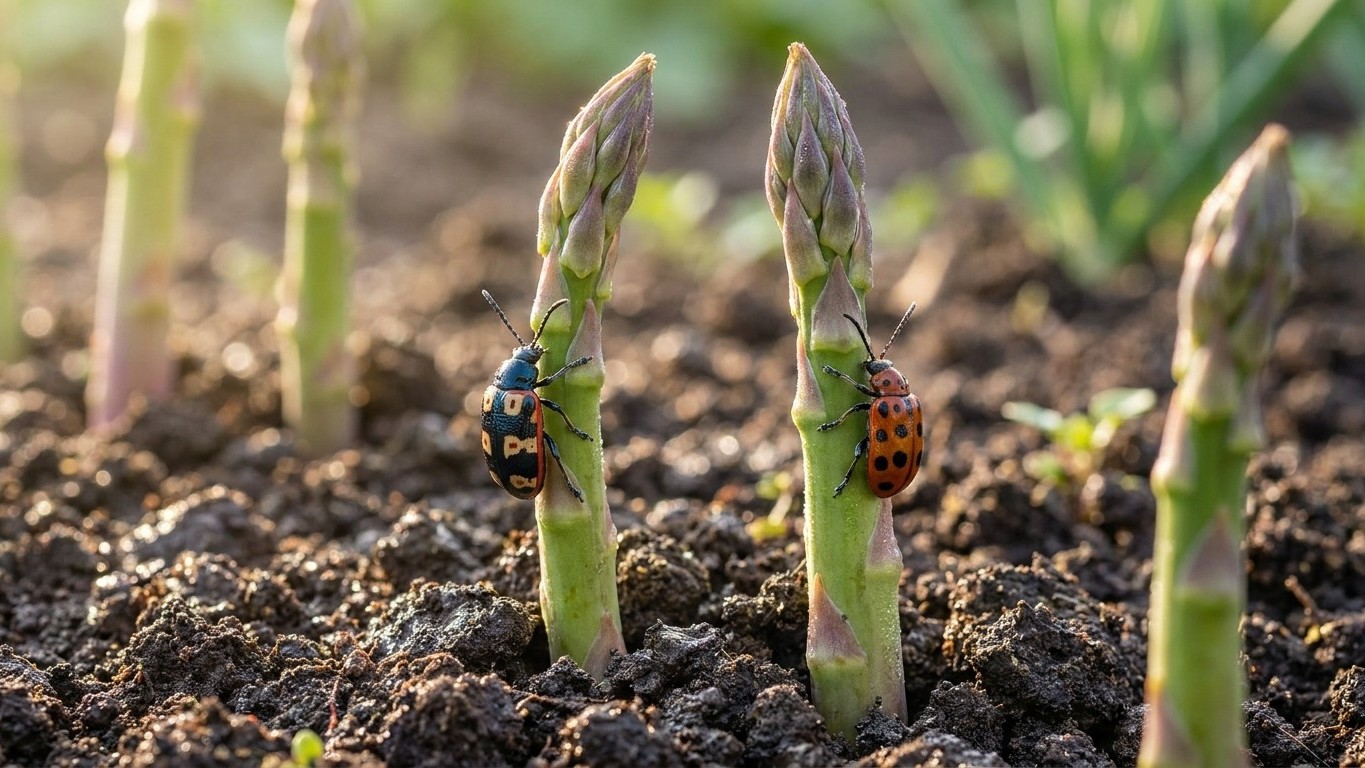

Insects that chew asparagus arrive in two waves: one on the spears in spring, another on the ferns through summer. Which species show up, and how early, changes from county to county. A late freeze, a dry July or a heavy soil can leave marks that look almost identical, so reading the damage correctly comes before reaching for any remedy.
Which pests attack asparagus in Nebraska
The service that names the insects feeding on asparagus in a given county is Nebraska Extension, working through its county offices. The most reliable way to read any pest list is by the part of the plant under attack: the spears in spring, the ferns from summer on, and the crowns underground over the years. Each part tells a different story, and each calls for a different response.
Which insects feed on asparagus?
On spears, feeding shows as scarred skin, gnawed tips or spears that bend and scab over. On ferns, it shows as stripped or chewed feathery growth, or a dull, scraped look on the stems. Below ground, a stand that thins year after year, with fewer and thinner spears each spring, points to trouble at the crown.
That last pattern matters more with asparagus than with almost any other garden crop. The crowns stay in the ground for 10 to 15 years, so a pest that settles in one season can be there the next. A tomato patch resets every spring. An asparagus bed does not.
Which insects can you rule out?
Any list of insects documented across a state includes many that have no business in an asparagus bed. Insects that specialize in corn or soybeans feed on those plants’ leaves and kernels. Borers and scale insects that live on orchard and shade trees need wood and bark. Pests of stored grain want a dry bin, not a living fern. A spear is a soft, fast-growing shoot, and the leaves that follow are fine needles. That is a very different meal from any of those, and a gardener who blames the neighbor’s cornfield for ragged ferns is probably looking in the wrong place.
When each one shows up, and what it does first
The calendar starts with the frost date. The reference station in Nebraska sees its last spring frost between April 12 and April 23. Suburban and rural gardens usually see it one to two weeks later, and more on higher ground. Spears break the soil in that early-spring window, and the first feeding damage follows them up.
What shows on the spears in spring?
The first sign is on the tips and the skin of the spear. Look for rough, scarred patches, nibbled edges or tips that look bitten off. Crowns planted this spring are in 8-inch furrows and are sending up their first thin shoots, so any damage to those shoots matters because the plant is still building its root reserves. If you are still deciding when to put crowns in, When to Plant Asparagus Crowns in Nebraska lays out the early-spring window.
What shows on the ferns in summer?
Once the spears open into ferns, the damage moves up. The first sign here is a change in texture rather than a hole: stems that look dusty, scraped or pale, and foliage that thins from the edges inward. Chewing damage follows if the feeding continues. Summer is when the ferns do the real work of feeding the crown, so every stripped branch costs next year’s spears.
Summer weather also muddies the picture. June brings 4.44 inches of rain at the reference station, August 4.6, and July only 3.55. That makes July the driest month, with about 12.6 inches across the whole summer. Days at or above 90°F speed up evaporation, and rain that falls in one thunderstorm mostly runs off. A fern that yellows in July may be thirsty, not infested. A rain gauge on your own plot settles what your garden actually received.
Late in the season, ferns yellow and die back on their own as the plant sends energy down to the crown. Browning that starts at the top of the fern after the nights turn cold is the plant closing down, not an attack.
Telling the damage apart from everything else
Most misdiagnosis in an asparagus bed comes from a handful of look-alikes. The table below pairs what you see with the usual causes and the sign that tells them apart. It does not tell you what is in your garden. It tells you what to look for before you ask someone who can examine a sample.
| What you see | Possible cause | What settles it |
|---|---|---|
| Soft, water-soaked spear tips across the whole bed at once | Frost after the spears are up | It follows a cold night, hits spears of every size together, and no insect is present |
| Ragged edges, scarring or missing tissue on a few plants | Insect feeding | Damage is uneven from plant to plant, and you may find the feeder or its droppings in the early morning |
| Yellowing ferns in a dry stretch | Water stress | Soil a few inches down is dry, and the ferns green up after a deep watering |
| Spots or lesions on ferns | A plant disease | Marks have defined edges and spread in a wet spell, and nothing is chewed |
| Snapped or bruised spears | Mechanical damage | Breaks are clean or crushed at the same height, often along a path or hoe line |
| Thin, spindly spears year after year | Weak crowns, which can come from wet ground or from harvesting too long | The whole bed thins together and the soil stays soggy after rain |
Drainage deserves a second look. The state soil, the Holdrege series, is well drained loam to silt, but a state spans hundreds of soil series, and river bottoms, hill country and ground scraped or filled by a builder behave very differently. Crowns sitting in ground that stays wet decline slowly and look like pest damage. Will Nebraska Soil Hold an Asparagus Bed for Fifteen Years? covers how to check your own spot.
When symptoms do not match the pattern you expect, cut a damaged spear or a fern tip and take it to the county Extension office rather than guessing. The office can identify what is on the sample, which a photo of a whole bed rarely allows.
What actually works here, and what is a waste of time
A physical barrier placed at the right moment does more than any treatment. A lightweight row cover laid over the bed before spears emerge keeps flying insects off the first shoots, and removing it once the ferns are up lets the plants grow normally. The timing matters more than the fabric. Lay it too late and the insects are already inside.
Clean beds help for the same reason. Old fern left standing through winter gives insects a place to wait, so cut it down once it has browned and clear it away. Early-morning checks work too. A gardener who walks the bed each morning in spring, when insects are still sluggish, and picks off what is chewing the spears will catch most problems before they spread.
Harvest discipline protects the crowns. Nothing is cut until year 3, and then the bed keeps producing for years. The cutting stops when most spears come up thinner than a pencil. Cutting longer to chase spears the insects have already marked only weakens the plant. Backfilling the furrow gradually over the first year also keeps the plants growing steadily rather than stalling under a heavy load of soil.
Several habits waste time. Spraying on a calendar schedule, before anyone has identified a pest, treats a problem that may not exist. Spraying for damage that is really frost, drought or a disease does nothing at all, and the real cause keeps working. Switching products when the first one seems not to work usually means the diagnosis was wrong in the first place. Whatever is approved in the state, and for which pest, is a question for the county Extension office, since only that office knows what is currently registered for use in Nebraska.
Where to check this for your own county
Nebraska Extension runs a county office across the state, and that is the place to bring an asparagus question. A county educator can look at a plant sample, tell you which insects are active locally this season and say what is currently approved for use in the state.
Pest presence varies inside a state, sometimes between neighboring counties. What is documented statewide describes the state as a whole and does not tell you what is in your own garden. The frost dates work the same way. The April 12 to April 23 window comes from a single reference station, so the timing of spear emergence, and of any damage that follows, shifts with your location. Soil shifts too: a sandy plot drains within a day, a heavy one holds water for days. The broader basics of the crop are covered in Growing Asparagus in Nebraska.
For the next step, cut a damaged spear or fern tip, seal it in a bag with any insect you find, note the date and which part of the bed it came from, and take it to your county office.
Common questions
Should I harvest in the first two years so insects do not get the spears?
No. Nothing is harvested until year 3. After that the bed keeps producing for years, and the crowns need every fern they can grow in the years before.
How do I know when to stop cutting each spring?
Stop when most of the spears are thinner than a pencil. That is a sign the crown is running low on reserves, and the ferns that follow will feed it for next year.
Does a wet summer mean fewer problems?
The reference station averages about 12.6 inches of rain over June, July and August, with July the driest month at 3.55 inches. What that does in your bed depends on your soil and on how hot the days run. A rain gauge on your plot shows what your bed actually receives.
How should I store spears once they are cut?
Aim for 32 to 35°F with near-saturated air, 95 to 100 percent humidity. Above 50°F the spears toughen quickly, and at 30.9°F or lower they suffer freezing injury and turn soft and water-soaked. In a home kitchen, standing the cut ends in a little water, or wrapping them damp, keeps them from losing moisture through the cut end.