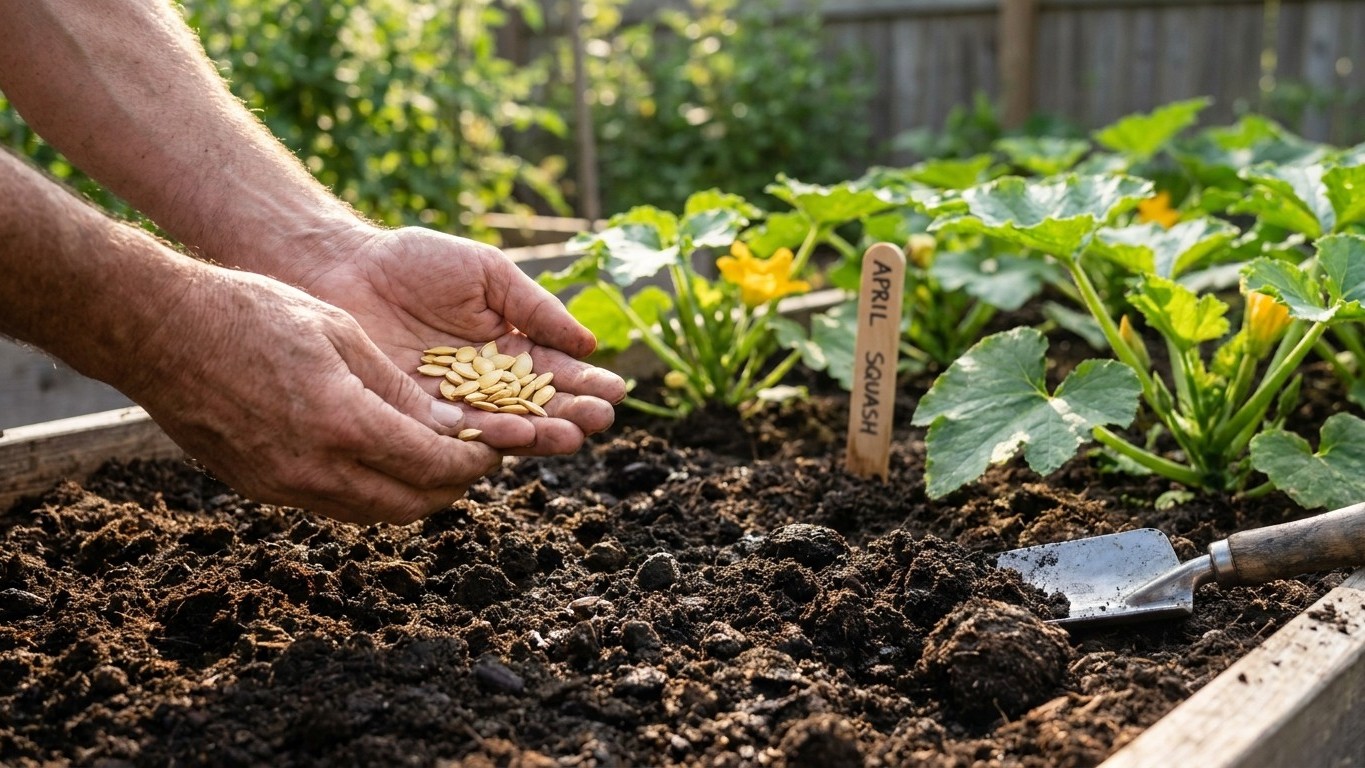

In South Dakota, direct-seed summer squash outdoors once the danger of frost has passed, using the window of April 29 to May 9 as your guide, and only after soil has warmed. That frost window is a probability, not a promise: it marks the 30-70% chance of a 32°F freeze at the reference station, not a guaranteed safe date for your own yard.
The short answer for South Dakota
Summer squash is a warm-season crop with zero frost tolerance, so the sowing decision in South Dakota hinges entirely on that spring frost window: April 29 to May 9 at station USW00014944, the NOAA reference point for these normals. That’s not “plant on May 9.” It means there’s still a real chance of a freeze into early May in a typical year, and squash seedlings that hit even a light frost turn to mush overnight.
The practical move is to treat May 9 as your target, not your gamble date, and to push a week later if you’re gardening outside town. Squash germinates poorly in cold soil anyway, so waiting rarely costs you much. Seeds sown when soil is still in the 50s (Fahrenheit) just sit there, sometimes rotting before they sprout, so an “early” planting often ends up slower than one two weeks behind it.
Working backward from the other end of the season sharpens this further. First fall frost at the same station lands between September 24 and October 4, which gives a working season of roughly 140 to 155 days between the two probability windows. Summer squash varieties typically need 45 to 60 days from seed to first harvest, so even a cautious mid-May sowing leaves a wide cushion before fall frost risk climbs. This is a crop with room to spare in South Dakota, unlike a slow-maturing winter squash that would be cutting it close.
That cushion is also why transplants aren’t necessary here the way they are for peppers or tomatoes in short-season states. Direct seeding after the frost window works fine and avoids the transplant shock that summer squash handles poorly, since its roots resent disturbance. If you want a slightly earlier start, starting seed indoors two to three weeks before your target date and transplanting tender seedlings out right around May 9 is a reasonable hedge, but it’s not required by the math of this state’s season length.
One more piece belongs in the short answer: heat. South Dakota’s reference station averages 13.8 days a year at 90°F or above, which is enough summer heat load to push squash through its growth cycle fast once it’s established, but also enough to stress young seedlings planted too early into cool, unsettled May weather. The frost date tells you when it’s safe to plant. The heat data tells you why waiting for genuinely warm soil, not just frost-free air, pays off.
What will not work here
Planting on the calendar date alone, ignoring soil temperature, is the most common failure here. April 29 is the early edge of the frost window, meaning roughly a 30% chance of a damaging freeze even after that date in a typical year. Seed or transplants going in that early aren’t just risking frost, they’re also going into soil that’s barely warmed, which stalls germination and invites seed rot regardless of whether a frost ever actually arrives.
At the other end of the calendar, waiting too long doesn’t fail because of season length, since South Dakota’s 140-plus frost-free days give summer squash plenty of room. It fails because gardeners assume a state with 27.9 inches of annual rain, mostly it seems well-watered, and then skip supplemental watering through July, the driest summer month at just 3.25 inches. Combine that with 13.8 days a year at 90°F or hotter, and a squash patch on a weekly watering schedule through a hot, dry July stretch will show it: blossom drop, misshapen fruit, and leaves that wilt hard by early afternoon even when the plant technically has enough soil moisture.
The moisture math that trips people up
June brings 4.23 inches on average, July drops to 3.25, and August recovers slightly to 3.34. That dip in the middle of the growing season is exactly when squash plants are sizing up and setting fruit, which is the worst time for a rainfall lull. A gardener relying on “normal South Dakota rain” without checking the calendar month by month is planning around June’s numbers while July actually shows up. On sandy soil, that July gap drains through in a day and needs active watering; on clay, the same rain lingers longer, but a single thunderstorm still tends to run off rather than soak in during a 90°F afternoon, so the rain gauge total can flatter the actual soil moisture.
The other thing that won’t work is treating this state’s hardiness zone label as a planting-date shortcut. USDA hardiness zones measure one thing only, average annual extreme minimum temperature, and say nothing about spring frost timing or summer heat load. A gardener who plants by “I’m in zone 4” instead of checking their local frost window is using the wrong tool for the job, since two spots in the same zone can still have frost dates weeks apart.
What changes across South Dakota
South Dakota spans USDA hardiness zones 3b through 5b, a spread wide enough that there is no single planting date that fits the whole state. That’s a difference of roughly two full zones, meaning winter extreme minimum temperatures vary by 20°F or more between the coldest and mildest corners of South Dakota. A zone gap that large almost always tracks with real differences in spring warm-up speed and growing-season length, even though the zone number itself doesn’t measure either of those things directly.
The frost dates used throughout this page come from a single reference station, and they’re a starting point, not a state-wide fact. Elevation, valley versus ridge position, and distance from the moderating effect of any river bottom all shift local frost timing, sometimes by a week or two in either direction. A garden that sits low and catches cold air draining downhill on clear spring nights will see frost linger later into May than the station data suggests, while a spot on a gentle rise nearby might clear out days earlier.
The practical shift for a reader in a colder pocket of the state, whether that’s due to zone, elevation, or just local topography, is straightforward: push the sowing window later than April 29 to May 9 rather than earlier, and don’t rely on the fall side of the calendar either, since a colder zone likely front-loads its first fall frost ahead of September 24. Someone gardening in a milder pocket has more flexibility on both ends but still shouldn’t assume the earliest edge of the window is safe, since even mild zones see frost variability year to year.
None of this replaces knowing your own zone and your own local frost history. This page can’t tell an individual reader which of zones 3b through 5b they’re gardening in, since that depends on exact location. The USDA’s interactive map is built for that lookup, and it’s the right next step before adjusting any date on this page.
Where to check this for your own county
This page gives South Dakota’s state-level numbers, drawn from one reference weather station. County-level guidance from South Dakota State University Extension will beat this every time, because it accounts for local frost patterns, soil types, and the specific varieties that have actually performed well in field trials across the state’s different growing regions. Find it at extension.sdstate.edu.
Once there, look for two specific things rather than browsing generally. First, a local or regional planting calendar for vegetables, which will translate the frost-probability window used here into a more location-specific recommended date, often broken down by the state’s distinct growing regions rather than a single statewide figure. Second, look for variety trial results or recommended cultivar lists for summer squash specifically, since SDSU Extension and similar land-grant programs regularly test which zucchini, yellow squash, and pattypan varieties handle the state’s heat and short shoulder seasons best in actual field conditions, not just seed-catalog descriptions.
Extension offices also typically field direct questions from local gardeners about frost timing that year, soil temperature readings, and pest pressure specific to a county, information that never makes it onto a general planting-calendar page like this one. If SDSU Extension’s published calendar gives a date range that differs from the April 29 to May 9 window cited here, trust the extension figure for planning purposes. It’s built from more localized data and, in most cases, a longer or more geographically distributed set of observations than a single airport weather station can offer.
Checking this against your own garden
Every date in this article is a regional average pulled from decades of weather-station records. Your own garden, on any given spring, might run a week ahead of it or a week behind, and there’s no substitute for checking the ground itself before you commit seed to it.
Soil warmth by feel is the first check. Push a finger a couple of inches into the bed in the morning: if it still feels cold and damp rather than just cool, the soil hasn’t warmed enough for squash seed to germinate reliably, regardless of what the calendar says. Waiting a few more days, even after the frost date has technically passed, usually pays off in faster, more even germination.
The second signal comes once plants are up and growing: watch for the first flush of male flowers, which typically appear before the female flowers that actually set fruit. Seeing male blooms tells you the plant has moved past its establishment phase and is heading into reproductive growth, a useful check on whether your particular bed’s microclimate, sun exposure, and soil are keeping pace with a typical season or lagging behind it.
Third, look at the first true leaves, the ones that emerge after the initial rounded seed leaves and actually look like squash foliage. Their size and color say a lot: small, pale, or slow-to-appear true leaves often point to soil that’s still too cool or nitrogen that hasn’t become available yet, both of which matter more in a state with the kind of variable spring warm-up South Dakota sees. A vigorous, deep-green set of true leaves within a couple of weeks of sprouting is the best sign that your particular patch of ground is running on schedule with the region’s normals, or even ahead of them.