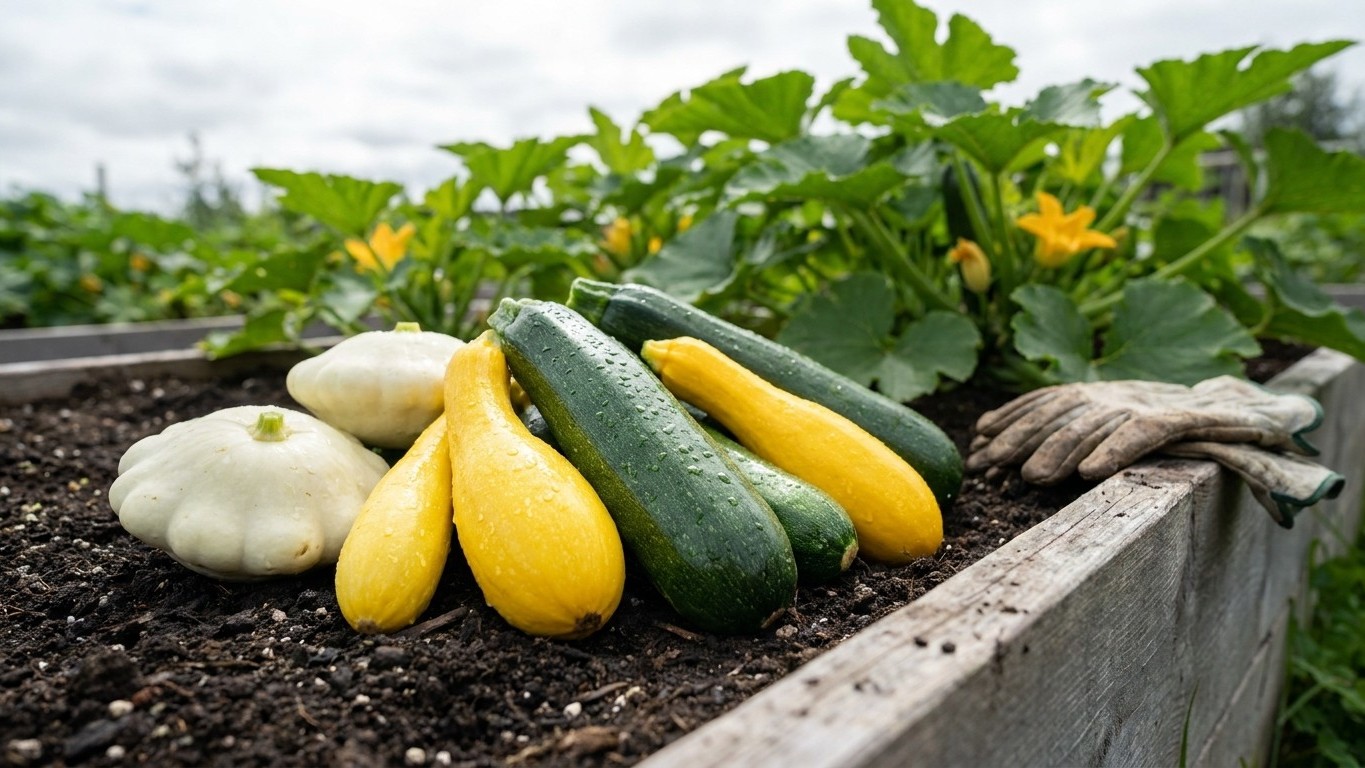

Bush-type zucchini and yellow crookneck varieties bred for powdery mildew resistance are the safest bet across South Dakota. The state’s frost-free window is long enough for almost any Summer Squash to mature, so the real filter here is disease pressure from summer rain patterns and heat load, not days-to-maturity.
The short answer for South Dakota
At the reference weather station used for South Dakota’s climate normals, the frost-free window runs from a last spring frost of April 29 to May 9, out to a first fall frost of September 24 to October 4. Depending on where those dates land in a given year, that’s somewhere between 138 and 158 frost-free days. Nearly every summer squash type, from 45-day zucchini to 60-day pattypan, fits inside that window with room to spare. That changes the whole calculus: this isn’t a territory where you pick varieties to beat the clock.
Instead, the deciding factors are heat and moisture. The reference station averages 13.8 days a year at or above 90F, which is real but moderate heat load, enough to stress plants during dry stretches but not enough to demand heat-specialist varieties the way a desert Southwest garden would. Summer rainfall averages about 10.8 inches across June, July and August, with June the wettest at 4.23 inches and July the driest at 3.25 inches. That combination, warm days and rain that often arrives in bursts rather than steady soaking, is the classic recipe for powdery mildew on squash leaves later in the season.
So the decision by type looks like this: favor compact bush habits over sprawling vines, since bush plants dry faster after rain and hold less standing moisture in a dense canopy. Favor varieties marketed with powdery mildew tolerance, since that’s the disease most likely to cut a South Dakota squash patch short in August, not frost or a lack of season length. Zucchini and yellow summer squash (both crookneck and straightneck) in modern disease-resistant strains are the reliable workhorses. Pattypan and other scallop types work too, but check for the same resistance traits before buying seed, since older heirloom pattypan lines tend to be more mildew-prone.
Because the window is generous, a second, later planting of a fast bush variety in June is a realistic option for gardeners who lose an early crop to squash bugs or vine borers, or who simply want a fresh flush of fruit before the first fall frost arrives.
What will not work here
Long-vine, sprawling summer squash types built for a longer, drier season are the first thing to skip. They take up garden space without buying a South Dakota gardener anything, since the frost-free window already covers fast bush varieties comfortably. What sprawling vines do add is a denser, damper canopy right when June’s 4.23 inches of average rain is falling, which sets up powdery mildew before the plants have even set much fruit.
Weekly watering schedules are the second common failure. July, the peak fruiting month for most summer squash, is also the driest summer month on average at 3.25 inches, and it lands during the stretch when the reference station’s 13.8 annual days above 90F are most concentrated. A single weekly soak doesn’t account for how much of that rain arrives as a hard thunderstorm that runs off a compacted bed rather than soaking to root depth. On sandy soils especially, a week without supplemental water during a hot, dry July is often enough to stall fruit set or trigger blossom drop.
Tight spacing is the third mismatch. Summer squash packed close together traps humidity inside the leaf canopy after rain, and with June and August both averaging over 3.3 inches of rain, that damp microclimate under the leaves doesn’t dry out quickly. That’s exactly the condition powdery mildew needs to spread from one plant to the next. Wider spacing than the seed packet’s minimum, plus pruning a few of the oldest leaves once plants are established, does more to protect a South Dakota squash patch than any fungicide schedule.
Finally, gardeners who plant based purely on the reference station’s dates and skip a fall-frost buffer risk losing a late second planting. A variety that needs 60 days to first harvest, seeded in early August, is cutting it close against a first fall frost that could arrive as early as September 24 rather than October 4.
What changes across South Dakota
South Dakota’s USDA Plant Hardiness Zones span 3b to 5b, a spread built on average annual extreme minimum winter temperature. That’s roughly a 20-degree difference in how cold it gets in a typical winter between the coldest corner of the state and the warmest, and it’s a rough proxy for how much the growing season itself shifts from place to place. There is no single answer for “when does the frost-free window open” across a range that wide; the reference station’s April 29 to May 9 last-frost figures describe one location, not the whole state.
Gardeners in the colder end of that range, typically at higher elevation or farther north and west, should expect a later last spring frost and an earlier first fall frost than the reference station shows, sometimes by one to two weeks on each end. That shortens the usable window meaningfully. For those gardens, the case for fast bush varieties gets stronger, and starting squash as transplants indoors two to three weeks before the expected last frost, rather than direct-seeding, buys back some of that lost time.
Gardeners closer to the warmer end of the state’s zone range, generally in the southeast river valleys nearer the reference station itself, can plan closer to the published dates and have more room for a slower-maturing variety or a later second planting without racing the fall frost.
None of this tells an individual gardener which zone they’re actually in. The USDA Plant Hardiness Zone Map lets anyone look up their specific location, and that’s the right next step before locking in a planting plan built on state-wide figures.
Where to check this for your own county
South Dakota State University Extension, at extension.sdstate.edu, is the state’s land-grant extension service, and it’s the source that can narrow any of this down to an actual county rather than a single airport weather station. A state-wide page like this one is useful for understanding the general pattern, heat load, rainfall timing, and the fact that hardiness zones vary by 3b to 5b across South Dakota’s borders, but it can’t tell a gardener in Rapid City the same thing it would tell one in Sioux Falls or Aberdeen.
Two things are worth looking for specifically once there. First, a county or regional planting calendar, if SDSU Extension publishes one for the area in question, since that will reflect local frost data rather than the single reference station cited in state-wide climate normals. Second, any variety trial results for summer squash conducted through SDSU’s horticulture or master gardener programs. Land-grant extension services routinely trial vegetable varieties under local soil and climate conditions specifically to answer the question this page can only answer in general terms: which zucchini, crookneck or pattypan varieties actually held up against powdery mildew and produced well in that particular county’s summers.
A county-level recommendation will always beat a state-level one, because it accounts for local soil type, microclimate and the exact disease pressure a given area sees in a typical year. This page describes South Dakota broadly. An SDSU Extension county office or its published trial data describes one piece of it precisely, and that’s the level of detail that should settle any final variety decision.
Checking this against your own garden
Every date and average on this page is a starting point, not a guarantee, and a gardener’s own observations in their own bed will always outrank them. Three signs are worth tracking as summer squash season gets underway.
Soil warmth by feel is the first. Summer squash seed germinates poorly in cold soil, so pressing a bare hand into the top couple inches of bed before direct-seeding tells more than a calendar date does. Soil that still feels cool and damp, even after the reference station’s last-frost window has passed, means that particular bed is running behind the regional average, likely due to shade, heavy clay, or a low spot that holds moisture and cold longer.
The first flush of male flowers is the second signal. Squash plants typically produce male flowers before females, and a strong early flush means the plant has settled in and started reproductive growth. If male flowers show up but no female flowers with a tiny swollen squash behind the petals follow within a week or two, something (often heat stress or inconsistent watering) is interrupting fruit set.
First true leaves, the second set that emerges after the rounded seed leaves, mark the point where a seedling has moved from living off stored seed energy to actually photosynthesizing on its own. Slow or pale true-leaf growth after a normal germination points toward a nutrient or watering issue worth catching early, before it costs a chunk of the harvest window.