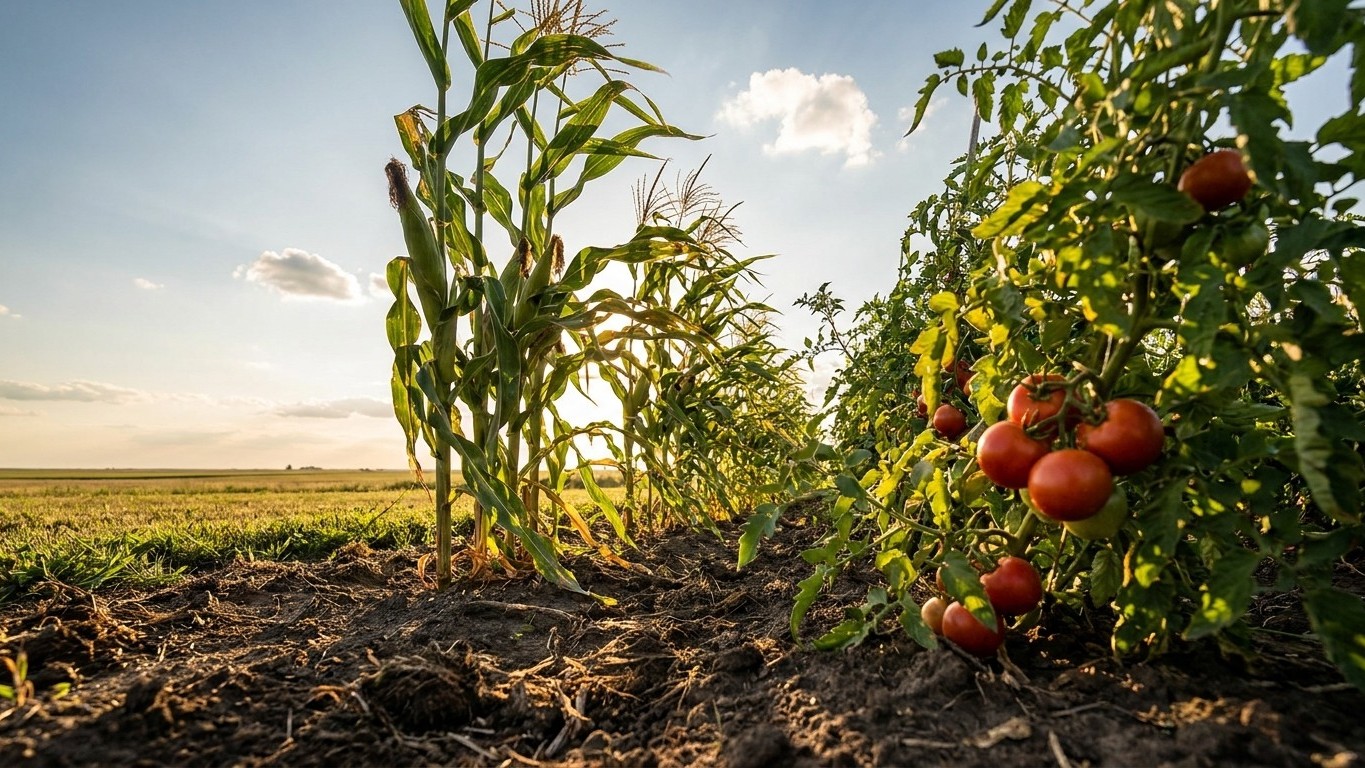

The planting date moves the calendar by weeks, so the day on a seed packet is a guess. The silk count is a measurement. Timing matters twice with this crop. Ears left on the stalk too long turn starchy, and ears left on the kitchen counter lose sugar by the day.
When sweet corn are ready in South Dakota
Look for three signs together: silks dried brown, husk still green and moist, and milky juice when a thumbnail punctures a kernel. Count the days from planting, which puts most first ears later in the season, depending on when the soil allowed planting. One sign alone misleads. Brown silks on a dry husk can mean the ear is past its prime, and clear juice means it is early.
The reference city for these dates is Sioux Falls. NOAA’s climate normals put the last spring frost there between April 29 and May 9 and the first fall frost between September 24 and October 4. Those numbers come from the airport station. Suburban and rural gardens usually see the last spring frost later and the first fall frost earlier, often by one to two weeks, and more at higher elevation. Your county extension office can tell you how far your ground sits from the airport.
What decides the planting date?
Soil temperature does, and the last frost date does not. Utah State University Extension says sweet corn needs soil above 60 F. That warmth arrives well after the last frost, sometimes by weeks, and a sunny April afternoon does not change it. Clemson Extension adds the depth that makes the reading useful: “Do not plant before the soil temperature at the 4-inch depth is at least 50 ºF. Wait to plant extra-sweet varieties until soil temperatures reach 65 °F.” A surface reading runs warmer than the seed zone and will send you out too early.
The two thresholds are not interchangeable. Ordinary sweet corn can go in at the lower number, but extra-sweet (sh2) seed sown into 50 F soil tends to rot. That is why a gardener can succeed one year and fail the next after switching varieties. The full planting logic is in When to Sow Sweet Corn in South Dakota.
Does the season leave room for the crop?
Utah State puts sweet corn at 60 to 90 days from planting. This clock answers a different question from the silk count. It tells you whether the crop fits the season, while the silk count tells you which week to pick. Corn planted in late May with a 90-day variety would be pushing toward the first fall frost range of September 24 to October 4. A garden that frosts earlier than the airport has even less room. If you want a late variety, count forward from your realistic planting date and compare it with your county’s first fall frost.
Sweetness has its own timing rule. Utah State says sweetness is lost if su, se and sh2 types tassel at the same time. The source gives no distance for this. The condition is simultaneous tassels, so staggering plantings or growing a single type solves it. Plant in blocks of three or more rows, because a single long row pollinates poorly. Ripe ears also draw raccoons, birds and worms, and What Eats Corn in South Dakota, and When covers what to expect. For the whole season from seed to table, see Growing Sweet Corn in South Dakota.
Keeping them, and for how long
The old advice to run from the garden to the pot has a mechanism behind it. Clemson Cooperative Extension states it plainly: “Sweet corn loses sugar from the kernel rapidly at high temperatures… Sweet corn can be stored under optimal conditions for about five days, but will lose sweetness with each day of storage.” Sugar leaves the kernel, and heat speeds the loss. A hot afternoon in the garden costs sweetness before the ear ever reaches the kitchen.
How long does picked sweet corn last?
Treat about five days as a ceiling. It describes optimal conditions, and a typical kitchen is not optimal. Clemson also says sweetness fades with each day of storage, so day one is better than day three, and day three is better than day five. An ear stored for the full five days is still edible, but it is not the corn you picked. The practical rule is to pick as close to eating as you can and to cool ears quickly if they come in warm.
Cold slows the sugar loss, and moisture keeps the husk and kernels from drying out. Leave the husks on until cooking, because they protect the kernels. A loose bag around the ears holds humidity without sealing in condensation. Ears piled in a warm bucket or a hot car trunk are on the wrong side of the heat warning, even for an hour.
Does the type of corn change how long it lasts?
It does, and this is the practical reason to choose one type over another. The su type loses sugar fastest. The se type holds its sugar longer, and sh2 holds it longest. A household that cannot eat everything in a day or two will do better with se or sh2. The su type suits the person who walks from the patch to a pot of boiling water, and sweetness for that person is excellent.
The type also changes planting. Extra-sweet sh2 seed waits for 65 F soil at the 4-inch depth, which means a later start. The gain is a slower fade after picking, so the later planting often pays for itself. Remember the tassel rule from the first section: the types should not tassel together, so check that the sh2 planting does not overlap with su or se plantings nearby.
Where in the house that actually is
The refrigerator comes closest. It is cold and fairly steady, and a crisper drawer holds humidity. A heated room fails because of the heat warning above, and a kitchen counter in late summer is the worst version of that. The garage looks cool but swings with the weather. Sioux Falls averages 13.8 days a year at 90 F or more, and a garage can run hotter than the outdoor air on those afternoons, especially with a sun-facing door. A basement is cooler than the living space and steadier than a garage, but it rarely matches a fridge.
Corn is not a delicate crop on cold, so the fridge is the right place. The tradeoff is space. Ears are long and the crisper drawer is small, so bend a bag around them rather than cutting off the stalk end, which opens the cut surface to drying. If an ear sits against the back wall and shows frost, move it forward.
Fridges vary more than people expect. A crowded shelf blocks airflow, and the top shelf and the door run warmer than the bottom. Put a thermometer where the corn will sit and read it the next morning, before the first big picking. If the reading is close to room temperature, the corn is losing sugar as if it were on the counter, and that costs you more than a short walk to a colder shelf. The thermometer takes a day to check and removes the guesswork.
Common questions
How do I know when sweet corn is ripe?
Use three signs together. The silks should be dry and brown, the husk should still be moist and green, and a punctured kernel should release milky juice. Silks alone can dry early in hot weather, and juice alone can mislead on a stalk with uneven ears. Watching the silks tells you which week to start checking.
Can I plant sweet corn right after the last frost?
Usually not. Soil at 60 F comes well after the last frost, and the seed needs the soil warmth, not the frost date. Clemson Extension says not to plant before the soil at the 4-inch depth is at least 50 ºF, and to wait until 65 °F for extra-sweet varieties. Use a soil thermometer at that depth rather than a calendar date.
Will different sweet corn types ruin each other?
They can, and timing is the issue. Utah State University Extension says sweetness is lost if su, se and sh2 types tassel at the same time. Growing one type, or staggering plantings so the tassels do not overlap, avoids it. Plant in blocks of three or more rows so the pollination is thorough.
Does a late variety fit the South Dakota season?
It may, but check. A variety needing 60 to 90 days from planting has to finish before your first fall frost. At the Sioux Falls reference station that frost falls between September 24 and October 4, and rural gardens often see it one to two weeks earlier. Count forward from a realistic planting date, then confirm your county’s frost range with the extension office before committing to a long-season type.