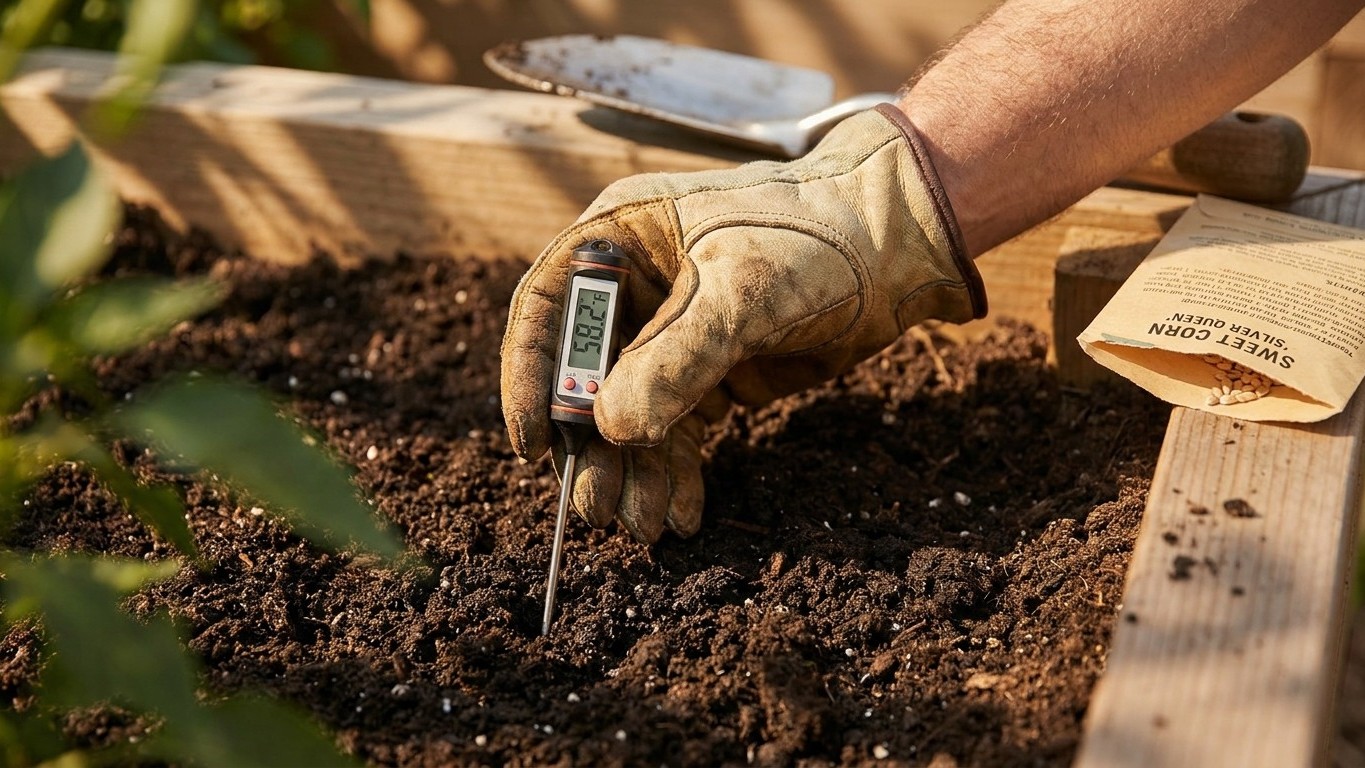

Sweet corn goes into South Dakota soil once the ground itself, not the calendar, hits 60°F, and that point arrives well after the last spring frost. Local frost typically clears between April 29 and May 9, but soil needs extra weeks to catch up. Once it does, the standard 60 to 90 day maturity window still lands comfortably before the first fall frost, which arrives between September 24 and October 4.
The short answer
Soil warmth lags behind air warmth by design. Frost leaving the ground on a given morning tells you nothing about whether that same ground can support corn germination. The seed needs the soil itself, not just the surface, to hold steady at 60°F, and that threshold shows up later than the frost-free date at station USW00014944, where last spring frost falls between April 29 and May 9. In practice, that gap pushes sweet corn planting toward the back half of May for most South Dakota gardens, sometimes later if a cool, wet spring keeps the ground sluggish. There’s no substitute here for checking the dirt directly rather than trusting the frost date alone.
The next question is whether the season still has room once planting slides that late. First fall frost at the same reference station runs September 24 to October 4. Count forward from a late-May or even early-June planting, and a 60 to 90 day crop lands in early August through mid-September, weeks ahead of the earliest frost date on record. Even a slow spring that delays planting into the first days of June still leaves enough runway for the full 90-day stretch to finish before the ground cools again.
Summer heat matters here too, not just its arrival date but its intensity. The Sioux Falls reference station averages 13.8 days a year at 90°F or above, a fair measure of how much heat load the season actually delivers once the corn is up. That heat drives germination forward faster once soil crosses 60°F, and it raises water demand through the growing months, so a warm start doesn’t mean the watering can gets set aside. Gardens in valleys or shaded low spots often lag several days to a week behind open, sun-exposed plots on soil warming, which shifts the whole planting window later still.
None of this changes with a soil thermometer sitting unused in a drawer. The only reliable way to catch the 60°F mark is to check planting-depth soil temperature directly for several consecutive mornings rather than count days from the last frost and hope.
Does a late variety fit here?
A 60-day variety
A short-season type has the easiest run in this state. Planted anytime from mid-May through early June, once soil holds at 60°F, it matures by mid-July to early August at the latest, leaving a wide cushion before the September 24 to October 4 frost window. That margin is generous enough that a second, staggered planting three or four weeks after the first is realistic in most years, stretching the harvest rather than compressing it into one narrow stretch. Cool, late springs barely dent this math since even a June planting still finishes well clear of frost.
A 90-day variety
A full-season type is a tighter fit, though it does fit under the reference station’s numbers. Planted by late May to early June, a 90-day crop matures roughly late August to mid-September, which sits ahead of the earliest recorded frost date of September 24 by around three weeks. That’s real margin, but it isn’t the kind of margin a 60-day crop carries. Delay planting because of a slow spring, or garden in a spot that runs cooler than the airport station used for these figures, and that buffer shrinks fast. Rural, low-lying, or higher-elevation gardens often see frost arrive one to two weeks earlier than the reference dates, which could push first frost close to September 10 to September 17 in those settings. Against that earlier timeline, a 90-day variety planted late has little room left, and in a cool or delayed year it may not reliably finish before the ground cools. The source behind these maturity figures names no specific variety, so treat the printed days-to-maturity on any seed packet as the real number to count from, and plant as soon as soil is reliably at 60°F rather than pushing the date back.
What goes wrong here
- Soil sown too cold. Seed planted the week frost clears, before the ground itself has caught up to 60°F, tends to rot or germinate unevenly, leaving gaps in the row. The fix is patience paired with a thermometer: check soil at planting depth on several consecutive mornings and wait for a steady 60°F reading rather than acting on the frost date alone.
- A variety too late for the season. Choosing a full 90-day type and then delaying planting past early June, whether from a cool spring or simple scheduling, leaves too little runway before frost, especially in rural or low-lying gardens where frost tends to arrive earlier than the reference dates suggest. The fix is matching maturity length to the actual local window rather than the printed regional frost range, and planting the moment soil hits 60°F instead of waiting.
- Sweetness lost to timing, not weather. Su, se, and sh2 types cross when they tassel at the same time, and the result is starchy, tough kernels instead of the sweetness the variety was bred for. This one has nothing to do with soil or frost. The fix is staggering plantings of different types so their tasseling windows don’t overlap, and keeping each type planted in blocks of three or more rows rather than single rows, which also improves pollination within that type.
Common questions
Can I plant sweet corn right after the last frost in South Dakota?
Not reliably. The last frost date at the reference station falls between April 29 and May 9, but soil generally needs additional weeks beyond that to hold steady at the 60°F sweet corn requires. Planting on the frost date alone usually means cold, slow, or rotted seed.
How do I check if my soil has actually reached 60°F?
Measure directly at planting depth, roughly two inches down, on several consecutive mornings rather than relying on air temperature or the calendar. A single warm afternoon doesn’t mean the soil underneath has caught up.
Will a 90-day sweet corn variety mature before the first fall frost here?
Usually, if planted by late May to early June against the reference station’s September 24 to October 4 frost window, leaving roughly three weeks of buffer. That buffer narrows considerably in rural or low-lying gardens, where frost often lands one to two weeks earlier than the reference dates.
Why did my sweet corn taste starchy instead of sweet this year?
Most likely because two different types, such as an su and an sh2, tasseled at the same time nearby. Sweetness in corn is decided by what pollinates it, not by the weather that season. Stagger plantings of different types so their tasseling doesn’t overlap.