
Yes, insulation matters here, but it’s only half the story. Tennessee runs an average of 40 days a year at 90°F or hotter at the Nashville reference station, and the state splits across two federal climate zones. That combination means insulation pulls double duty in this state: it holds heat out of a house baked by a summer sun and holds heat in during winters that still bite in the mountains and the highlands.
The short answer for Tennessee

Forty days above 90°F is not a Deep South number, but it’s not a footnote either. It’s enough heat load to matter for cooling bills, for attic temperatures, and for how hard an air conditioner works from June through September. Compare that to a coastal Gulf state pushing past 90 or 100 such days, and Tennessee looks moderate. Compare it to a northern New England state where 90°F days barely register, and Tennessee looks like a genuinely hot-summer state.
The climate-zone split backs that up. Under the 2021 IECC, 61 of the state’s 95 counties sit in zone 4A, and 34 sit in zone 3A. Zone 3A is a warm-humid zone, the same designation used across much of the Deep South. Zone 4A is a mixed-humid zone, warmer than the northern states but cooler on average than the true Southern band. That’s not a small distinction: it means a big chunk of Tennessee, roughly a third of its counties by count, carries the same warm-humid label as Mississippi or Alabama, while the majority sits one notch cooler.
What that means for a homeowner is straightforward. Insulation here is not a one-season purchase. In the 3A counties, cooling load is a serious part of the year’s energy picture. In the 4A counties, heating still claims a meaningful share, especially at higher elevations in the eastern part of the state. Either way, the same insulation upgrade helps with both problems, which is the point of the next section.
One caution worth repeating: a county count is not a population count. Nashville, Memphis, Knoxville and Chattanooga are spread across both zones, and this page can’t tell an individual reader which zone their own county falls into. The ENERGY STAR zone map and the county table in the 2021 IECC are the places to check that detail before buying material.
What happens above the ceiling
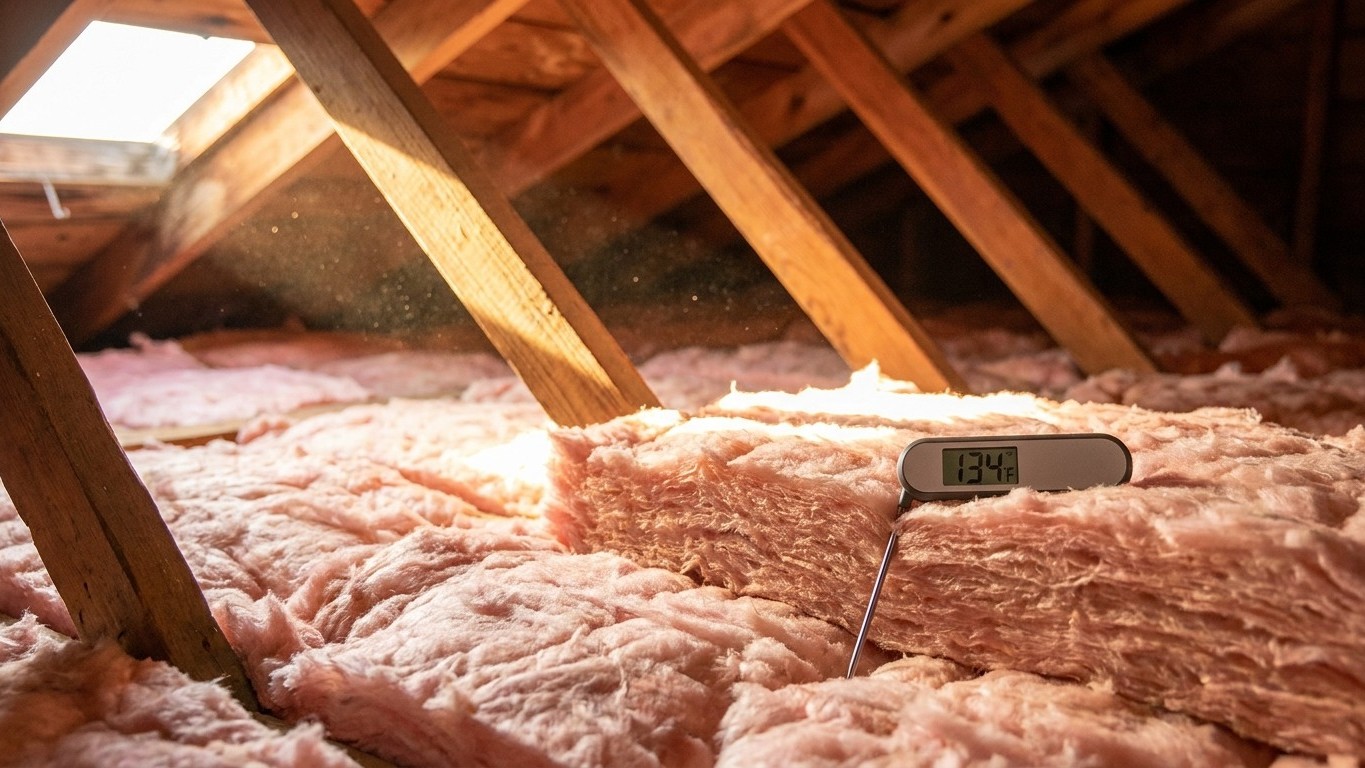
A roof deck under a Tennessee summer sun doesn’t just get warm, it gets hot enough to turn the attic into the hottest space in the house, often 30 to 50 degrees above the outdoor air temperature on a clear afternoon. That heat doesn’t stay put. It radiates and conducts downward through the ceiling, into any ductwork routed through the attic, and into whatever’s stored up there. A thin or gappy layer of attic insulation lets more of that heat through into the living space below, which means the air conditioner runs longer to make up the difference.
The useful thing to understand is that this is the exact same physical mechanism insulation fights in January, just running in reverse. Insulation resists heat flow. It doesn’t care which direction the heat is trying to move. In winter, warm indoor air tries to escape upward and outward; insulation slows it down. In a Tennessee July, the flow reverses: a superheated attic tries to push heat downward into the house, and the same fiberglass, cellulose, or foam batt slows that down too. There’s no such thing as “winter insulation” versus “summer insulation.” It’s one product doing one job in both directions.
ENERGY STAR publishes retrofit target levels for existing wood-framed homes by climate zone, and the table below shows the two zones relevant to Tennessee’s counties. The source table has a merged header: two of the three numbers cover the attic, split between an uninsulated attic and one that already has 3 to 4 inches in place, and the third number is for the floor, not a third attic figure.
| Zone | Attic (uninsulated) | Attic (already has 3-4 in.) | Floor |
|---|---|---|---|
| Zone 3 | R49 | R38 | R19 |
| Zones 4A and 4B | R60 | R49 | R19 |
These are retrofit recommendations for existing homes, not requirements written for new construction. And they cover two of Tennessee’s zones, not all zones nationally. A reader in a zone 3A county and a reader in a zone 4A county are working from different rows of that table, which is exactly why checking the county-level map matters before buying insulation by the roll or the bag.
What homes in Tennessee cool with
Ninety-three percent of Tennessee households report using some form of air-conditioning equipment, and 86 percent of households use a central air-conditioning system specifically, according to the U.S. Energy Information Administration’s 2020 Residential Energy Consumption Survey. Another 16 percent report using an individual unit, a category that covers ductless mini-splits, window units, wall units, and portables. Those percentages describe households surveyed, not the total housing stock, and they can overlap since some homes run both a central system and a supplemental window unit in a converted room or addition.
Eighty-one percent of households also report using ceiling fans, which matters more than it sounds. A fan doesn’t cool a room’s air, but it lowers the perceived temperature enough that a lot of Tennessee households likely nudge their thermostat up a degree or two rather than fight the heat with air conditioning alone.
The connection to insulation depends entirely on how the cooling gets delivered. In the 86 percent of homes running central air, the ductwork very often runs through the attic, the same space that turns into an oven on a 90°F afternoon. Ceiling insulation slows heat moving into the living space below, but it does nothing to protect ducts sitting exposed in that same superheated attic air. Leaky, uninsulated ducts up there can lose a meaningful share of cooled air before it ever reaches a vent, which is a separate repair from anything discussed on this page. For homes relying on individual units instead, a window unit or mini-split, the calculation shifts. There’s no attic duct run to worry about; what matters is the envelope of the specific room or zone that unit serves, including how well that room holds onto cooled air around the unit itself and through its walls and windows.
Anyone dealing with attic ductwork specifically should look at a duct insulation and sealing guide, and anyone relying on a window unit or mini-split should check a room air conditioner guide, since both are separate jobs from what’s covered here.
What the heat asks for that the cold does not
Two additions belong specifically to hot-climate houses, and neither one is standard insulation.
A radiant barrier is a reflective material, usually a foil-faced product installed under the roof deck or draped over attic insulation, and it works by reflecting radiant heat rather than resisting conducted heat the way fiberglass or cellulose does. It carries no R-value because it isn’t insulation in the traditional sense. It earns its keep only under a sun-loaded roof deck, which describes a real chunk of Tennessee’s summer, particularly in the 3A counties and anywhere a roof bakes through a long August afternoon. For a state averaging 40 days above 90°F, a radiant barrier is a legitimate consideration, especially in an attic where ductwork already runs through that heat. It would be a different answer entirely in a state where 90°F days barely happen; there, a radiant barrier wouldn’t have enough sun-loaded heat to reflect in the first place.
The second hot-climate detail is about which direction moisture moves. In winter, water vapor pushes from the warm indoor air toward the cold outdoors, which is why cold-climate codes call for an interior vapor retarder. In a warm, humid summer, that flow reverses: the damp air sits outside, trying to push inward. That’s precisely why the model energy code doesn’t require an interior vapor retarder in its warmest zones, including zone 3A, where 34 of Tennessee’s counties sit. Getting this wrong, installing the wrong barrier in the wrong place, can trap moisture instead of blocking it. That’s a decision specific enough to deserve its own explanation; a Tennessee vapor barrier guide covers where a retarder helps and where it doesn’t.
What the work is worth
ENERGY STAR states that “EPA estimates that homeowners can save an average of 15% on heating and cooling costs (or an average of 11% on total energy costs) by air sealing their homes and adding insulation in attics, floors over crawl spaces, and accessible basement rim joists.” Both numbers matter together: 15 percent applies specifically to heating and cooling costs, while 11 percent applies to total energy costs, a broader category that includes water heating, lighting, and appliances.
The reason that figure fits this page so well is right there in the wording: it covers heating and cooling together, not a winter saving that happens to carry over into summer as an afterthought. For a state that splits between zones 3A and 4A, and averages 40 days above 90°F a year, that combined framing matches how Tennessee homes actually use energy across the calendar.
A few limits are worth keeping in mind. These are averages drawn from energy modeling of a “typical” existing U.S. home, not a guarantee for any specific house, and actual results depend heavily on what’s already installed, how leaky the house is to begin with, and local energy rates. The estimate also names exactly where the modeled work happened: attics, floors over crawl spaces, and accessible basement rim joists. It doesn’t extend to wall insulation, new windows, or new doors, even though those upgrades can matter too. And there’s no federal tax credit tied to this work anymore; the residential energy efficiency credit that covered insulation projects closed at the end of 2025.