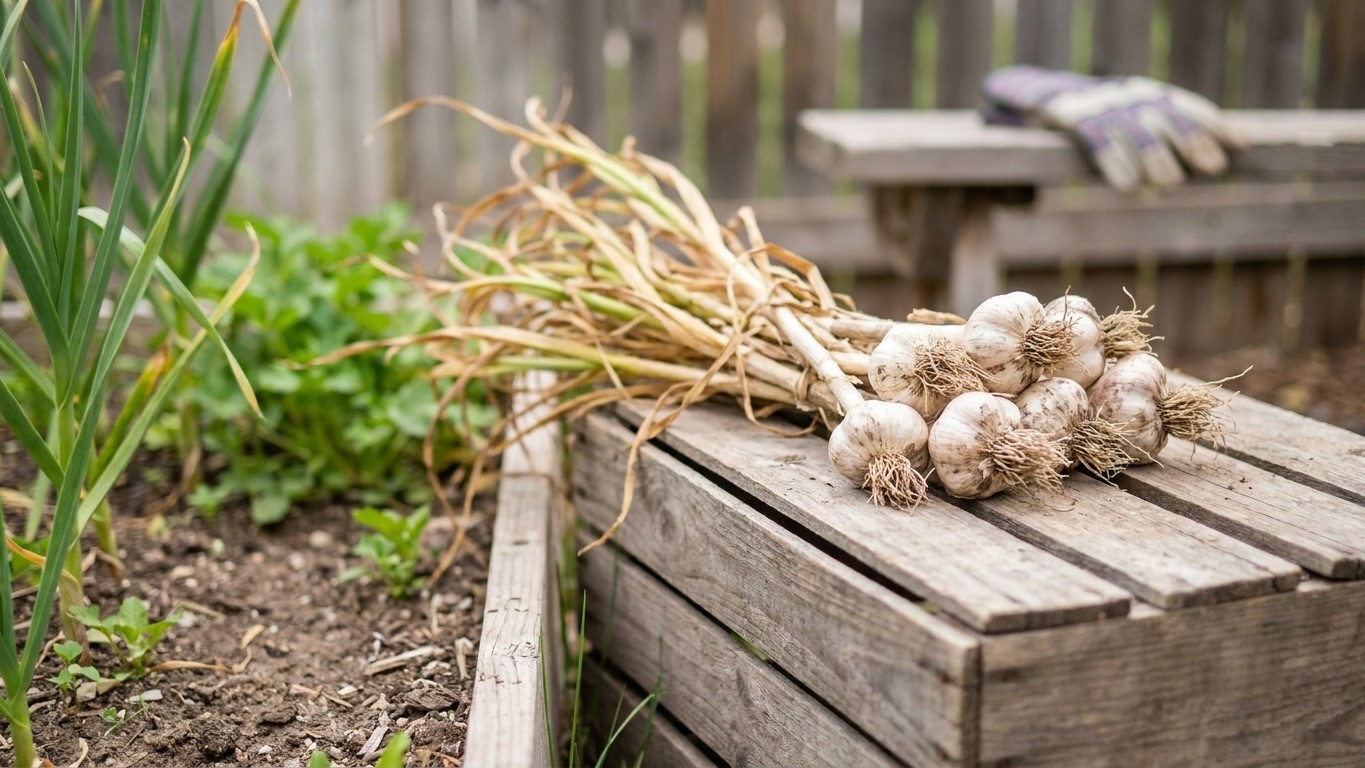

Garlic goes into the ground in Tennessee in fall and comes out the following summer, and the day to lift it isn’t fixed on a calendar. It’s fixed by the plant itself: when the lower leaves have browned but four or five upper leaves are still green, the bulb has finished sizing and it’s time to dig, whether that lands in your neighbor’s garden a week earlier or later.
When garlic is ready to lift in Tennessee
The leaf-count method beats any date on a wall calendar because it reads the plant’s own progress rather than the weather. Each green leaf on a garlic stalk corresponds to a wrapper layer around the bulb below ground. Pull too early, while six or more leaves are still green, and you get small, thin-skinned cloves that won’t cure well. Wait too long, past the point where most of the plant has collapsed, and the wrappers split, cloves separate in the soil, and the bulb loses its ability to store at all.
Tennessee’s geography stretches this timeline more than gardeners expect. The Cumberland Plateau and the mountain counties of East Tennessee run cooler and lag behind Nashville’s growing season, and that gap doesn’t close by summer. According to NOAA NCEI’s 1991-2020 Climate Normals, the first fall freeze at 32°F arrives between October 28 and November 8 in Middle Tennessee, based on the 30 to 70 percent probability band. That’s a midpoint, not a guarantee. In roughly one year out of two, the first freeze shows up later than that window, sometimes considerably later. The date matters here because it anchors when garlic typically goes into the ground the prior autumn, and a later or earlier planting date shifts the whole clock forward or back the following summer.
Test-dig before you commit
Once the leaf signal looks right, pull one bulb as a test rather than the whole row. Brush off the soil and look at the cloves. They should be plump and distinct, with wrappers intact and unbroken. If the cloves look small or the wrapper is still thin and tight to the bulb, rebury that test plant’s neighbors and check again in a few days. Digging the whole bed on a guess costs you a season’s worth of storage life if the timing is off by even a week.
Handle the bulbs gently coming out of the ground. A garden fork loosens the soil around the row so you can lift by the neck rather than yanking, which bruises the base plate and shortens storage life before curing even starts. Bruised bulbs are the ones that rot first in the pantry come January.
Curing it, and where to hang it here
Curing is the step that turns a fresh, moist bulb into something that survives months on a shelf. The outer wrappers need to dry down and tighten around the cloves, and the neck needs to close off and go papery, sealing out the organisms that cause rot. None of that happens if the bulbs go straight into a bag or a bin the day they’re pulled.
What Tennessee summers make hard is finding a spot that’s dry enough. July and August here run humid, and that humidity slows curing and invites mold on the outer layers before they’ve finished tightening. The fix isn’t heat, it’s airflow. A closed garage that traps hot, still air is worse than a shaded carport with a box fan running. Direct sun scalds the bulbs and cooks the cloves from the outside in, so shade is non-negotiable regardless of where you hang them.
Comparing common curing spots
| Location | Airflow | Humidity risk | Notes |
|---|---|---|---|
| Screened porch | Good, natural | Low to moderate | Best all-around option if shaded from afternoon sun |
| Carport with fan | Good, forced | Low | Fan matters more than the space itself |
| Closed garage | Poor | High | Traps heat and moisture unless vented |
| Basement | Variable | Often high | Fine only if a dehumidifier keeps it dry |
Bundle the bulbs in small groups, roots still attached, and hang them where air moves freely on all sides rather than laying them in a single flat pile. A pile traps moisture at the contact points and that’s where rot starts. Curing continues until the outer wrappers rustle like paper and the necks feel dry and tight rather than soft or green. Only then is it time to trim the roots and tops and move the bulbs to storage.
Storing it through a Tennessee winter
Once cured, garlic wants conditions almost opposite to what it needed while curing: cool, dry, and dark, with steady airflow but no direct draft of humid outside air. A pantry shelf, a closet on an exterior wall, or a dry basement corner all work, as long as the space doesn’t swing wildly between the muggy air of a Tennessee fall and the dry heat of a woodstove-warmed room in January.
The refrigerator is the wrong answer, even though it feels like the safe choice. Refrigerator humidity is high enough to trigger early sprouting, and once a clove sprouts, its stored energy shifts into growing a shoot instead of staying edible. Mesh bags, paper sacks, or open baskets let the bulbs breathe. Plastic bags and sealed containers trap the small amount of moisture bulbs release over time, and that moisture is exactly what mold needs to get started.
Keep it away from other stored produce
Garlic stored near potatoes or onions tends to break down faster, since potatoes especially give off moisture that garlic doesn’t tolerate well in a shared bin. Give it its own shelf or basket rather than tucking it into the same root cellar box as everything else from the fall garden. Check stored bulbs every few weeks through winter and pull any that show softness or a sprout starting, since one going soft can speed up decline in the ones sitting next to it.
Hardneck types, which tend to do better in Tennessee’s winter cold, generally hold up for a shorter stretch in storage than softneck types. If a long pantry life matters more to you than winter hardiness, that tradeoff is worth weighing when you choose what to plant the following fall, since the sub-page on planting covers variety selection for this region in more detail.
What goes wrong here
Most storage failures trace back to one of three mistakes: harvesting on the wrong day, curing in a spot that stayed too humid, or sealing bulbs in plastic before they’d finished drying down. Each one is fixable the next season once you know which step slipped.
Pest pressure is a smaller factor for garlic specifically than it is for the rest of a Tennessee vegetable garden, but it isn’t zero. University of Tennessee Extension documents aphids and root maggots as active pests in home gardens across the state, and both can affect alliums. Aphids cluster on foliage and weaken the plant’s ability to size bulbs properly before harvest, which shows up later as smaller, thinner cloves that don’t cure as well. Root maggots work below ground, damaging the base plate where roots attach, and that kind of damage often isn’t visible until you’ve already pulled and started curing a bulb that won’t seal properly at the neck.
University of Tennessee Extension’s broader pest list for the state, which also includes cabbage looper, Colorado potato beetle, corn earworm, flea beetles and cutworms, harlequin bug, imported cabbageworm, Mexican bean beetle, spotted and striped cucumber beetles, squash bug, squash vine borer, and tobacco and tomato hornworms, is aimed mostly at the other vegetables sharing space in a typical home garden rather than garlic itself. Worth knowing if garlic beds sit close to tomatoes, squash, or beans, since pressure on those neighboring crops can spread if left unchecked. For current guidance specific to your county, the University of Tennessee Extension office is the resource to check.
The other recurring problem is simpler than pests: gardeners rushing the cure because storage space is tight or the weather forecast looks unsettled. A bulb moved to a sealed container even a few days early carries enough residual moisture to start mold at the neck within weeks, and that spreads to bulbs stored nearby. Patience at the curing stage costs nothing and saves the whole harvest.
Common questions
How do I know if I harvested garlic too early in Tennessee?
Cloves that are small, closely packed, or have thin, underdeveloped wrappers usually signal an early harvest. The bulb will still be edible fresh but won’t cure or store well.
Can I still cure garlic if a Tennessee summer rain soaks the bulbs after harvest?
Move wet bulbs to the best airflow you can find as soon as possible and extend the curing time. Wet bulbs left in still, humid air are the most common source of curing mold.
Should I wash garlic bulbs before storing them?
No. Brush off loose soil by hand and leave the wrappers intact. Washing introduces moisture right before storage, which works against everything curing was meant to accomplish.
Does East Tennessee’s cooler climate change when I should harvest garlic?
Yes, in effect. Cooler spring conditions on the Cumberland Plateau and in East Tennessee delay the plant’s growth relative to Nashville, which pushes the harvest window later as well. Watch the leaves rather than relying on a date that works for a different part of the state.