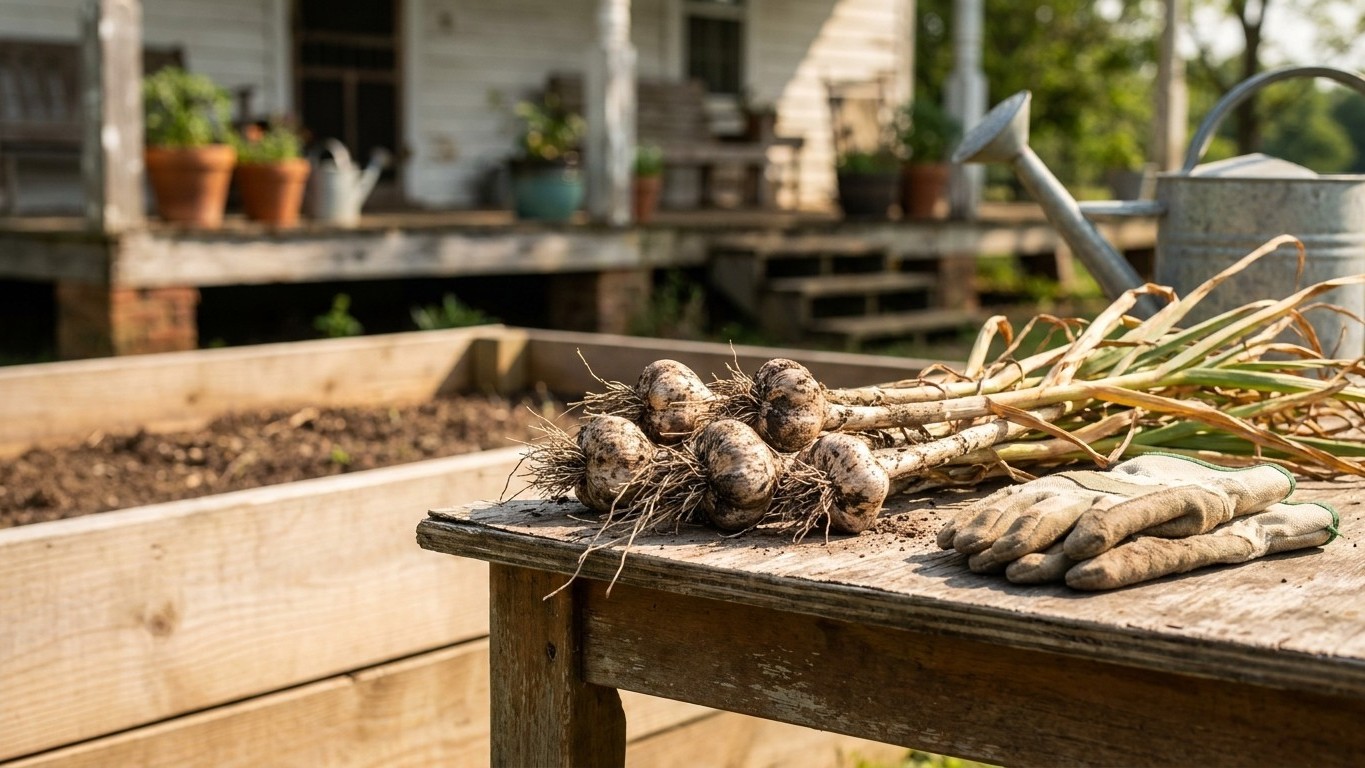

Garlic goes into Tennessee soil in early October to mid October, timed against NOAA’s 1991-2020 climate normals, which put the first fall frost near Nashville at October 28 to November 8. That head start lets the cloves put down roots before the ground turns cold, without pushing so much top growth that a hard freeze knocks the planting back. Check your own county’s frost record at the University of Tennessee Extension before you commit to a date, since the Nashville figure does not describe the whole state.
The short answer for Tennessee

The window and its anchor
Plant garlic in early October to mid October — that’s the window that works across most of Tennessee. Cloves need three to four weeks of root growth before the ground turns cold, and that stretch of fall gives them exactly that without pushing up top growth a hard freeze can knock back. Check your own county’s first frost date before you pick a day, since your yard likely doesn’t sit where Nashville does.
Why the date isn’t a guarantee
A frost date is a midpoint, not a promise. At this station, the first 32°F freeze falls after November 8 in roughly half of all years, and before October 28 in the other half. Planting toward the earlier end of the window costs you little if frost holds off longer than usual. Planting toward the later end and then getting an early freeze can leave cloves without enough root mass to carry them through winter.
Tennessee’s winter itself is not the limiting factor here. The University of Georgia Extension (Bulletin C854) credits this part of the country with roughly 21.8 weeks below 40°F over a season, well past the six to eight weeks garlic needs to split into cloves rather than growing as a single round bulb. That depth of cold is why both hardneck and softneck types perform in this state, unlike places where a mild winter pushes growers toward the softneck side of the family by default. That single anchor point, though, only describes conditions around Nashville. Elevation, latitude, and nearby water move the real date earlier or later, which is the arithmetic covered next.
Working it out for your own garden
The starting point is simple. NOAA’s 1991-2020 normals put Nashville’s first fall freeze at October 28 to November 8. Garlic wants roughly three to four weeks of root establishment before the ground gets that cold, which is why the calculated planting window lands in early October to mid October rather than earlier or later.
To redo this arithmetic for your own garden, you need your own county’s frost data, not Nashville’s. Subtract three to four weeks from your county’s first fall freeze range, and you land on a planting window shaped like Nashville’s, shifted earlier or later depending on how your local climate compares to the reference station.
Elevation and water change the count
Elevation is the biggest single mover. Nashville’s Central Basin sits at a modest elevation compared with the rest of the state. Areas that climb into the Cumberland Plateau or the higher country of East Tennessee sit far above that, and NOAA’s own data flags this part of the state as cooler and later in spring than Nashville. In fall, that same cooler air mass tends to bring an earlier first freeze, which pulls the garlic planting window back toward late September on the highest ground.
Large bodies of water work in the opposite direction. A reservoir the size of Kentucky Lake or Watts Bar holds heat into autumn and can delay the first freeze in the ground immediately around it by a week or so compared with a dry ridge a few miles away. West Tennessee, low and flat near the Mississippi River bottomlands, also tends to hold warmth later into fall, which can push the practical planting date toward the back half of the window or slightly past it.
Every cultivar shares one window
Every variety below, hardneck and softneck alike, carries the same early October to mid October set-out window, because that is what the Nashville-based arithmetic produces for all of them:
- Hardneck: Bavarian Purple, Blue Music, Chesnok Red, Duganski, Fall Festival, Georgian Crystal, Georgian Fire, German Red, German White, and Ivan
- Softneck: Early Red Italian, Inchelium Red, Italian Late, and Lorz Italian
For fuller profiles of each, see Garlic Varieties That Suit Tennessee Winters, which covers flavor and storage differences the planting date alone won’t tell you.
What changes across Tennessee
The state is not one climate
Tennessee runs roughly 500 miles from the Appalachians to the Mississippi River, and the frost calendar stretches with it. Middle Tennessee, including Nashville, is the reference point behind the October 28 to November 8 window used above. East Tennessee, particularly the Cumberland Plateau and the higher ground around the Smokies, sits at much greater elevation, and NOAA’s data for this region notes it runs cooler and later in spring than Nashville, which in fall tends to mean an earlier first freeze and an earlier garlic planting window, likely into late September on the highest ground. West Tennessee, low and flat along the Mississippi River bottomlands near Memphis, tends to hold warmth longer into autumn, which can push the practical planting date later, toward the back half of the range or slightly beyond it.
| Region | What drives the difference | Effect versus the Nashville window |
|---|---|---|
| Middle Tennessee (Nashville Basin) | Reference station behind NOAA’s Oct 28 to Nov 8 window | Baseline: early to mid October |
| Cumberland Plateau / East Tennessee highlands | Elevation well above the Basin | Likely earlier: late September into early October |
| West Tennessee (Mississippi River bottomlands) | Low, flat ground near Memphis | Likely later: mid to late October |
| Areas near large reservoirs (Kentucky Lake, Watts Bar) | Open water holds heat into fall | Slightly later, by roughly a week |
None of these secondary effects are measured at their own weather stations here, they’re directional adjustments off the one Nashville figure NOAA provides. Treat them as the direction to lean, and confirm against your own county’s record before you settle on a date.
The mistakes this climate punishes
Planting after the window closes
Waiting past mid October is the mistake this state punishes hardest, because Tennessee’s winter arrives with real cold behind it, not a token frost. The University of Georgia’s 21.8-week figure for time spent below 40°F is more cold than a clove strictly needs, but only if the clove goes into the ground with enough time left to root first. Plant after the window closes, especially in the Cumberland Plateau or higher East Tennessee where cold arrives sooner, and the clove can meet a hard freeze with barely any root system built, which weakens or kills it outright.
Skipping mulch where freeze-thaw cycles are common
Tennessee winters rarely hold a stable snowpack the way the Upper Midwest does. Instead the ground freezes, thaws during a warm spell, and freezes again, sometimes several times in one winter. That cycle heaves shallow-planted cloves right out of the soil surface. A three to four inch layer of straw mulch, put down the same week you plant rather than weeks later, keeps soil temperature more even and is one of the cheapest steps that prevents a real loss.
Planting into wet, poorly drained ground
September and October, the exact months garlic goes into the ground, sit inside the published temperature range for both fusarium basal rot and white rot according to the University of California’s IPM guidelines for onion and garlic (UC ANR Publication 3453). Those published thresholds are soil temperatures, not air temperatures, and soil lags air by weeks and swings less. A month’s average also hides a lot of daily variation, so this is not a forecast of disease, and it comes from one reference station’s monthly averages rather than a survey of the whole state. What it does mean is that heavy, wet clay that stays cold and saturated through fall gives either pathogen a better foothold than a raised, well-drained bed does. Neither disease is avoidable purely through drainage, since both also travel in infected seed stock, so starting with clean, disease-free cloves from a known source matters as much as the soil does.
Checking this against your county
Everything above is built on one weather station near Nashville. Tennessee stretches from the Mississippi River to over a mile high in the Smokies, and no single frost date fits all of it. Before you commit to a planting date, check your county’s own numbers through the University of Tennessee Extension, which can point you to county-level frost data and a local horticulture agent. If your county sits at meaningfully higher elevation, or right against a large reservoir, adjust the window a week or two in the direction those factors already suggest, and revisit the basics in Growing Garlic in Tennessee before you plant.
Common questions
Is it too late to Plant Garlic in Tennessee in November?
It’s risky rather than impossible. NOAA’s frost window for the Nashville area runs October 28 to November 8, and a November planting gives cloves less time to root before the ground cools, which matters more in a year when the freeze lands on the early side of that window. If you’re past mid October, plant anyway rather than waiting for spring, and add extra mulch to compensate for the shorter root period.
My garlic already has green shoots coming up in December. Did I do something wrong?
Probably not. A mild fall stretch in Tennessee can push a little top growth before hard cold sets in, and established garlic tolerates this fine as long as the roots had time to develop first. The shoots may get nipped back by a freeze, but the plant itself keeps growing from the base in spring.
Should I plant hardneck or softneck garlic in Tennessee?
Either works here, since the state’s winter cold comfortably clears what garlic needs to split into cloves. The practical difference is in storage and kitchen use rather than survival: softneck types generally store longer in a pantry, while hardneck types tend to have a shorter shelf life but are the ones most growers reach for first.
Can I plant garlic cloves from a grocery store bulb?
You can, but it carries more risk than buying seed stock from a garlic supplier. Grocery garlic is often grown out of state, sometimes treated to slow sprouting, and rarely labeled by variety, so you won’t know if it’s suited to a Tennessee winter or whether it’s carrying a soil-borne disease into your bed.
The Moon calendar is a separate, older custom: see when to plant garlic by the moon, written as tradition rather than fact.