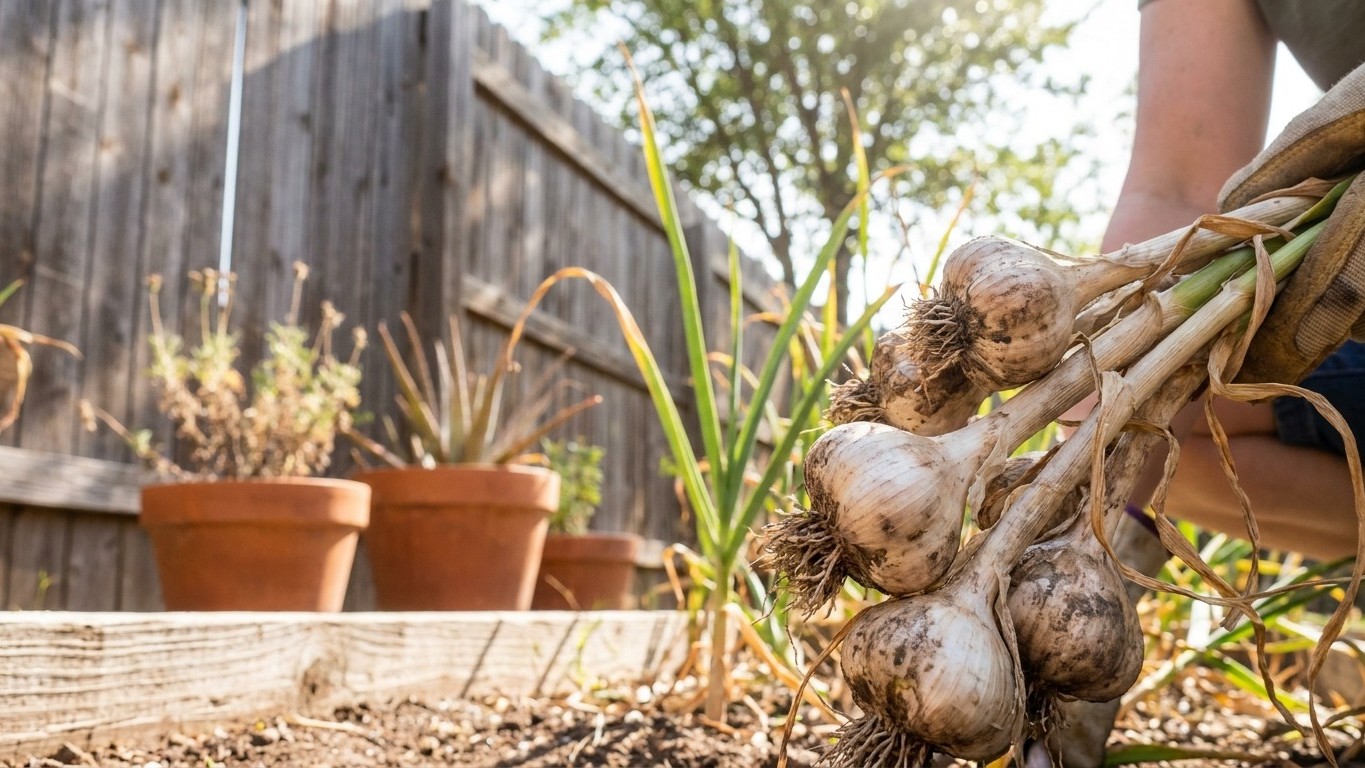

Wondering which garlic will actually make it through your own winter? Softneck is the safer bet almost anywhere near the Gulf Coast, since that stretch of Texas barely sees enough sustained cold for a hardneck bulb to split into cloves the way it’s built to. Head inland toward the Panhandle or the Hill Country and the cold runs deeper and longer, opening the door to hardneck types instead. Start by finding your own county’s frost record and average winter chill before you order seed garlic, since that’s what decides which group belongs in your ground.
The short answer for Texas

For growers anywhere near the Gulf Coast, garlic goes into the ground in fall and comes out the following summer, and the safest bet is a softneck variety planted in the November window described below. That timing is anchored on NOAA’s 1991-2020 climate normals for Houston’s Bush Intercontinental Airport station (IAH), which put the city’s first fall freeze at December 1 to December 19.
That range is a midpoint, not a guarantee. NOAA builds it from a 30 to 70 percent freeze-probability band, which means the actual first freeze lands later than this range about as often as it lands within or before it. A warm December pushes the real freeze later still, and a cold snap off the coast can pull it forward.
The cultivars covered on this list break into two groups:
- Softneck: Early Red Italian, Inchelium Red, Italian Late, and Lorz Italian, all suited to a mild winter with little sustained cold.
- Hardneck: Bavarian Purple, Blue Music, Chesnok Red, Duganski, Fall Festival, Georgian Crystal, Georgian Fire, German Red, German White, and Ivan, all wanting more sustained winter cold than the Gulf Coast reliably provides.
All of them are set out early November to late November, several weeks ahead of that Houston freeze range depending on exactly where each date falls within it. Houston is one station on a very large state, and even within the Houston area, Hobby Airport on the south side runs about two weeks milder than the IAH station used for these normals. A Panhandle or Hill Country address needs an entirely different starting figure, worked out below.
Working it out for your own garden
The Houston figures work as a worked example, not a planting calendar for the rest of Texas. NOAA’s own caveat about these normals holds beyond Houston too: a mild Gulf Coast reading does not describe a freeze date for the Panhandle, the Hill Country, or anywhere further inland. The method below is what carries over, not the date itself.
Finding your own frost window
Start with the same kind of source used here: NOAA’s climate normals for the weather station nearest you, or the frost data your county’s Texas A&M AgriLife Extension office keeps on file. Then run the same subtraction used for Houston. NOAA’s 1991-2020 normals put Houston’s first fall freeze at December 1 to December 19 at station IAH. Set out at the start of the November window, November 1, and measured against the earliest edge of that freeze range, cloves get about four weeks in the ground before freeze risk starts to climb. Measured against the latest edge of the range instead, that cushion stretches to nearly seven weeks. Planted at the tail end of the window, November 30, the cushion narrows to as little as a few days if the freeze lands right at the early edge of its own range.
That spread is the point. The freeze date itself is a probability band, not a single day, so the lead time it buys a clove is a range too. Planting earlier inside the recommended window buys a wider margin than planting late inside it, for any variety on this list.
Adjusting for local geography
Elevation, a large reservoir, and coastal exposure can each shift a frost date by roughly two weeks in either direction, the same effect that keeps the Gulf Coast running weeks behind inland stations at a similar latitude. A garden a mile or two from a large lake or bay tends to freeze later than one further inland at the same elevation, and a garden several hundred feet higher than the valley floor near it tends to freeze earlier. None of these adjustments are precise to the day, so treat them as reasons to lean your own window a week earlier or later than a flat read of the nearest station, and check the fuller arithmetic in When to Plant Garlic in Texas: Counting Back From the First Frost before settling on a date.
What changes across Texas
The Panhandle and the High Plains around Amarillo see winter cold arrive months earlier and stay months later than the Gulf Coast does, with far more hours below 40°F. That cold accumulation is exactly what hardneck garlic needs to complete the process that splits a single clove into a head of several. Houston’s own average winter logs zero weeks below 40°F, well short of the six to eight weeks hardneck types need for that split, according to the University of Georgia Extension (publication C854). A grower in the Panhandle or the northern Hill Country works with a genuinely colder climate and can grow German Red or Duganski with less concern about that chill requirement.
Hill Country and North Texas sit between these two extremes. Elevation and distance from the coast both push the first freeze earlier than Houston’s, and winter cold accumulates for longer, though neither region matches the sustained cold of the Panhandle. Growers there often see workable results from both softneck and hardneck types, provided hardneck seed stock gets a period of refrigeration before planting to make up any shortfall in field chill.
South Texas and the immediate coast run the other direction. The Rio Grande Valley and the coastal strip see frost rarely in most years, which makes the case for softneck cultivars even stronger there than in Houston. East Texas, with a humid climate similar to the Gulf Coast, faces the same chill shortfall as Houston, along with the disease pressure covered next.
The mistakes this climate punishes
The single most common mistake along the Gulf Coast is planting a hardneck variety and expecting Panhandle results. Without enough accumulated cold, hardnecks like Bavarian Purple or Chesnok Red can come up as a single round clove rather than a segmented head, or bulb weeks late and small. Pre-chilling seed cloves in a refrigerator for several weeks before the November set-out window makes up some of that shortfall, but it does not fully replace a cold winter, and a straightforward softneck such as Inchelium Red or Lorz Italian removes the guesswork entirely.
The second mistake runs the opposite direction: treating a mild winter as license to plant late. Garlic set out after the target window has less time to root before growth slows for the season, which weakens the plant heading into the wetter months, when disease pressure runs highest.
Disease pressure from a warm, wet fall
According to the UC IPM Pest Management Guidelines for onion and garlic (UC ANR Publication 3453), several soil-borne pathogens have published temperature ranges that overlap a large share of the Texas growing season. Those thresholds are published as soil temperatures, air temperature is a rougher proxy, and a monthly average hides a lot of day-to-day swing. None of this means a given disease is guaranteed, and falling outside a range never means a disease is impossible, since infected seed cloves carry it regardless of the weather.
| Disease | Pathogen | Months in range (of the growing season) |
|---|---|---|
| Fusarium basal rot | Fusarium oxysporum f. sp. cepae | 8, including 1 at the published optimum |
| White rot | Sclerotium cepivorum | 7, including 2 at the published optimum |
| Pink root | Setophoma terrestris | 4, all at the published optimum |
| Southern blight | Sclerotium rolfsii | 0 months at its optimum, though less active outside it is not the same as absent |
The practical response is drainage, not variety choice. Raised beds, wide spacing, and clean seed stock cut this risk far more than picking one cultivar over another, since none of the varieties on the Texas list carry resistance ratings against these soil pathogens.
Checking this against your county
Every figure above comes from one Houston-area station, and Texas is too large for one station to speak for it. Before ordering seed garlic, check your own county’s frost data and planting guidance through Texas A&M AgriLife Extension, which maintains county offices across the state with local recommendations. If you’re still working out the basics of the crop, start with Growing Garlic in Texas for the steps that come before variety selection, then confirm your local planting window against your county office’s own figures rather than the Houston range used as an example here.
Common questions
Can I use garlic from the grocery store instead of ordering seed garlic?
You can, but it’s a gamble. Grocery garlic is rarely labeled by variety, so you won’t know whether you’re planting a softneck suited to a mild winter or a hardneck that needs more cold than the Gulf Coast delivers. Much of it is also imported and sometimes treated with a sprout inhibitor, which can slow or stop rooting entirely.
What actually happens if I plant a hardneck variety in South Texas anyway?
It will usually still grow, but the bulb often comes up as a single rounded clove instead of a head divided into several, since that division depends on cold exposure the plant never got. Refrigerating the seed cloves for several weeks before planting can partly close that gap, though it does not fully replace the sustained cold a naturally cold winter provides.
Should I mulch garlic beds through a Texas winter?
A light mulch layer helps hold soil moisture and suppress weeds through a mild Texas winter more than it protects against frost, since freezes here rarely go deep enough to threaten a rooted clove. Piling mulch too thick in a wet fall can trap moisture against the neck of the plant, which raises the risk of the soil-borne rots covered above rather than lowering it.
How do I know if my seed garlic needs refrigeration before I plant it?
Check whether it’s a hardneck or softneck type first. Softneck varieties are bred for mild winters and generally need no pre-chilling on the Gulf Coast, while hardnecks grown outside their preferred cold range benefit from several weeks in the refrigerator before the November set-out window, loose in a paper bag rather than sealed in plastic.