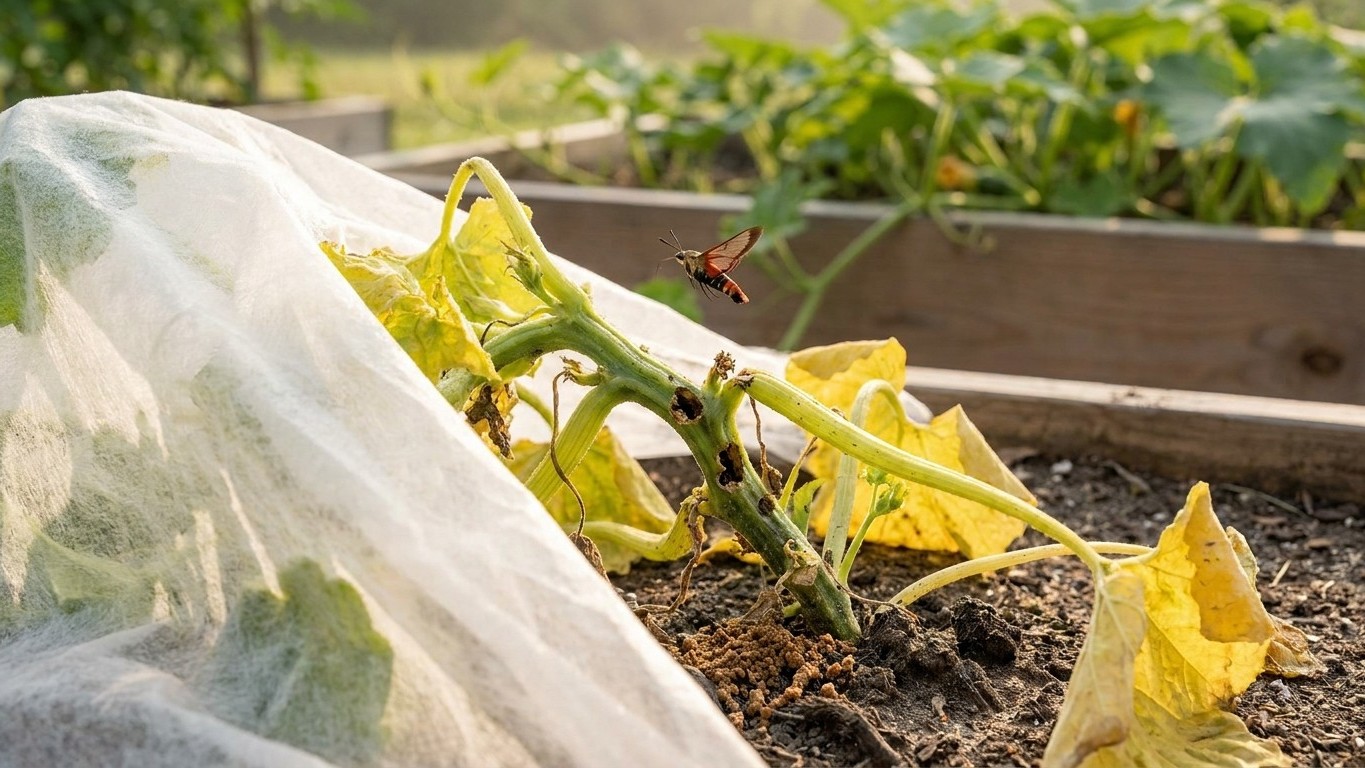

Squash vine borer moths start flying in Tennessee anywhere from mid-May in the western part of the state to mid-June at higher elevations in the east, with peak egg-laying usually landing in the first three weeks of June. Once the larvae tunnel into a stem, no spray fixes it. The only real leverage gardeners have is timing: covering plants before moths arrive, catching the first signs of entry within days, and pulling the trigger on surgery or removal before the vine collapses.
That narrow window is why so many Tennessee gardeners lose a squash patch that looked perfectly healthy on Monday and lay flat by Friday. The wilting looks like drought stress or a root disease. It isn’t. It’s a caterpillar working through the base of the stem, and by the time the leaves droop, the damage is already done.
When Squash Vine Borer Moths Are Active in Tennessee

The squash vine borer (Melittia cucurbitae) overwinters as a pupa buried an inch or two below the soil surface, usually right where last year’s vines grew. Adults emerge once soil temperatures climb into the consistent 60s and 70s Fahrenheit, which in Tennessee typically means late May in the west and stretches into mid-June in cooler pockets of the Cumberland Plateau and the higher valleys of East Tennessee. Middle Tennessee, including the Nashville basin, usually sees first flight sometime between the last week of May and the second week of June.
The moth itself throws people off because it doesn’t look like a typical moth. It flies during the day, has a wingspan close to an inch and a half, and sports an orange abdomen with black dots that makes it resemble a wasp more than anything from the butterfly family. Gardeners who spot one hovering around squash leaves in daylight often assume it’s a beneficial insect and let it be. That’s a mistake worth correcting early in the season.
One Generation or Two?
Northern states typically deal with a single generation per year. Tennessee’s longer, warmer growing season means West Tennessee and parts of Middle Tennessee can see a partial second generation emerge in late July or August, especially in years with an early, warm spring. That second wave is why fall squash plantings sometimes get hit even after gardeners successfully protected their spring crop. East Tennessee’s cooler microclimates make a second generation less consistent, but it’s not unheard of in warm years.
Spotting the Damage Before the Vine Collapses
The first visible clue is rarely the wilting itself. It’s a small pile of what looks like wet sawdust or greenish-yellow frass sitting at the base of the stem, right at soil level. That frass is larval excrement pushed out of the entry hole as the caterpillar tunnels deeper into the vine. Splitting the stem open near that spot usually reveals a fat, cream-colored grub up to an inch long.
Wilting that shows up despite regular watering is the second warning sign, and it’s the one most gardeners notice first because it’s dramatic. A single larva can hollow out enough of the stem’s interior to cut off water and nutrient flow to the entire plant within a week. Summer squash and zucchini wilt fastest because their stems are relatively thin and hollow. Winter squash and pumpkins, with thicker vines, sometimes survive an infestation that would kill a zucchini outright, simply because they have more vascular tissue for the borer to chew through before doing fatal damage.
Checking the base of every squash plant twice a week starting in late May, right through late June, catches most infestations while the larva is still small enough to remove without destroying the stem.
What Actually Stops Squash Vine Borer
Prevention beats intervention with this pest, mostly because once a larva is a week or two into the stem, options narrow fast. The tactics that hold up in Tennessee gardens fall into three categories: keeping moths off the plant, disrupting the timing of the infestation, and physically removing larvae before they do fatal damage.
Row Covers Timed to the Flight Window
Floating row cover fabric laid over young squash plants blocks moths from reaching the stem to lay eggs. The catch is that squash needs pollinators to set fruit, so covers have to come off once flowering starts, right around the time moth pressure peaks in early-to-mid June. Some gardeners split the difference by removing covers only during morning hours to allow bee access, then replacing them by midday. It’s more labor than most people want to commit to, but for anyone who’s lost a full patch to borers before, it’s a trade worth making.
Stem Wrapping and Barrier Methods
Wrapping the lower 4 to 6 inches of stem in aluminum foil or a strip of nylon stocking at transplant time physically blocks the moth from reaching bare stem tissue to lay eggs. This works best on vining varieties trained along a single main stem rather than sprawling types with multiple vine points touching soil, since every soil contact point is a potential egg-laying site.
Surgical Removal
If frass shows up before the plant has wilted badly, a slit made lengthwise along the stem with a sharp knife, right where the entry hole sits, lets a gardener dig out the larva by hand. After removal, mounding moist soil over that section of stem encourages new root growth from the buried node, which helps the plant recover even if the original stem section is compromised. This works far more often than people expect, especially on vining winter squash where the plant has multiple potential rooting points along its length.
Beneficial Nematodes and Bt
Bacillus thuringiensis (Bt) injected directly into the stem near an entry hole can kill young larvae before they tunnel deep enough to cause serious vascular damage. Beneficial nematodes applied to the soil around the base of plants target the pupae stage in the ground, reducing the population that emerges the following season. Neither method reverses damage already done to a badly wilted plant, but both reduce pressure on next year’s crop when applied consistently.
Planting Timing and Variety Choice
Because moth flight in Tennessee clusters heavily around late May through June, some gardeners deliberately delay planting summer squash until early July, after the first generation has laid its eggs and moved on. This sacrifices a few weeks of harvest but sidesteps peak pressure entirely. It’s a common strategy in West Tennessee, where the growing season runs long enough to still get a full squash harvest from a July planting before first frost.
Variety selection matters more than most seed catalogs let on. Cucurbita moschata types, which include butternut squash and most cushaw varieties, have solid, less hollow stems that borers struggle to tunnel through effectively. Gardeners who’ve lost zucchini and yellow squash to borers season after season often find butternut sails through the same summer with minimal damage, planted in the same soil, right next to the losses.
Crop rotation and fall tilling round out the long-game approach. Since pupae overwinter in soil close to where the vines grew, tilling that area in fall exposes them to cold and predators, cutting into the population that emerges the following spring. Moving squash to a different bed each year, even a modest 10 to 15 feet away, reduces the odds that emerging moths find host plants immediately upon leaving the soil.
None of these tactics work in isolation as well as they do stacked together. A gardener running row covers through early flowering, checking stem bases twice weekly, and planting a butternut variety alongside a delayed zucchini crop is playing defense on three fronts instead of one, which is about what this pest requires given how little warning it gives before the damage is irreversible.
Related guides
- Squash vine borer in Kentucky: When It Shows Up and What Stops It
- Squash vine borer in Georgia: When It Shows Up and What Stops It
- Squash vine borer in Texas: When It Shows Up and What Stops It
- Squash vine borer in Wisconsin: When It Shows Up and What Stops It
- Squash vine borer in Arkansas: When It Shows Up and What Stops It
- Squash vine borer in Massachusetts: When It Shows Up and What Stops It