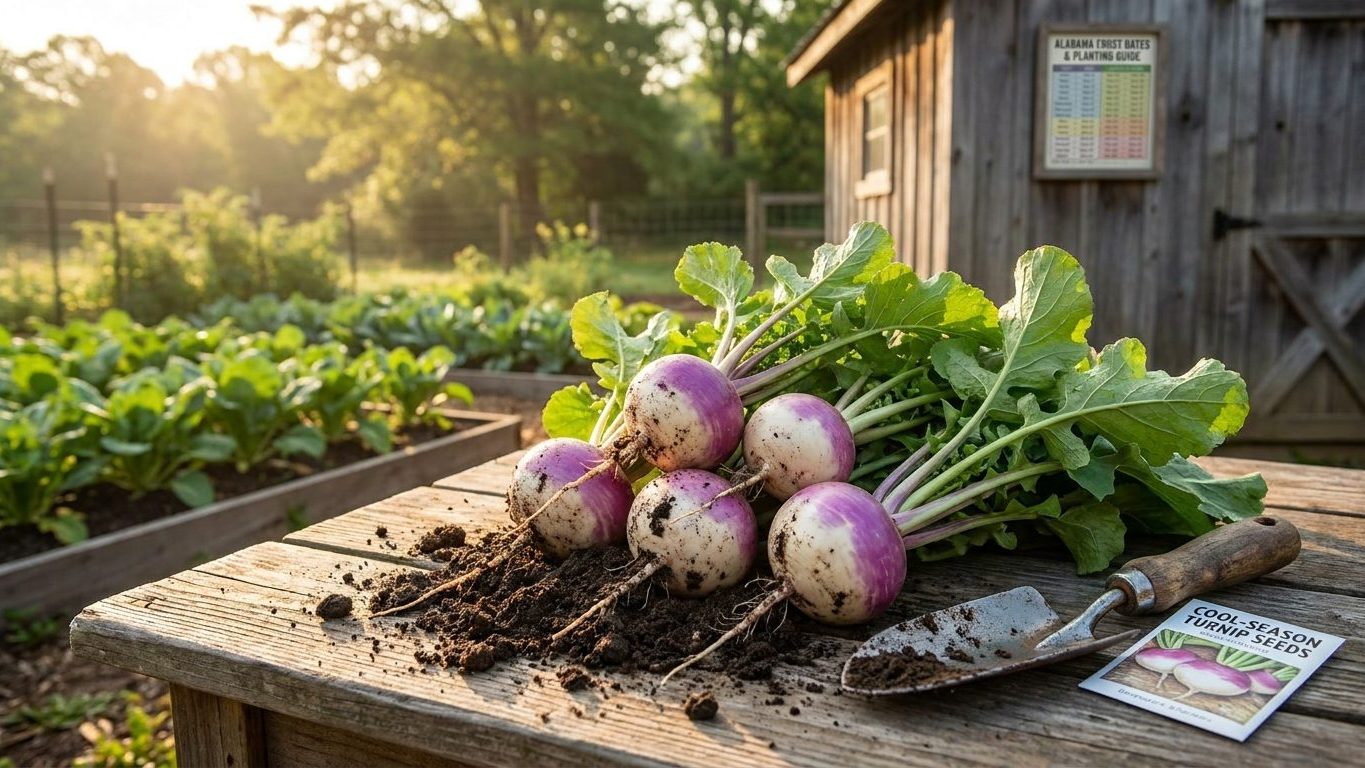

Most Tennessee gardeners get the best turnips from a fall planting, sown from mid-August to early September. A spring sowing also works, but it has to go in early, from late February into March, before warm weather turns the roots woody. Rutabaga is the fussier cousin and nearly always belongs in the fall slot.
The short answer for Tennessee
Sow turnips in late summer, roughly mid-August through early September, for a fall harvest, and again in late February through March for a spring crop. Those windows come from two sets of frost dates: March 31 to April 12 for the last spring freeze, and October 28 to November 8 for the first fall freeze.
Both ranges come from NOAA’s 1991-2020 Climate Normals for the Nashville station (USW00013897). They are probabilities of a 32°F freeze, taken from the band where the odds run between 30 and 70 percent. They are not dates when frost is forbidden or guaranteed. A freeze after April 12 is entirely possible, and so is an early one before October 28. Turnips shrug off light frost, which is why these dates work as a guide rather than a deadline. For the broader picture of the crop, see Growing Turnips and Rutabaga in Tennessee.
The fall window comes from counting backward. Most turnip varieties are sold at roughly 40 to 60 days to harvest (the seed packet gives the exact figure). Count 60 days back from October 28 and you land at the end of August. Days shorten fast in autumn and growth slows, so starting a couple of weeks earlier builds in a cushion. That is how mid-August to early September comes out. The spring window works the other way: begin as soon as the ground can be worked, a month or more ahead of that March 31 to April 12 band.
| Crop and season | Sowing window | What it is counted from |
|---|---|---|
| Turnips, fall | Mid-August to early September | First fall freeze, October 28 to November 8 |
| Turnips, spring | Late February through March | Last spring freeze, March 31 to April 12 |
| Rutabaga, fall | Aim for the early end of the fall window | Longer days to harvest, so more lead time before freeze |
Rutabaga takes noticeably longer than turnips (commonly around 90 days or more), so it needs more runway before the first freeze. If you are still choosing what to plant, The Best Turnips and Rutabaga for Tennessee covers varieties.
One limit on all of this: these dates are anchored to Nashville. East Tennessee and the Cumberland Plateau run cooler and later in spring, so the spring window slides for them. More on that below.
What will not work here
The most common failure is a spring rutabaga. It needs a long, cool run to size up, and a crop sown in March has to compete with a Tennessee spring that swings from frost to warmth within weeks. Roots that bulk up in heat come out tough and bitter. Treat rutabaga as a fall crop and save yourself a season of disappointment.
Late spring turnips fail for the same reason. Sown in April or May, they race toward warm weather, and the roots turn woody or bolt before they size up. The spring window is short on purpose. Past about early April, the better move is to wait for August.
Summer sowing is the opposite trap. A seed row put in during July or the first days of August meets hot soil, and the seedbed surface crusts and dries within hours. Watering once a week, the habit that works fine for established tomatoes, will not carry a turnip seed to germination in late August. Seedlings need the surface kept consistently moist, often daily, until they are up. Tennessee summers are also humid, which punishes crowded plantings. Dense foliage stays wet, air stalls, and leaf diseases move in. Thin to the spacing on the packet even when it feels wasteful.
Sowing too late fails too, just more slowly. Seed sown in mid-October, close to the first-freeze band, produces a pile of greens with small roots at best, because shortening days and cooling soil stall growth. Greens will still be worth picking, so late sowing is not a total loss if greens are what you want.
Then there is the idea that Tennessee winters are mild enough to leave roots in the ground and forget about them. The mean daily minimum of the coldest month is 30.1°F at the Nashville reference station. That figure is an average of nights, not the record low, so individual cold snaps run well under it. Fall roots can hold in the garden for weeks past the first freeze, but plan to harvest them rather than counting on them to overwinter, especially if you live north or at altitude.
Finally, a calendar borrowed from the wrong part of the state is a plan that fails. A Nashville date applied in the Cumberland Plateau puts spring seed into cold soil and fall seed under an earlier freeze than the calendar assumed.
What changes across Tennessee
Tennessee is not one garden. The USDA Plant Hardiness Zone Map (2023 edition, built on 1991-2020 normals) places the state across zones 5b to 8a. That is six half-zone steps, roughly a 25°F spread in the average annual coldest night, from the coldest ridges to the warmest low ground. There is no single zone for Tennessee and no single sowing date.
The hardiness zone is built on one variable only, the average annual extreme minimum temperature. It tells you about winter survival, not about when to sow a cool-season annual. Treat it as a warning about how different two Tennessee gardens can be, and not as a sowing instruction.
If you garden in the east or on the Plateau
East Tennessee and the Cumberland Plateau run cooler and later in spring than Nashville. A reader there should start spring turnips later, pushing the window back by a week or two, and should not assume the March 31 to April 12 band applies to them. The spring caution in the data covers only spring, but the same cooling logic points to an earlier first freeze in the fall. That part is an inference, not a measured figure for your area. The practical move is to sow fall turnips in early-to-mid August rather than the end of the month, and to give rutabaga the earliest slot you can.
If you garden in the warmer parts of the state
Warmer, lower ground gives you the other problem: heat lingers into September. The late end of the fall window is more forgiving on frost but harder on germination, so keep the seedbed moist and consider a light shade cloth over newly sown rows. To see where your own garden sits, check the USDA zone map by ZIP code. Do not guess your zone from the state average.
Where to check this for your own county
The best source for a precise local answer is your county office of University of Tennessee Extension. The extension service is part of the land-grant university system, and its agents know how your county’s soils, elevation and weather differ from the state picture.
Two things are worth looking for. First, a local or regional vegetable planting calendar that lists turnips and rutabaga with sowing dates for spring and fall. Second, any variety trial results from your area, which show which cultivars have actually performed in nearby soils. A variety that does well in a trial plot twenty miles from you beats a variety that merely looks good in a catalog.
This page does not hold a turnip-specific calendar from the extension service. Say so plainly: the windows above come from NOAA frost probabilities for the Nashville station and ordinary days-to-harvest arithmetic, and they have not been checked against a county-level calendar. Treat them as a starting point.
A county recommendation beats a state one, every time. This page is the state one, built from a single reference station and a hardiness range that spans six half-zones. If your county agent gives you a date that differs from the one here, follow the agent. If you are still weighing what to plant, the variety guide linked earlier pairs well with a county calendar.
Checking this against your own garden
Your own observations outrank every date on this page. Three are worth watching, and none requires a tool beyond your hands and eyes.
- Soil warmth by feel. In spring, a handful of soil that feels cool and workable, not frozen or sodden, means turnip seed can go in. In late summer, if the top inch feels hot and dries out by afternoon, the bed is telling you to keep watering daily or wait a week. Compare a sunny bed with a shaded one and you learn how much your yard varies.
- The first male flowers on squash or cucumbers. If you grow them, or a neighbor does, the first flush of male blossoms signals that settled warm weather has arrived. That is your cue that the spring turnip window has closed.
- The first true leaves on your seedlings. The first pair of leaves are the seed leaves. The true leaves follow, and how quickly they appear tells you how fast your soil is warming or cooling. A bed that shows true leaves days ahead of another is your warmer microclimate, and that is where your earliest spring sowing and your latest fall sowing belong.
Write down what you see, with dates, for one season. A single notebook entry for sowing, emergence and harvest will do more for next year’s calendar than any average.
The Moon calendar is a separate, older custom: see when to plant turnips by the moon, written as tradition rather than fact.
Common questions
Can I sow turnips in spring in Tennessee?
Yes, if you sow early. Late February through March is the usual window, and the crop needs to size up before warm weather arrives. Sown in April or later, spring turnips tend to turn woody.
Should I wait until after the last frost to sow?
No. Turnips tolerate light frost, so spring seed can go in a month or more before the March 31 to April 12 band. That band is the range where the odds of a 32°F freeze run between 30 and 70 percent, not a date to wait for.
Is fall better than spring for turnips here?
For most gardeners, yes. Fall sowings from mid-August to early September mature into cooling weather, which suits the crop. Spring plantings have a narrower window before heat sets in.
When should I sow rutabaga?
In the fall, at the early end of the window. Rutabaga needs more days to mature than turnips, so it requires more lead time before the first freeze, which falls between October 28 and November 8 in the Nashville data. In East Tennessee and on the Cumberland Plateau, go earlier still.