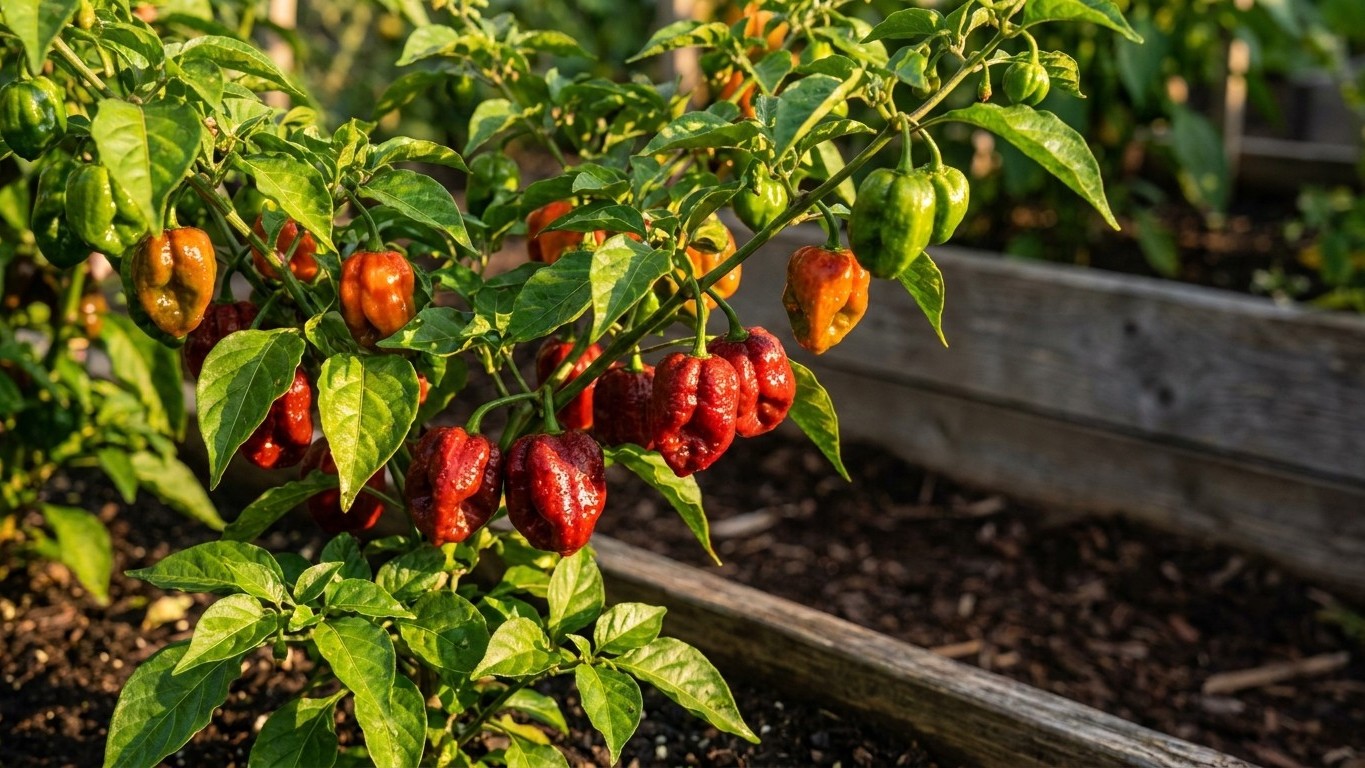

Pick a pepper when it reaches full size and the color you want. Clemson Extension puts that at about 70 to 85 days after transplanting. Then keep it out of the refrigerator. Whole peppers store best at 45 to 50 F, and a household fridge runs colder than that, so the skin pits and softens. Maryland adds its own wrinkles, including a summer heat load that can stall fruit set and a spring frost window that moves your calendar. This page is one piece of Growing Peppers in Maryland.
The short answer
The reference station for Baltimore averages 24.6 days a year that reach 90 F or more, according to NOAA NCEI Climate Normals. That is a little over three and a half weeks of hot afternoons. Utah State University Extension says pepper fruit set fails at both ends of the thermometer, and 90 F days are the hot end. Any of those 24.6 days that land while your plants are blooming can knock flowers off before they turn into fruit. The number is a yearly total, not a schedule. It does not say when the hot days fall, and it comes from one station, so your yard may run hotter or cooler.
The cool end
The same Utah State source names the other failure: nights below 55 F. This site does not carry summer night minima, so it cannot tell you how many such nights your county gets. You have to watch your own. A cheap min/max thermometer on a stake beside the bed, read each morning while the plants are in flower, will tell you more than any regional estimate. Do not guess from your latitude or from how cold your winters get. Neither predicts what a July or September night does in your garden.
Picking and storing
Clemson Extension says peppers should be ready for harvest in about 70 to 85 days after transplanting. That is a window, not a date, and it moves with every hot spell and cool snap. The fruit tells you more than the calendar. Pick when it has reached full size, feels firm and has the color you are after. Peppers left to change color hang on the plant longer, which is the trade for sweeter fruit.
Storage is where most people go wrong. Clemson’s guidance reads: “The optimal conditions for storage are temperatures of 45 to 50 °F and 80- to 90-percent relative humidity for two to three weeks.” A household refrigerator is colder than that range. Below about 45 F, peppers develop chilling injury, which shows up as pitted, softening skin. Two to three weeks is also a ceiling under ideal conditions, not a promise. If your plants have been dropping blossoms, Why Peppers Fail to Set Fruit in Maryland covers that problem in detail.
When to start seed here
Start from the day the plants go outdoors, then count backward. The arithmetic takes five steps, and you can redo it for any county.
- Find your last spring frost. For the Baltimore reference station, NOAA NCEI puts it at April 3 to April 16. That is the band where the chance of one more 32 F freeze sits between 30 and 70 percent (NOAA NCEI data file). Western Maryland, in Garrett and Allegany counties, is mountainous and runs weeks later. The Eastern Shore runs milder. Use the band for the place you garden, not the one on this page.
- Wait for 60 F soil. Utah State says to transplant when the soil reaches 60 F, after frost. A frost-free forecast alone is not enough, because cold soil stalls pepper roots. A soil thermometer pushed a few inches down in the morning settles it.
- Pick your transplant date. Use whichever comes later, the last frost or the day the soil reaches 60 F. Say that works out to May 1. That date is only an example, so swap in yours.
- Subtract 8 to 10 weeks. Utah State says transplants need 8 to 10 weeks indoors. Eight weeks before May 1 is about March 6, and ten weeks before is about February 20. Sow somewhere in that stretch.
- Add 70 to 85 days for first harvest. Clemson’s window runs from transplanting. Seventy days after May 1 lands on July 10, and 85 days lands on July 25. That is your first-picking window.
Check the result against the heat. If your picking window lines up with the stretch when afternoons commonly pass 90 F, flowers are opening in that heat too. Keep a few weeks of flexibility in your sowing date rather than treating the earliest one as the best. Seedlings that outgrow their pots before the soil warms up end up leggy and stressed, which is no head start at all.
What goes wrong here
Three failures account for most of the disappointment in Maryland pepper beds. Each has a cause you can see and a fix you can apply this week.
- Blossom drop. Flowers fall off without setting fruit when days pass 90 F or nights dip under 55 F, the two limits Utah State names. You cannot cool the air, but you can soften the blow. Water deeply during a hot spell, mulch to keep roots cooler, and use light shade cloth on the worst afternoons. For the cool end, a row cover over the plants on a chilly night buys a few degrees. Plants usually flower again once the weather steadies, so do not pull them.
- Sunscald. Pale, papery patches appear on the side of the fruit facing the sun, and they turn sunken and tan with time. It happens when strong sun hits fruit that foliage no longer covers, often after a plant loses leaves to disease, insects or heavy pruning. Keep the canopy intact and pick affected fruit early so it doesn’t rot. Shade cloth helps in the hottest weeks. Chewed or holed fruit is a different problem, and What Eats Pepper in Maryland, and When sorts those out.
- Blossom-end rot. A dark, leathery, sunken spot forms on the bottom of the fruit, the end opposite the stem. The cause is usually uneven watering that interrupts calcium delivery, more often than a calcium shortage in the soil. A dry stretch followed by a downpour sets it up well. Water on a steady schedule, mulch, and run a soil test before adding any amendment. Remove affected fruit, and later peppers on the same plant often come in clean once moisture evens out.
One note on the fridge before you carry the harvest inside: chilling injury looks a lot like the failures above, with pitted, soft spots. Fruit that looked perfect on the plant and turns mushy in the crisper has a storage problem, not a garden one.
Common questions
Can whole peppers go in the refrigerator for a day or two?
The safe storage range is 45 to 50 F, and a household fridge is colder than that. Below about 45 F, peppers pit and soften from chilling injury. Time matters, but the simplest rule is to keep whole raw peppers on the counter or in a cool spot you have checked with a thermometer. Cut or cooked peppers are different, and those belong in the fridge.
How do I know a pepper is ready to pick?
Use Clemson’s 70 to 85 days after transplanting as a rough guide, then judge by the fruit. It should be full size, firm and glossy, in the color you want. Cut it with pruners and leave a bit of stem rather than twisting it off, since stems snap easily and can tear the branch.
My plants are flowering but not setting fruit. Why?
Check the weather first. Utah State links failure to days above 90 F and nights below 55 F. Baltimore’s average is 24.6 days a year at 90 F or more, but this site does not carry night minima, so record your own nights for a week. Why Peppers Fail to Set Fruit in Maryland goes deeper.
When should I pick before the season ends?
This page carries a last spring frost band but no fall frost date, so there is no published number here to quote. Watch the forecast, and pick mature fruit before a frost is predicted. Chilling injury can start in the garden as well as in the fridge, so cold nights hurt fruit still hanging on the plant.