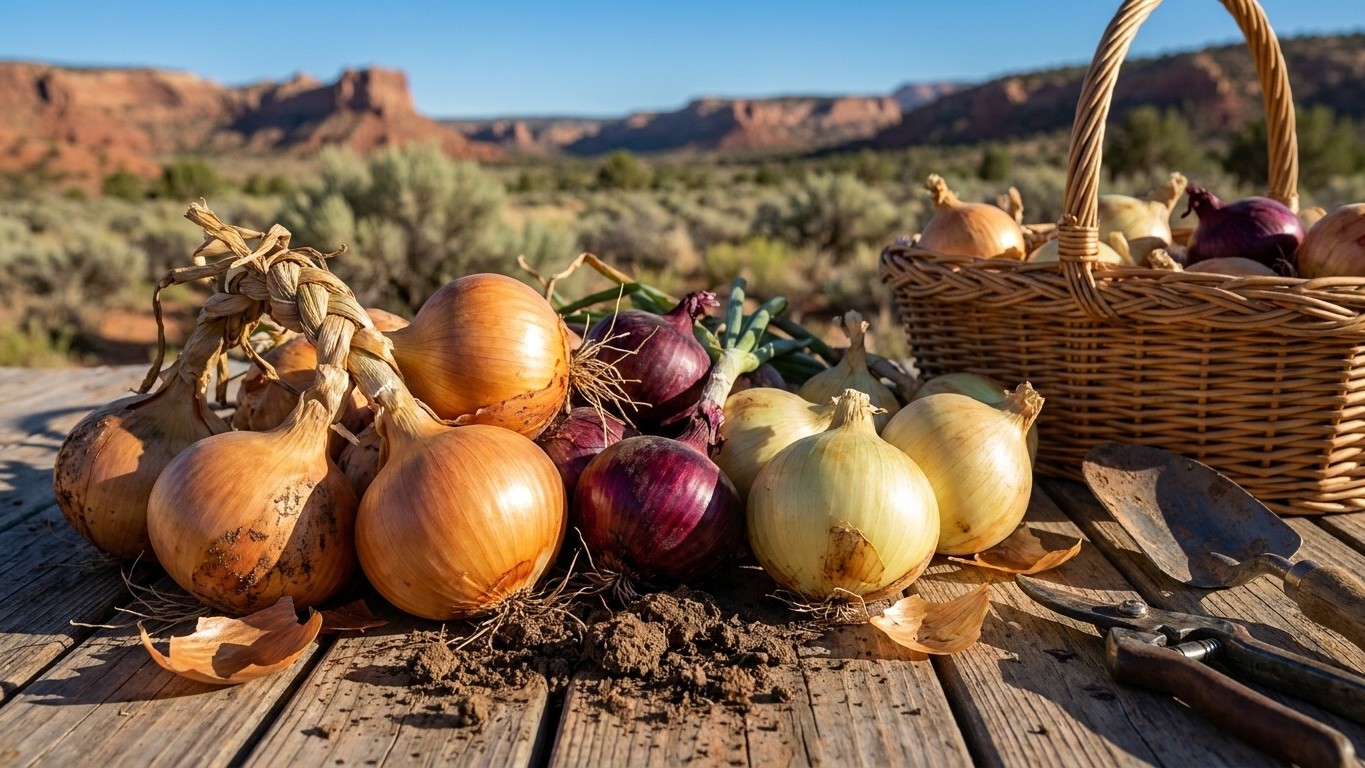

Lift onions once most of the tops have fallen over and the necks have gone soft. Then cure them in a warm, shaded, airy spot until the necks are tight and the outer skins feel papery. Only cured bulbs go into storage. Texas gardeners with fall-planted short-day onions usually reach that point as the days lengthen in spring, a little earlier near the Gulf and later farther north. Pungent onions keep for months in cool, dry air. Sweet ones barely keep.
When are onions ready to lift in Texas?
Day length decides when an onion stops making leaves and starts making a bulb. Warmth matters far less. The reference city for these numbers is Houston, at 29.98 degrees north, where the longest day of the year has 13 h 56 of daylight. Clemson Cooperative Extension puts the bulbing trigger for short-day onions at about 12 hours, so those varieties start swelling early in spring. A long-day onion needs 14 to 16 hours, and Houston never gets that much. Long-day types would grow leaves and then rot there. A gardener far up the Panhandle or along the Red River sits several degrees north of Houston and has longer summer days, so check your own latitude before assuming the Gulf Coast timetable applies.
Ignore the calendar once the plants start talking. The tops yellow, then flop over at the neck. When a majority of the tops are down, more time in the ground only invites rot. Pull the onions on a dry day, ideally after a few days without rain, and shake off loose soil with your hand. Don’t knock them against a fence or toss them into a bucket. A bruise you can barely see is where rot will begin.
Some bulbs should skip storage altogether. Any onion with a thick, green, stiff neck, a split skin, or visible damage goes to the kitchen first. Insect feeding and disease in the field can open a bulb to decay, which is why it helps to know What Eats Onion in Texas, and When before the season starts, not after the harvest. For a wider look at the whole growing calendar, see Onions in Texas.
How do you cure onions after lifting?
Curing dries the neck and the outer scales so they seal the bulb like a wrapper. Lay the onions in a single layer on a screen, a wire rack, or slatted crates, with air moving underneath. Keep them out of direct summer sun, which can scald the bulbs, and out of the rain. A covered porch, a barn aisle, or an open garage with a box fan running works well. On the humid Gulf Coast, where the air stays damp for days, the fan matters more than the location.
Leave the tops on while they cure. Moisture inside the neck dries down, and cutting the leaves early leaves an open wound. Curing is finished when the neck is tight and no longer pinches wet when you squeeze it, the outer skins rustle, and the roots are shriveled and wiry. The time varies with the weather and the size of the bulb, so use that test instead of counting days. A thick-necked onion that feels spongy near the top is not done.
Once cured, trim the roots close and cut the tops to leave a short neck, or braid them if the tops are still pliable. Brush off dry dirt but don’t wash the bulbs, because water undoes the work. Then sort them. Sweet onions are the reason for sorting, since Missouri Extension (publication G6355) says that “as a rule, ‘sweet’ onions do not store as well as the more pungent types.” The bite of an onion comes from volatile sulfur compounds, and the same compounds help protect the bulb in storage. A sweet variety carries fewer of them. It tastes better raw, and it will not last the winter. If you grow for storage, the choice of variety matters as much as the storage room, which is the point of The Best Onion Varieties for Texas.
Keeping them, and for how long
Cured onions want cool, dry air. Clemson Cooperative Extension’s Home & Garden Information Center says: “Ideal conditions are between 45 °F and 55 °F, and 50 to 60 percent humidity.” That is dry compared with what most root crops want. Carrots and other roots like damp, cold storage, and a single cellar can’t hold both well. Put onions in a root cellar at high humidity and they sprout and rot from the neck down.
No storage period applies to every onion, so treat any quoted duration as a maximum under ideal conditions. A bulb at 45 °F to 55 °F and 50 to 60 percent humidity gets the longest life its variety can give. A bulb in a warmer or damper spot gets less, sometimes far less. Day length shapes this too. Short-day onions run sweeter and have fewer protective compounds, and long-day types keep longer. So a southern garden gives onions to eat soon after harvest, while a northern garden gives onions that feed a household into March. A Texas gardener who plants short-day varieties should plan to eat the crop through the summer and fall, and not count on onions in the pantry at the end of winter.
How do you store cured onions?
Air is the main tool. Use mesh bags, open baskets, slatted crates, or old pantyhose with a knot between bulbs. Anything that lets air flow around each onion works, and anything that traps moisture does not. Keep onions away from potatoes, and check the pile regularly. One soft onion can spoil its neighbors. Pull out any that feel soft or smell sour, and eat the sprouting ones soon.
Where in the house that actually is
The numbers sound simple until you look for a room that matches them. A domestic refrigerator runs colder than the 45 °F floor, and the closed air inside turns onions soft. A heated or air-conditioned living area is too warm for long keeping. A garage swings with the weather. It can sit in range on a mild winter night and climb well past it by afternoon, and in a Texas summer it will be far outside the range for weeks. Moisture in the garage can follow the same swings, damp after a storm and dry after a week of heat.
In a Texas house, the room that comes closest is usually an interior closet, a pantry on the north side, or a rarely used spare room, shut off from the kitchen and the vents. These spots stay cooler and drier than the main rooms and don’t see direct sun. They may not reach 55 °F in summer, so expect shorter storage than the ideal figures promise. Winter gives you a better chance, especially in an unheated room that stays dry. A shaded porch can serve in fall and early winter, though a stretch of damp or hot weather can undo it in days.
Don’t guess. Put a thermometer and a hygrometer in the spot for a few days before the onions move in, and read them morning and afternoon. Skipping that check can cost you the whole crop, because an onion stored a few degrees too warm sprouts, and one stored in damp air rots. If the numbers run high, put the best-cured, most pungent bulbs in the coolest spot and use the rest first. A small fan that keeps air moving in a closet helps more than most people expect.
Common questions
Can I store onions in the refrigerator?
Whole cured onions do poorly there. The fridge is colder than the 45 °F to 55 °F range and the air is humid, so the bulbs soften and mold. Keep cut onions in a sealed container in the fridge.
How do I know an onion is cured enough to store?
The neck is tight and dry, with no moisture when you squeeze it, and the outer skins are papery and rustle. The roots are shriveled. If the neck still feels thick or damp, give the bulb more time in a shaded, airy spot.
Why do my sweet onions rot in storage?
Sweet onions carry fewer of the volatile sulfur compounds that protect a bulb, so they do not keep as well as pungent types. Missouri Extension says as much. Eat them first, and don’t expect one to last the winter.
Should I cut the tops off before curing?
No. Leave them on until the neck is fully dry, then trim to leave a short neck. Cutting early leaves an open wound that lets in rot, and the tops help moisture leave the bulb as it dries.
Clemson’s guidance covers onions, leeks, shallots, and garlic in one fact sheet at hgic.clemson.edu, and your county extension office can tell you which curing window fits your part of the state.