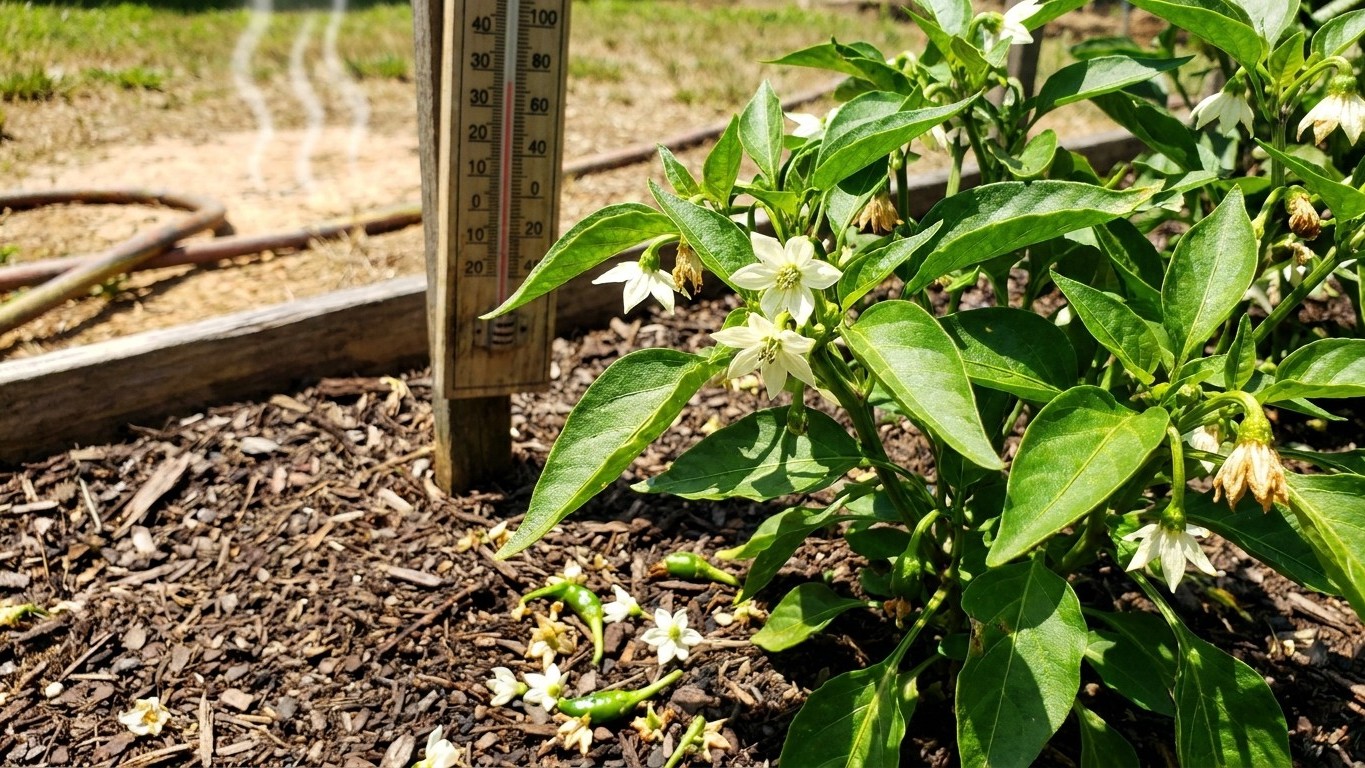

Peppers stop setting fruit in Texas because both ends of the state’s temperature swing push blossoms outside the narrow window where pollen stays viable and flowers can hold. It isn’t a single scorching afternoon or one chilly night that ruins a plant. It’s the accumulation, heat piling up day after day in summer, and cool snaps arriving before the plant is ready for them in spring or fall.
The short answer
Houston’s reference station logs 102.4 days a year at or above 90°F, according to NOAA NCEI Climate Normals covering 1991-2020. That’s the number that matters most for pepper growers anywhere in the state’s warmer stretches, because it’s not the average summer temperature that ruins fruit set, it’s how many individual days cross that 90°F line. Each one of those days is a chance for pollen to turn sterile before it ever reaches the stigma. String together a run of them in July or August, and a plant that was loaded with blossoms in June can go weeks without setting a single new pepper, even while it keeps flowering.
The mechanism is straightforward once you see it. Pepper pollen is a fragile thing. Above roughly 90°F, especially when that heat holds through the afternoon pollination window, the pollen grains lose viability fast. Flowers open, get visited by whatever pollinators are around, and still drop unfertilized. The plant isn’t sick. It’s just been handed conditions where fertilization can’t finish the job.
The other end of the range causes the identical symptom for a different reason. Nights that drop below 55°F slow pollen development enough that fruit set stalls again, this time because the flower parts never mature properly before opening. This is where a lot of springtime frustration in Texas comes from, particularly for anyone who transplants a little early hoping to beat the summer heat, only to watch April blossoms fall off without setting.
Here’s the catch worth being upfront about: this site tracks days above 90°F by territory, because that data is measured and published at a station level. Summer night minimums aren’t part of that same dataset. Texas is enormous and its microclimates vary by elevation, distance from the Gulf, and even by which side of a city you’re on. A grower in the Hill Country and a grower thirty miles from the coast can have night lows that differ by several degrees on the same date. There’s no reliable way to infer that number from where you sit on a map, and guessing based on latitude or on how cold your winters get will mislead you. The only dependable move is watching your own thermometer on the nights that matter, late spring and again in early fall, and treating 55°F as the line where fruit set becomes unreliable.
When to start seed here
The timing question comes down to counting backward from two dates that have to line up: the last frost, and the day your soil actually reaches 60°F. Pepper seedlings need 8 to 10 weeks indoors before they’re ready to go in the ground, and they shouldn’t go in until both of those markers have passed, according to Utah State University Extension. Here’s how the arithmetic works, using Houston’s own frost data as a worked example rather than a statewide rule.
- Start with the local frost window. For the Houston area, NOAA NCEI’s 1991-2020 Climate Normals put the 32°F freeze probability in the 30 to 70 percent band between February 4 and March 1, based on the IAH station. That’s a probability range, not a guarantee, so treat the later end as the safer target if you don’t want to gamble on an early planting.
- Add time for soil warmth. Air temperature crossing above freezing doesn’t mean the soil is warm enough. Peppers need soil at 60°F before transplanting, and soil lags behind air temperature by anywhere from one to several weeks depending on how much sun your bed gets and whether it’s mulched. Push your transplant date out accordingly rather than transplanting the day frost risk clears.
- Count back 8 to 10 weeks for seed starting. If your realistic transplant date lands in mid-March once frost and soil warmth both check out, start seed indoors in early to mid-January. If it lands later, in early April, push seed starting back to match, landing in late January or early February.
- Adjust for your own county. Texas spans four USDA hardiness zones, and the Panhandle freezes months earlier and later than the Gulf Coast. Hill Country and North Texas sit somewhere in between. Even within the Houston metro, Hobby Airport runs about two weeks milder than IAH, which is the station behind the numbers above. Pull your own station’s frost data before locking in a date rather than borrowing Houston’s window wholesale.
The point of this exercise isn’t to hand you a fixed calendar date. It’s to give you a method you can rerun with your own county’s frost and soil numbers, because a planting schedule built on someone else’s station will be off by weeks in either direction.
What goes wrong here
- Blossom drop from a hot spell. A run of days at or above 90°F, the kind Houston logs 102.4 times a year on average, sterilizes pollen before flowers can set. The plant keeps blooming but stops producing. There’s no fix for the heat itself, but shading the plant during the worst afternoon hours with light cloth, and keeping soil moisture even so the plant isn’t fighting drought stress on top of heat stress, gives blossoms a better shot once temperatures ease.
- Blossom drop from a cool night. The same symptom shows up when nights fall below 55°F, usually in early spring before summer heat has settled in, or again in early fall as it retreats. Since this site doesn’t track night minimums by territory, the only real defense is watching your own overnight lows during those transition weeks and holding off on expecting fruit set until nights consistently clear 55°F.
- Sunscald on exposed fruit. Texas sun is strong enough that fruit left without leaf cover, often after aggressive pruning or after a plant drops leaves under heat stress, develops pale, papery patches on the side facing the sun. Leaving more foliage intact through summer, rather than pruning for airflow the way you might in a milder climate, protects the fruit that does set.
- Blossom-end rot. This shows up as a sunken, leathery patch on the fruit’s blossom end and usually traces back to uneven watering rather than a true calcium shortage in the soil. Heat swings that dry soil out fast, followed by a heavy watering, create exactly the kind of inconsistency that triggers it. Mulching to hold moisture steady and watering on a regular schedule instead of reacting to how dry the surface looks solves most cases.
Common questions
Can I do anything to stop blossom drop during a Texas heat wave?
Not directly, since the pollen sterility that causes it is a temperature response, not a nutrient or watering problem. Shade cloth during peak afternoon hours and consistent soil moisture reduce added stress, which helps the plant resume setting fruit faster once the heat spell breaks, but they won’t keep fruit setting while days stay above 90°F.
Why did my peppers set fruit fine in June but stop in July?
June in much of Texas often sits below the 90°F threshold on more days than July or August do. Once the state moves deeper into summer and the count of 90°F-plus days climbs, as it does toward Houston’s annual average of 102.4, pollen viability drops and fruit set slows or stops even though the plant keeps flowering.
Should I transplant earlier to avoid the summer heat altogether?
Only if your soil has actually reached 60°F and your local frost risk has passed. Transplanting into cold soil to dodge summer heat usually backfires, since a stressed, chilled transplant sets fruit even less reliably than a heat-stressed one, and cool nights below 55°F carry the same blossom-drop risk as hot days.
Does the same 90°F threshold apply everywhere in Texas?
The mechanism does, pollen sterility above 90°F, but the count of days that reach it varies widely across the state’s four USDA zones. Houston’s 102.4 annual days above 90°F is specific to that station; other regions, from the Panhandle to the Hill Country, will show a different tally, so check the figure for your own area rather than applying Houston’s count statewide.