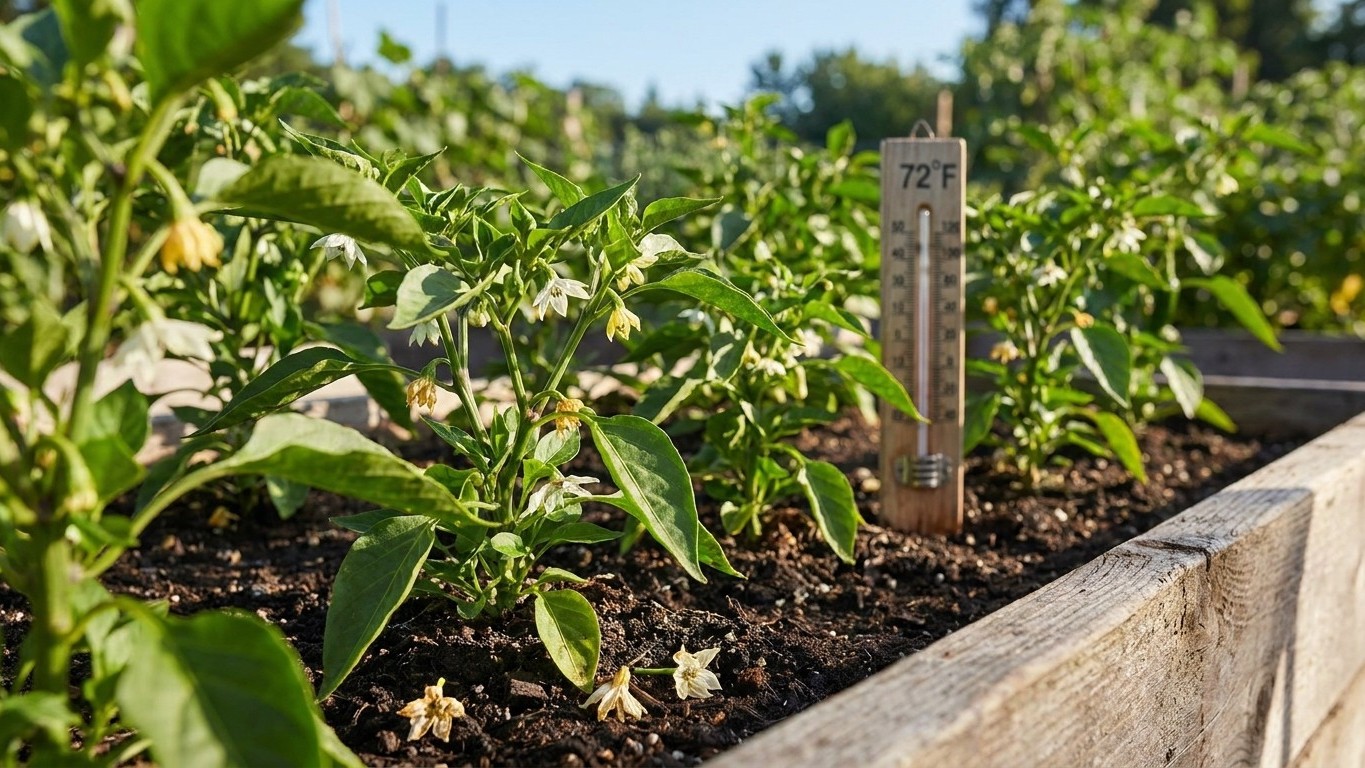

Start pepper seed indoors 8 to 10 weeks before you plan to set transplants outside, timing that back-count to when soil hits 60°F after your last frost. Around Houston, that frost window runs February 4 to March 1, but Texas spans four USDA zones, so a Gulf Coast date tells a Panhandle or Hill Country gardener almost nothing. The trigger is your own soil thermometer and your own frost record, not a statewide calendar.
The short answer
The Houston reference station logs an average of 102.4 days a year at or above 90°F, based on NOAA NCEI Climate Normals for 1991-2020. That number matters more than it sounds like it should, because pepper fruit set collapses once daytime highs push past that same 90°F line. Flowers open, pollen turns sterile in the heat, and the bloom drops without setting fruit. A summer that racks up 102 days that hot isn’t a handful of bad afternoons. It’s roughly a third of the year sitting in a temperature band that can shut down pollination on any given day, which is why so many Texas pepper plants look lush and loaded with flowers all July and produce almost nothing until the weather breaks in fall.
That’s one end of the failure window. The other end is just as real and gets ignored far more often: pepper fruit set also fails when nights drop below 55°F, according to Utah State University Extension. Cool nights slow pollen development the same way scorching days sterilize it, just through a different mechanism. Early spring transplants set out too soon can sit through weeks of chilly nights, hold their blossoms, and drop every one of them before a single pepper forms.
Here’s the gap in the data, and it matters: this site tracks days at or above 90°F for Texas locations, but it does not carry summer night minimums. There’s no published figure here for how many nights in a Texas summer dip below that 55°F threshold, and guessing at one from latitude or from the coldest month of the year would be a mistake. Nighttime lows depend on elevation, local humidity, wind exposure, even how close a yard sits to pavement or open field, none of which a state-level average captures. A gardener in the Hill Country and a gardener forty miles away on the coastal plain can see night temperatures diverge by several degrees on the same date. Watch your own thermometer through the shoulder seasons, spring and again in early fall, rather than assuming the state’s heat numbers say anything about its nights.
When to start seed here
The math behind a pepper seed-starting date is the same everywhere, but the dates you plug into it change by county. Here’s how to run it for your own address.
- Find your local last spring frost date. For the Houston area, NOAA NCEI’s 1991-2020 Climate Normals put the 32°F freeze probability window at February 4 to March 1, based on data from station USW00012960 at Bush Intercontinental Airport. That’s the mild Gulf end of the state. Even nearby, Hobby Airport runs roughly two weeks milder than IAH, and the Panhandle freezes months earlier in fall and later in spring. Pull your own station’s normals before using any date from this article.
- Don’t transplant on the frost date alone. Soil has to reach 60°F, and cold, wet Texas clay in February often lags well behind the air. Check soil temperature at a 4-inch depth for several consecutive mornings before trusting it.
- Set your transplant target as the later of those two conditions. If your last frost date has passed but soil is still sitting at 52°F, wait. Peppers set into cold soil sulk for weeks rather than grow.
- Count back 8 to 10 weeks from that transplant date. That span, per Utah State University Extension, is how long pepper seedlings need indoors to reach transplant size and vigor.
- Use the Houston window only as an example of the method, not a fixed date. If frost risk there clears by early March and soil warms shortly after, an 8 to 10 week count-back lands seed-starting in early-to-mid January for that specific station’s normals. A Panhandle gardener working from a frost date months later would push seed-starting back to match.
- Recheck soil temperature before the actual transplant day arrives. A cold snap in late winter can push the 60°F mark back by a week or two even after your calculated date passes.
What goes wrong here
- Blossom drop from a hot spell. Once daytime highs climb past 90°F, a threshold Houston hits an average of 102.4 days a year, open flowers abort instead of setting fruit. Shade cloth over the plants during the worst afternoon heat, and keep watering consistent so the plant isn’t fighting drought stress on top of heat stress.
- Blossom drop from a cool night. The same failure shows up in reverse when nights fall below 55°F, according to Utah State University Extension, which can happen with an early transplant or a late cold snap. Because this site doesn’t track summer night lows, watch your own overnight temperatures directly rather than assuming your area is warm enough based on daytime heat alone. Hold transplants a little longer, or cover them on chilly nights, until lows stabilize.
- Sunscald on exposed fruit. Texas sun is intense enough that peppers left without leaf cover, especially after aggressive pruning, develop pale, papery patches on the side facing the sun. Let foliage grow fuller than you would in a milder climate, and avoid over-thinning leaves just to “let light in.”
- Blossom-end rot on the fruit itself. Irregular watering, heavy rain followed by a dry stretch, interrupts calcium uptake and shows up as a sunken, leathery spot on the fruit’s bottom end. Even soil moisture, achieved with mulch and a consistent watering schedule rather than occasional deep soaks, prevents most of it.
Common questions
Can I use the Houston frost date if I live somewhere else in Texas?
No. That February 4 to March 1 window comes from a single NOAA NCEI reference station near Houston. Texas covers four USDA hardiness zones, and frost dates shift by months from the Gulf Coast to the Panhandle. Pull normals for your own nearest weather station instead.
How do I know when my soil actually hits 60°F?
Use a soil thermometer at a 4-inch depth, checked in the morning over several consecutive days rather than a single reading. Air temperature and soil temperature can lag each other by a week or more in early spring, especially in clay-heavy ground.
What if my nights are still below 55°F after my last frost date?
Hold your transplants. A frost-free night isn’t the same as a warm enough night for pepper fruit set. Since this site doesn’t track summer night minimums, check your own overnight lows directly before moving plants outside.
Does starting seed earlier indoors help beat the 90°F heat window?
It can shift bloom time earlier, ahead of the worst summer stretch, but only if the transplant date and soil temperature line up first. Starting seed too early without a matching outdoor window just leaves leggy, rootbound seedlings waiting on the windowsill.