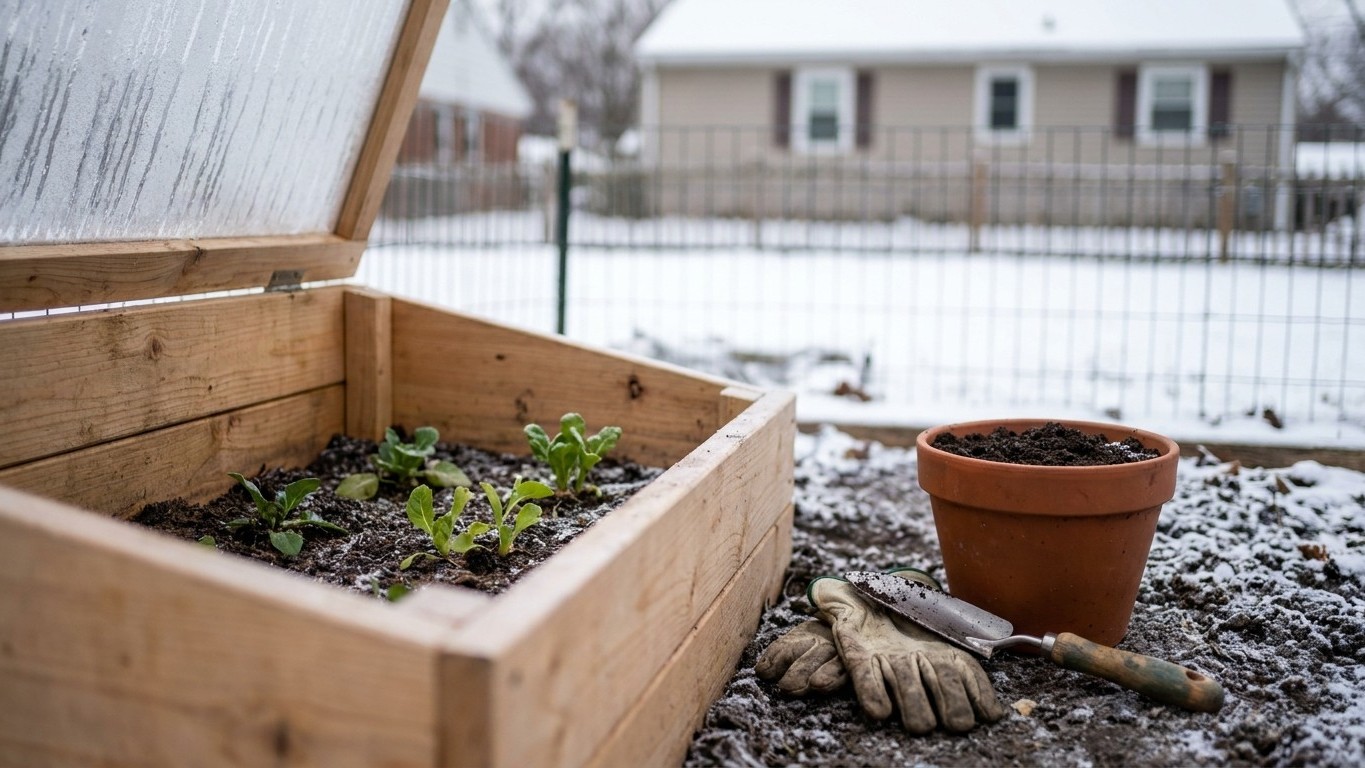

January in most of Texas still sits inside the frost window, so the ground stays reserved for cold-hardy crops: garlic, shallots, English peas, and leafy greens under some kind of cover. The real work this month is dormant pruning, seed ordering, and soil prep, not full-scale planting.
What goes in the ground in January

The calendar says January. The soil and the sky say something else, and that’s what actually decides whether a seed or a transplant survives. For the Houston area, NOAA’s 1991-2020 Climate Normals put the last spring freeze somewhere between February 4 and March 1. That means most of January sits squarely inside the freeze-risk window, not past it. Planting a tender crop now is a bet against a freeze that statistically hasn’t finished happening yet.
What survives that bet: garlic and shallot cloves, which want a long cold spell before they bulb up and don’t mind a hard freeze on top of them. English peas, planted where the soil is workable and not waterlogged, tolerate a light frost once they’re up. Hardy greens, collards, kale, spinach, mustard, can go into open ground if they’re given a row cover or cold frame for the coldest nights. Root crops started earlier in fall, carrots, beets, turnips, can still be direct-sown in mild pockets, but they need protection on the nights that dip hardest.
Bare-root fruit trees, roses, and cane berries go in now too, while they’re dormant and not asking the soil for warmth. This is also the window for forcing rhubarb or chicory indoors in a dark box, a trick that works regardless of what’s happening outside.
None of this holds evenly across the state. Texas spans USDA hardiness zones 6a to 10a, and the Houston freeze dates above are the mild Gulf end of that range. The Panhandle, at the cold end, is still locked in real winter through January with a much later last freeze than the Gulf Coast figures suggest. The Rio Grande Valley, at the warm end, may already be past its riskiest nights. Treat the Houston window as one data point, not a statewide instruction, and don’t put warm-season seed in the ground anywhere in the state this month on the strength of a few mild afternoons.
What to start under cover
Indoor seed-starting in January runs on a different clock than outdoor planting: instead of asking “is it safe outside,” the question is “how many weeks until it’s safe outside, and does this crop need that head start.” Tomatoes, peppers, and eggplant are the classic candidates, since they typically need six to eight weeks indoors before they’re sturdy enough to go in the ground, and they can’t go outside until well after the last freeze risk has passed.
Work the arithmetic backward from the local last-frost window rather than from a fixed date on the wall. In the Houston area, where NOAA’s data puts the last freeze between February 4 and March 1, seed started indoors in early to mid-January lands close to the six-to-eight-week mark for a transplant that goes out once the freeze risk has genuinely passed, not just eased. Gardeners farther north or at higher elevation need to push that start date later, since their frost window closes weeks after Houston’s.
The two ways this goes wrong are mirror images of each other. Start too early, and the seedlings get rootbound in small trays, stretch for light, and turn leggy and stressed weeks before it’s safe to plant them out, a plant that never really recovers its vigor. Start too late, and the transplant misses its window entirely, forcing a gardener to either buy nursery starts or skip the crop for the season. Neither failure is about bad luck. Both trace back to counting from the wrong date.
Onions from seed, along with lettuce and brassica transplants meant for an early spring bed, are lower-risk to start now since they tolerate a wider range of transplant timing than a heat-loving tomato does.
What is ready to pick
January harvests in Texas lean on what went into the ground months earlier, plus whatever the citrus trees are doing. Along the Gulf Coast and in the Rio Grande Valley, citrus, grapefruit and oranges especially, hits its harvest stretch in the depth of winter, one of the few fresh fruits actually coming off a Texas tree this month.
Overwintered greens, kale, collards, spinach, and mustard planted in fall, keep producing as long as they’re getting some frost protection on the coldest nights. A cold frame or low tunnel over a bed of these greens can supply cut-and-come-again harvests through the whole month. Cabbage and broccoli started in fall are approaching maturity in the milder parts of the state; a broccoli head is ready when the central cluster is tight and firm, before the individual florets start to loosen and yellow.
Root vegetables sown earlier, carrots, beets, turnips, can be pulled as needed; cold soil actually holds them well, acting as a kind of natural storage. Indoors, sprouts and microgreens are the fastest fresh food a household can produce this month, ready in one to two weeks from seed regardless of what the weather’s doing outside.
Stored crops need a check-in now. Winter squash, potatoes, and onions held from fall should be turned over and inspected; a soft spot or a sweet, fermenting smell means that piece needs to be pulled before it spreads rot to the rest of the bin.
The jobs that matter this month

January’s real value isn’t in what gets planted, it’s in what gets fixed, sharpened, and set up before the growing season demands attention elsewhere. Dormant pruning tops the list: fruit trees, grapevines, and cane berries are leafless and inactive now, which makes it the correct time to cut for shape and airflow without stressing active growth or losing the season’s fruit buds. Wait until spring growth starts and every cut costs yield.
Seed ordering belongs on this list with a real deadline attached. Seed companies sell out of the popular varieties by late winter, and a gardener who waits until March to order is choosing from what’s left, not what they actually wanted.
Soil testing and amending pays off precisely because nothing’s growing to disturb. A soil test now gives time for lime or sulfur to adjust pH before spring planting, something that doesn’t work as a last-minute fix once beds are full. Turning the compost pile, even in cold weather, keeps decomposition moving and means finished compost is ready by the time spring beds need it.
Tool maintenance, cleaning and sharpening pruners, shovels, and hoes, takes an afternoon now and saves frustration later. Bed and fence repairs are easier to spot and fix while beds are empty than after they’re planted. Rotation planning, deciding which family of crops goes where based on what grew there last, is a job that has to happen before seed goes in the ground, which makes January, not spring, the actual deadline.
None of this is filler work. Skip the pruning window and a fruit tree carries the wrong shape all season. Skip the seed order and the variety list shrinks. Skip the soil test and spring amendments arrive too late to matter.
What not to do in January
The most common mistake is planting by feel instead of by data: a run of 70-degree afternoons convinces a gardener that it’s safe to put tomatoes or peppers outside, and then a freeze arrives on schedule, since the mild stretch didn’t move the actual last-frost window. NOAA’s Houston normals put that window between February 4 and March 1, and a warm week in early January doesn’t shorten it. Wait for the calendar window to close, not for a comfortable afternoon.
A related error is uncovering cold frames or pulling row covers off hardy greens too early after a mild spell, only to have them exposed when the next cold front rolls through. Texas winters swing hard between warm Gulf air and Arctic fronts, sometimes within the same week; leave protection in place until the freeze risk has genuinely passed, not until it feels unnecessary for a few days.
Nitrogen fertilizer applied now is another classic misstep. Nitrogen pushes soft, leafy growth, and that new growth is the most freeze-vulnerable tissue on the plant. Feeding a garlic bed or an overwintering green a dose of nitrogen in January can trigger a flush of tender leaves right before the next hard freeze damages them. Hold nitrogen until growth is meant to accelerate, closer to the actual last-frost date.
Pruning spring-flowering shrubs, azaleas and similar plants that set their buds the previous year, also belongs on the avoid list. That pruning happens right after bloom, not now, or the flower buds get cut off before they ever open.
Checking this against your own county
A statewide answer for January is a starting point, not an instruction, and Texas makes that gap wider than most states. The territory spans USDA hardiness zones 6a to 10a, and the Houston freeze dates cited here sit at the mild Gulf end of that spread. Elevation in the Hill Country, latitude differences between the Panhandle and the Rio Grande Valley, and even airport-to-airport variation within Houston itself (Hobby runs about two weeks milder than IAH) all shift these windows by weeks in either direction.
Texas A&M AgriLife Extension (agrilifeextension.tamu.edu) publishes county-level guidance and planting calendars that account for these regional differences directly. Checking a home county’s freeze data there is a better move than stretching one Gulf Coast station across the whole state.
Common questions
Can tomatoes go outside in Texas in January?
No. Even in the mild Gulf Coast zone, January sits inside the last-frost window (February 4 to March 1 for the Houston area per NOAA), well before tomatoes could survive outdoors without protection.
Is it too late to plant garlic in January?
It’s on the later side but still workable in many parts of the state if the soil is unfrozen and can be worked; garlic planted now will simply bulb smaller than a fall-planted crop, since it gets less cold exposure before spring.
What fruit is actually harvestable in a Texas January?
Citrus is the standout, particularly in the Rio Grande Valley and along the Gulf Coast, where grapefruit and oranges reach harvest during the coldest months of the year.
Why does the same “January” advice not work across the whole state?
Texas covers USDA hardiness zones 6a through 10a, a spread wide enough that a freeze date accurate for Houston can be off by weeks for the Panhandle or the Rio Grande Valley; county-level data from Texas A&M AgriLife Extension closes that gap.
Gardeners who plant by the Moon can check the January 2027 moon planting calendar, a tradition rather than a proven method.