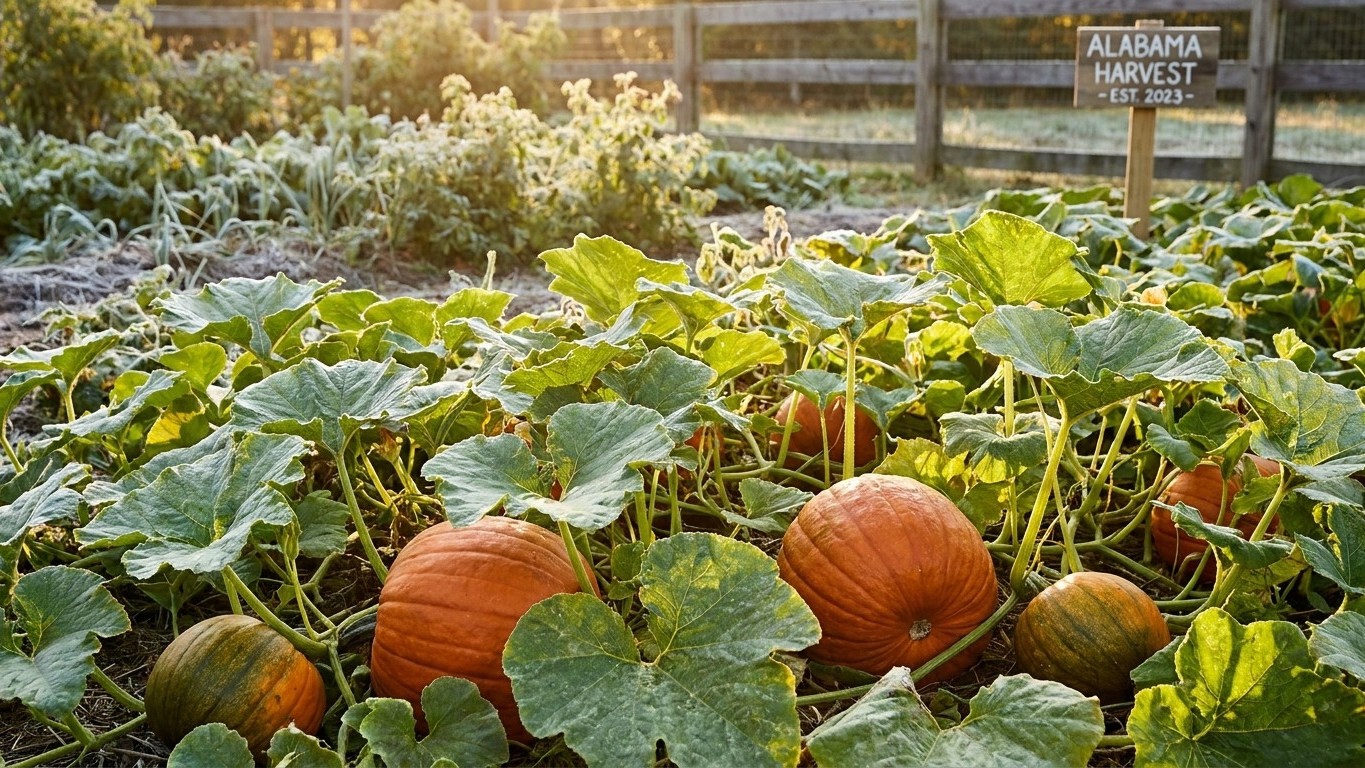

In most of Texas, the math works only if pollination happens by early fall. Around Houston, first fall frost lands somewhere between December 1 and December 19, and a pumpkin needs 45 to 55 days after its flower opens to turn from green to orange. Count backward from that frost window and the real deadline isn’t a planting date at all. It’s the day the flower opens.
The short answer
NOAA’s 1991-2020 Climate Normals put the first fall freeze at Houston’s IAH station somewhere in a nineteen-day spread, December 1 to December 19. That’s the number to subtract from, and subtracting isn’t optional. It’s the whole calculation.
Pumpkins take 45 to 55 days to mature after flowering, not after the seed goes in the ground and not after the vine sets its first true leaf. Flowering is the starting gun. So take the earliest edge of the frost window, December 1, and pull back 55 days, and you land around October 7. Take the latest edge, December 19, and pull back only 45 days, and you land around November 4. That gives a flowering cutoff window running roughly from the first week of October to the first week of November, not a single line on the calendar.
That spread matters because a pumpkin flowering on October 8 is playing it safe. One flowering on November 3 is betting on the mild end of both ranges lining up in the same year, and betting on 45 days instead of 55. Growers who let vines flower into mid-November are asking a fruit to finish coloring in the same stretch of days the frost window itself covers. That’s not a margin. That’s a coin flip.
None of this holds outside the Houston area. Texas spans four USDA hardiness zones, and the IAH figures above sit at the mild Gulf end of the state. The Panhandle freezes months earlier in fall and months later in spring than Houston does. Hill Country and North Texas run on their own clocks entirely. Even inside the Houston metro, Hobby airport reads about two weeks milder than IAH, which means a flowering cutoff calculated for one side of town can be off by two weeks on the other side. A Houston frost window is not a Texas planting calendar, and treating it as one is how a perfectly good vine ends up carrying a green pumpkin into December.
When to sow here
Working backward from a fall flowering cutoff only helps once the front end of the season is set correctly, and that’s where a lot of Texas gardeners lose weeks without realizing it. The last spring frost in the Houston area falls between February 4 and March 1. Soil, though, doesn’t warm on the same schedule as the air above it. The ground lags the air by weeks, so pumpkin seed going into 65°F soil, the minimum this crop needs to germinate reliably, happens well after that last frost date, not on it and not shortly after it.
- Mark the last spring frost window first. February 4 to March 1 is the frost boundary for the Houston area specifically. Treat it as the starting line, not the planting line.
- Wait for the soil, not the calendar. Because the ground lags the air by weeks, soil in a Houston-area bed typically isn’t sitting at a steady 65°F until well into that lag period. Air temperature charts won’t tell you this. A soil thermometer will.
- Check at seed depth, not the surface. A reading taken an inch or two down, at mid-morning before the sun has heated the top crust, gives a truer picture of what the seed itself is sitting in.
- Use row covers if the season feels short. Row covers trap heat and can buy about two weeks, warming a bed to 65°F faster than open air alone would manage. That two-week head start moves the entire chain of dates, sowing, flowering, harvest, two weeks earlier too.
- Count forward once flowering starts, not before. Once the first female flowers open, that’s the moment the 45-to-55-day clock actually starts running toward harvest, and the fall frost window is what that clock is racing against.
The gap between “last frost” and “soil ready” is the piece most planting calendars skip, and it’s exactly the piece that determines whether a Texas pumpkin patch has any real cushion before the fall cutoff window closes.
What goes wrong here
- A late flower that never colors. When the first mature female flowers don’t open until deep into the fall cutoff window, closer to November than October, there simply isn’t enough runway left before frost to complete the 45-to-55-day maturation. The fruit sizes up but stays green or pale. The fix is pushing sowing earlier using row covers to gain that two-week head start, so flowering happens nearer the safer early-October edge of the cutoff window rather than the riskier early-November edge.
- A fruit caught by frost before the skin hardens. A pumpkin can look nearly done, full color, full size, and still have a soft, thin skin that a freeze damages badly. Harvest with the stem attached before the frost date arrives rather than gambling on a few extra days of ripening on the vine. A pumpkin cut a touch early with an intact stem holds up far better than one left on a dying vine into a freeze.
- A vine that dies back before the skin hardens. Vines under stress from pests, disease, or simple exhaustion late in the season can collapse before the fruit’s rind has thickened, even without a frost involved. Squash bugs and cucumber beetles are common culprits behind that kind of early vine decline in Texas gardens, and both already have dedicated pages on this site covering identification and control specific to squash bugs in Texas and cucumber beetles in Texas. Catching either problem early keeps the vine alive long enough for the rind to finish hardening on schedule.
Common questions
Can pumpkins still be planted in midsummer in Texas?
It depends entirely on whether flowering can happen inside the cutoff window calculated from the local first fall frost. In the Houston area, that means working backward from the December 1 to December 19 frost window and confirming there’s still time for flowers to open in the early-October-to-early-November range. Outside the Houston area, that math changes with the local frost dates.
What happens if a flower opens after the cutoff window?
The fruit will likely still grow in size, but it runs out of the 45 to 55 days it needs after flowering to finish turning from green to its mature color before frost arrives. A fruit caught this way is typically green or only partially colored when the season ends.
Does soil temperature really matter more than the last frost date for sowing?
Yes, for germination specifically. The last frost date only marks when air temperatures stop dropping to freezing. Soil needs to independently reach 65°F, and it reaches that threshold weeks after the last frost, not on the same day.
Are frost dates the same across Texas?
No. The dates in this article come from the Houston area’s IAH weather station and represent the mild Gulf end of the state. The Panhandle, Hill Country, and North Texas all run on different frost schedules, and even Houston’s own Hobby airport reads about two weeks milder than IAH.