
In the Houston area, pumpkins need to flower by early October to early November to ripen before the first fall frost, which lands somewhere between December 1 and December 19. Sowing happens later than most gardeners expect: not at the last spring frost (February 4 to March 1) but once the soil itself reaches 65 F, often weeks after the air has warmed. Texas covers four USDA zones, so this Gulf Coast timeline shifts hard once you move north or west.
The short answer
Start with the frost date, not the seed packet. In the Houston area, the first fall freeze arrives somewhere between December 1 and December 19, based on three decades of NOAA data collected at the IAH weather station. That’s a real range, not a single cutoff, and it matters because pumpkins don’t ripen on a fixed calendar. They ripen 45 to 55 days after the flower opens, according to Utah State University Extension, which tracks pumpkin growth stages closely. Not 45 to 55 days from the seed going into the ground. From the moment a flower opens and the fruit sets.
Run the math backward from the earlier end of that frost window. Counting back 55 days from December 1 lands on October 7. Counting back 45 days from that same date lands on October 17. So if the frost hits on the early side, flowers need to open no later than mid-October to guarantee a ripe pumpkin with hardened skin.
Now run it from the later end. December 19 minus 55 days is October 25. December 19 minus 45 days is November 4. If frost holds off until the tail end of its usual window, flowers opening through early November still have a shot at finishing.
That gives a real window for the Houston area: the last safe flower openings fall somewhere between early October and early November, depending on which end of the frost range shows up in a given year and how quickly an individual fruit matures. Neither edge of that window is a promise. A flower that opens on November 3 in a year when frost arrives December 1 instead of December 19 has already lost the bet.
None of this holds for the rest of the state. Texas spans four USDA hardiness zones, and the Houston figures used here sit at the mild end of the Gulf Coast. The Panhandle freezes months earlier in fall and months later in spring. Hill Country and North Texas run their own separate clocks, shaped by elevation and distance from the coast. Even inside the Houston metro, Hobby Airport tends to run about two weeks milder than the IAH station these figures come from. Treat this window as a Gulf Coast example, not a statewide planting calendar.
When to sow here
- Let the last spring frost window close first. In the Houston area, that stretch runs February 4 to March 1. Seeds and young pumpkin vines have no tolerance for a freeze, so nothing goes into the ground before this window has passed, and even the tail end of it carries risk in a colder-than-average year.
- Wait for the soil, not the air, to catch up. Pumpkins need soil at 65 F to germinate reliably, and soil temperature lags behind air temperature by weeks. Along the Gulf Coast, clay-heavy soils hold onto both cold and moisture longer than sandy ground does, so a calendar that says frost season has ended doesn’t mean the dirt six inches down has warmed to match.
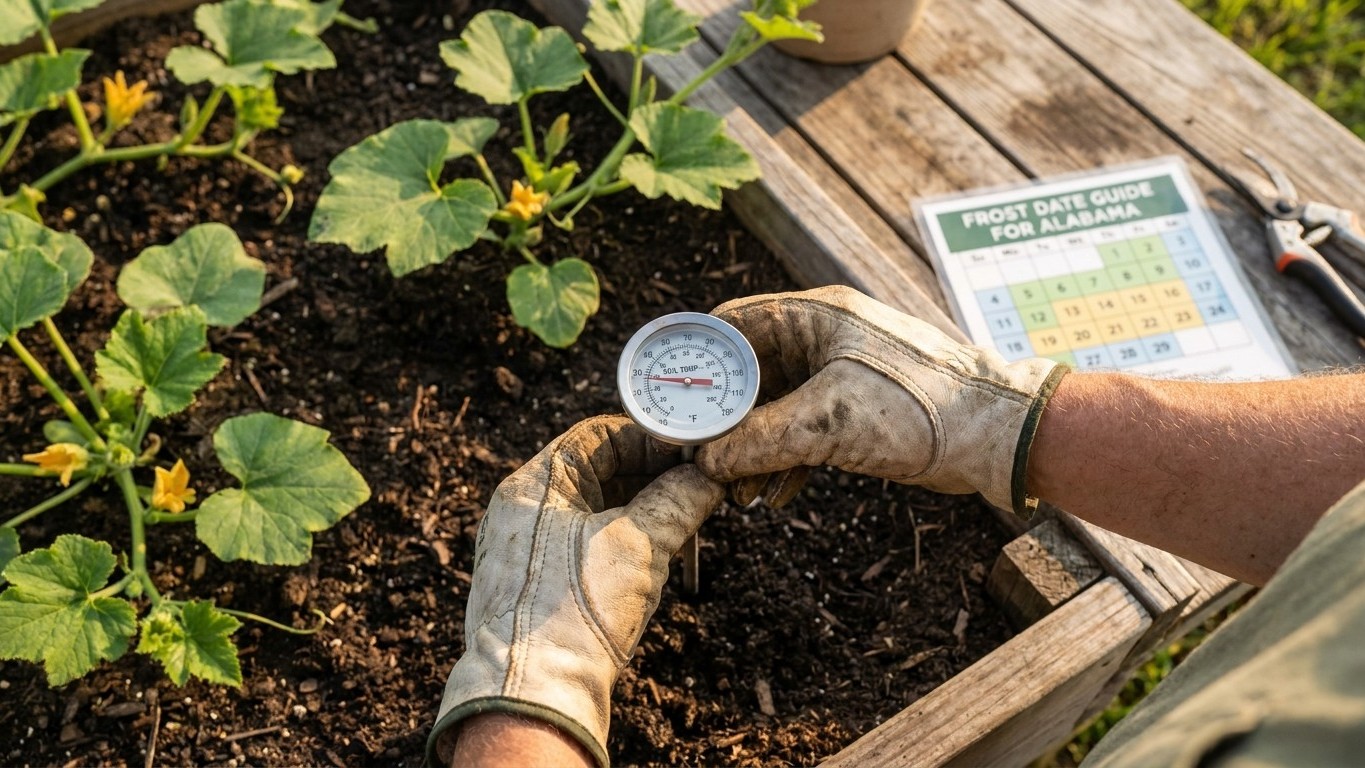
- Check with a soil thermometer instead of guessing. Push it several inches into the bed, take the reading in the morning before the sun has heated the surface, and wait for consistent readings near 65 F over several days rather than trusting one warm afternoon.
- Weigh row covers if the season feels tight. A row cover can buy roughly two weeks of head start by trapping warmth against the soil surface, which matters most in years when the fall frost arrives on the early side of its window and the 45-to-55-day flowering clock leaves little margin.
- Count forward from sowing to first flowers. Pumpkin vines spend several weeks in early growth before the first blooms open, so the sowing date has to leave room for that stretch before the flowering clock even starts counting.
- Count backward from the fall frost window. Once flowering begins, the fruit still needs 45 to 55 more days. Working backward from December 1 through December 19 sets the outer boundary for how late flowering, and therefore sowing, can happen and still produce a pumpkin with hardened, storable skin.
What goes wrong here
- A flower opens too late and the fruit never colors. If pollination happens after the safe cutoff, somewhere in the early October to early November range depending on the year, the pumpkin stays small and green when frost hits. Tracking flowering dates on the vine itself, rather than only the sowing date, catches this early. Once the calendar passes the cutoff, pinching off new flower buds redirects the plant’s energy into fruit already set instead of blooms with no chance of finishing.
- A nearly-ripe fruit gets caught by an early frost. Because the frost date is a range and not a fixed point, a freeze arriving December 1 instead of December 19 can catch fruit that would have finished given three more weeks. Utah State University Extension recommends harvesting with the stem attached before frost hits, even if the pumpkin hasn’t fully colored, and storing it somewhere it will not freeze rather than leaving it exposed on the vine hoping for a few more warm days.
- The vine collapses before the skin has hardened. Foliage disease and insect pressure, including squash bugs and cucumber beetles, can take down a vine weeks before the fruit is ready, cutting off its ability to finish toughening the rind. This site’s Texas pages on squash bugs and cucumber beetles cover identification and control for this region. Fruit from a vine that dies early can still be cut and cured somewhere warm and dry, though the skin won’t be as durable as one that hardened naturally in the field.
- Seeds go in before the soil is ready. Planting into soil that hasn’t reached 65 F often causes rot or patchy, uneven germination, which gardeners sometimes blame on a bad batch of seed instead of cold dirt. The fix is patience with a soil thermometer, or a two-week jump using row covers rather than trusting the spring frost date alone.
Common questions
Can I still plant pumpkins in July in the Houston area?
July sowing is tight but workable if the vine reaches flowering within a few weeks and the fruit gets its full 45 to 55 days before frost. Given the December 1 to December 19 frost window, a July sowing usually leaves enough runway, though late July cuts the margin thin in a year when frost arrives on the early side.
Does the 45-to-55-day figure include the time before flowering?
No. That figure starts counting only once a flower opens and the fruit sets, according to Utah State University Extension. The weeks a vine spends growing before it flowers at all sit outside that count, and need to be added separately when working out a full sowing-to-harvest timeline.
What if my soil never seems to reach 65 F?
Raised beds and dark mulch both warm faster than bare, low-lying ground and can help close the gap between air and soil temperature. Checking with a soil thermometer over several mornings is more reliable than judging by the calendar or a single warm afternoon.
Is the frost date the same everywhere in Texas?
No, and this is the most important caution on this page. The December 1 to December 19 window applies to the Houston area, measured at the IAH weather station. The Panhandle, Hill Country, and North Texas all run on different frost schedules shaped by elevation and distance from the Gulf, so this window should not be used as a statewide planting guide.