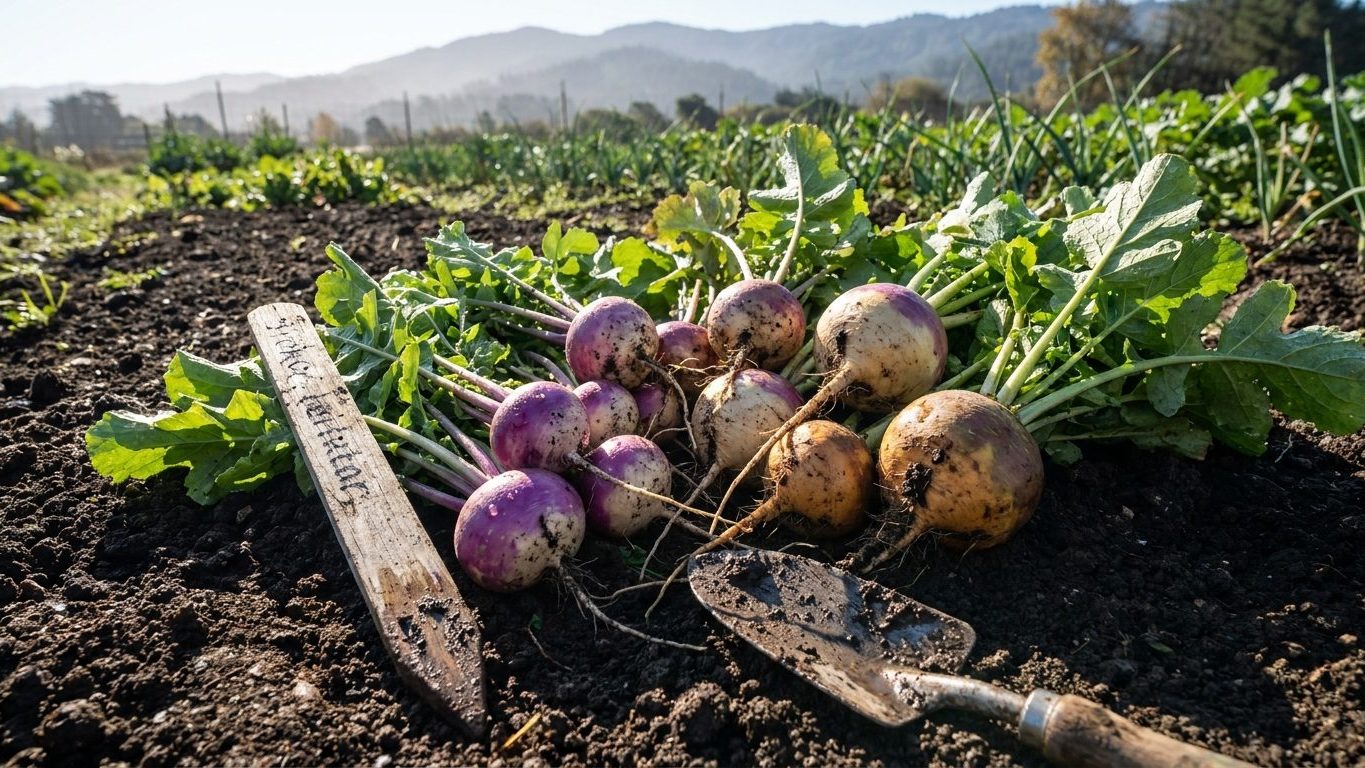

For most of Texas, the best turnips are fast-maturing types sown in fall and eaten through winter, ideally ones that give you both a tender root and good greens. Rutabaga is the gamble. It wants a long, cool stretch that this state rarely provides, and the answer shifts a lot between the Gulf Coast and the Panhandle. For the wider picture, start with Growing Turnips and Rutabaga in Texas.
The short answer for Texas
Choose quick turnips first and treat rutabaga as an experiment. Dual-purpose turnips, which make a decent root and edible tops from the same row, are the safest pick anywhere in the state because they tolerate being harvested young if the weather turns on you.
The reasoning starts with the frost numbers, and they come with a warning. NOAA’s 1991-2020 Climate Normals for Houston (the IAH airport station) put the last spring frost between February 4 and March 1, and the first fall frost between December 1 and December 19. Those dates are a probability, not a promise. They mark the band where the chance of a 32°F freeze sits between 30 and 70 percent. Houston’s coldest month averages a daily minimum of 43.7°F, so winter cold is not what limits turnips on the Gulf end of Texas. Warmth is. Anything that has not finished its root by the time spring heat arrives will turn woody, bitter or bolt.
Houston is the mild Gulf end of the state, and this page does not claim it as a statewide calendar. Hobby airport runs about two weeks milder than IAH, and the Panhandle freezes months earlier and later. For timing, the page on when to sow turnips in Texas goes further.
Turnips by type
The decision is easier by type than by seed packet name.
| Type | Fit for Texas | Best use |
|---|---|---|
| Small, quick salad turnips | Strong. They finish before heat arrives. | Raw or lightly cooked roots, fall and late winter |
| Globe or purple-top turnips | Good in fall sowings. Spring sowings are risky. | Roots and greens together |
| Greens-type turnips | Very good. Forgiving of crowding and cold snaps. | Cut-and-come-again leaves |
| Rutabaga | Marginal in the south and center. Better in the north. | Storage roots, only with a long cool season |
Where rutabaga fits
Rutabaga grows slower than any turnip and sweetens with cool nights. In the northern half of the state, a fall sowing that starts early enough can work. On the Gulf Coast, you are betting a long crop against a short cool window. Plant a few feet of it next to your reliable turnips and let the results decide whether it earns more space.
What will not work here
Spring sowing is the first casualty. With the last frost falling between February 4 and March 1 even at the mild Houston end, the weather warms quickly after that. A turnip sown in late February in the south has only a short run before warmth pushes it toward bolting, and a rutabaga sown then has almost no chance of sizing up. Whatever the seed packet says about spring planting was written for a longer, cooler spring than most of Texas gets.
Summer sowing fails for the opposite reason. Seedlings in hot soil are stressed from day one, and flea beetles and heat-induced toughness finish the job. If you want turnips in the ground in September, you are sowing at a time when the soil is still too warm for good germination and steady growth in much of the state. Wait for the heat to break, and expect that date to land weeks apart in Amarillo and Corpus Christi.
Weekly watering will not carry a crop through a hot, dry stretch in West and Central Texas. Turnips are shallow feeders. When the top few inches of soil swing between bone dry and soaked, roots crack, turn pithy and develop a sharp, hot flavor. A thin layer of mulch and lighter, more frequent watering do far more than one deep soak a week.
On the humid Gulf side, the problem reverses. Close spacing that works in a dry climate traps moisture around leaves, and fungal leaf spots follow. Thin turnips to the spacing the seed packet gives and use the thinnings as greens. Heavy clay that stays wet after winter rains rots roots, so raised rows or beds make a real difference in Houston and east of it.
Sandy soils bring their own trouble. Root-knot nematodes are common in many sandy Texas soils, and they leave knobbly, galled roots on turnips. Rotating the bed away from tomatoes and okra, which nematodes also love, helps more than any variety choice.
The last failure is borrowing dates. A gardener in the Panhandle who follows a Houston calendar will sow into soil that is still cold and risk a hard freeze on young seedlings. A Rio Grande Valley gardener who follows a northern calendar will sow too late and watch heat arrive before the roots do. Dates travel badly in this state.
What changes across Texas
Texas has no single answer, and the USDA Plant Hardiness Zone Map 2023 (built on 1991-2020 normals) shows why. The state runs from zone 6a to zone 10a. That system rests on one variable, the average annual extreme minimum temperature, so it tells you how cold the worst nights get, not how hot summers run or how long the cool season lasts. Still, a spread this wide means that a gardener in the far north and one on the southern coast are working with two different crops.
In the north and at altitude, the cool season is shorter at both ends. Fall sowings need to go in earlier so roots size up before a hard freeze, and a spring sowing becomes a real option because the heat arrives later. Rutabaga makes more sense here than on the coast, where its long maturity runs into warm weather. A light cover, such as a floating row cover, buys time when an early freeze threatens young plants.
In the Gulf and southern parts of the state, the picture flips. Winter is the growing season, with turnips sown in fall and picked through winter, and the frost that matters is an occasional visitor rather than a season. Even inside Houston the dates shift, since Hobby airport runs two weeks milder than IAH. If two weather stations in one city disagree that much, a statewide calendar cannot be right for anyone.
To see where your own garden sits in that range, look up your location on the USDA Plant Hardiness Zone Map rather than guessing from a neighbor’s advice. Then treat the zone as a starting point for how cold your worst nights get, and use local frost observations for timing.
Where to check this for your own county
Your county office of Texas A&M AgriLife Extension is the best next stop. Every Texas county has one, and the staff there know the local soils, the pests that show up in your part of the state and the dates that have actually worked for growers nearby.
Look for two things. The first is a local planting calendar or vegetable planting guide for your county or region, which will give sowing windows for cool-season crops such as turnips. The second is any record of varieties trialled near you. A variety that performed well in a Central Texas trial tells you more than a catalog description written for the whole country. If your county office has a horticulture agent or a Master Gardener program, ask them directly which turnips and rutabaga they see succeed, and which they see fail.
A county recommendation beats a state one, plainly. This page is the state one. It can tell you what types suit Texas’s heat and season, and where the risks lie, but it cannot know that your county has alkaline clay, a late-spring wind pattern or a nematode problem in the sandy creek-bottom soil. Where this page and your county agent disagree, go with the agent.
Checking this against your own garden
Your own observations outrank every date here. Three are worth watching, and none needs equipment.
First, feel the soil. Push your hand a few inches into the bed in the morning. If it still feels warm, like a sun-heated bathwater, it is too early for a fall sowing, and turnip seed will germinate poorly or seedlings will struggle. When the soil feels cool and damp, you are in the window. Check a spot against a south wall and one in open shade, and the difference shows you how much your yard’s microclimate shifts timing.
Second, watch the first true leaves. A turnip seedling opens a pair of rounded seed leaves, then the first rough, lobed true leaves appear. If true leaves arrive quickly and the plant looks sturdy, conditions suit it. If they stall, or seedlings stretch and flop, the bed is too warm or too shaded. Write down the sowing date and the date true leaves appear, and next year you will have a calendar made for your yard.
Third, notice your first frost and where it lands. Walk out on the first cold morning and see which corners show frost on the grass or on car windshields. Low spots and open ground freeze first, while beds by a house wall often escape. That tells you where to put tender seedlings late in the season and where a hardy rutabaga row can wait longer.
Common questions
Can I grow rutabaga in Texas at all?
Yes, with limits. It does best in the cooler northern half of the state with an early fall sowing. On the Gulf Coast, its long maturity runs into warmth. Plant a small test row before you commit space.
Which turnip type is best for greens?
Greens-type turnips are the most forgiving, since you harvest leaves rather than waiting on roots. They handle crowding and cold snaps well. Dual-purpose globe types give you roots and tops from one planting.
Is Texas too hot for turnips?
Not in the cool season. Houston’s coldest month averages a daily minimum of 43.7°F, so winter is mild enough to grow them. Summer is the problem, which is why turnips here run fall through winter, with spring as the riskier window.
Do the Houston frost dates apply to my county?
Only if you live near Houston, and even there they vary. Those dates come from the IAH station, and Hobby airport runs two weeks milder. Check with your county AgriLife Extension office for dates that fit your location.