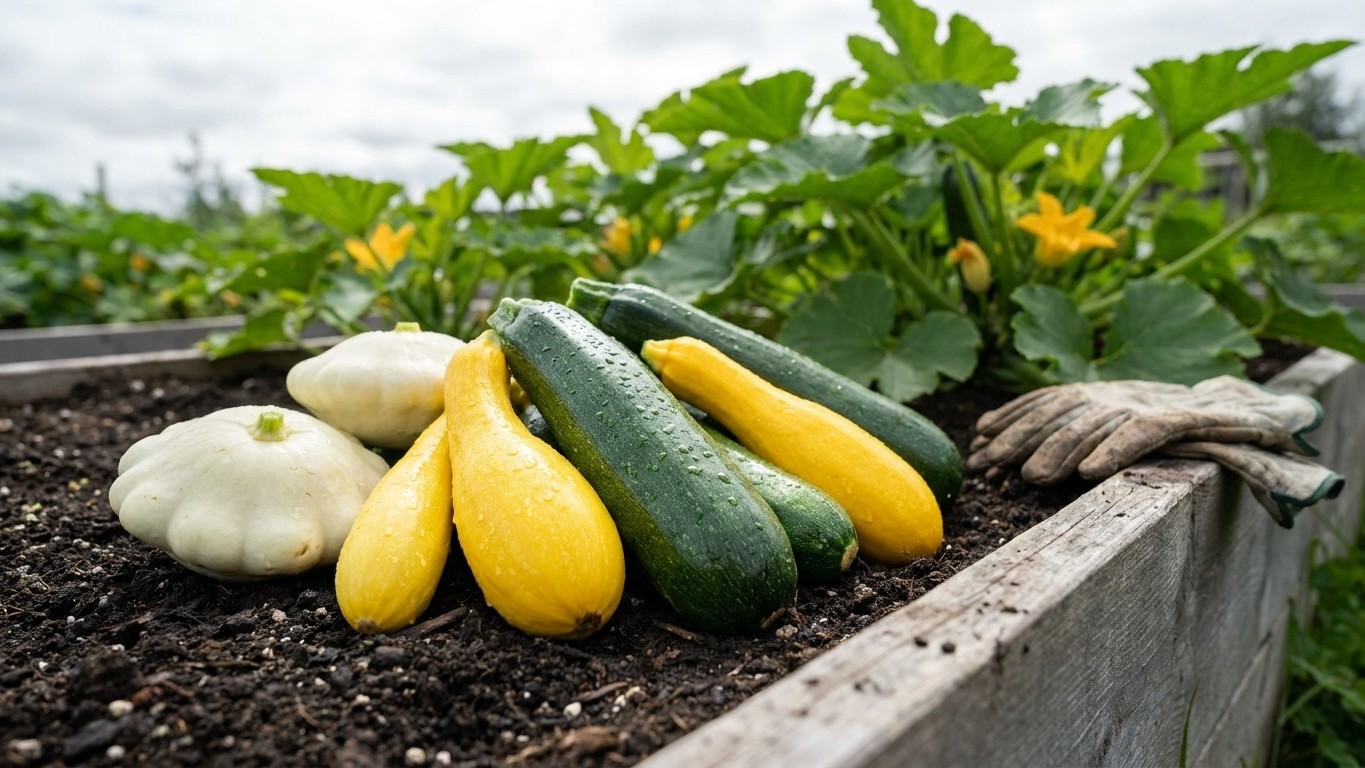

Fast-maturing bush types, chosen for cool-soil vigor and mildew resistance rather than heat tolerance, are the safest bet across Vermont. Zucchini and patty pan varieties bred to set fruit in cooler nights outperform anything marketed for long, hot growing seasons, because Vermont simply doesn’t offer many of those days.
The short answer for Vermont
Vermont’s growing season runs from a last spring frost of April 30 to May 10 to a first fall frost of October 3 to October 13, both measured at the Burlington reference station on Lake Champlain, the mildest corner of the state. That’s a frost-free window of roughly 145 to 165 days at that one location. But the number that actually decides which type of summer squash makes sense here is different: Burlington averages just 5.4 days a year at or above 90°F. That’s a low heat load, and it rules out betting on varieties that need sustained warmth to really take off.
That combination, a workable season length but thin heat, points toward bush-type zucchini and yellow crookneck or straightneck squash bred for quick maturity and cool-soil germination. These types are typically listed at 45 to 55 days to first harvest, which fits comfortably inside even a shortened window, and they don’t sulk the way some heat-hungry specialty types do when nights stay in the 50s through much of June.
Patty pan and scallop types belong in the same category: compact, fast, and forgiving of a cool start. What doesn’t belong is anything sold as a long-season or vining specialty squash bred for Southern or Southwestern conditions. Those varieties are built around heat units Vermont rarely accumulates, and a summer with only 5.4 days above 90°F won’t push them through their full maturity curve reliably.
Disease resistance matters as much as speed. Vermont summers bring about 11.9 inches of rain across June, July and August, with June the wettest month at 4.26 inches. That kind of humidity load favors powdery mildew and bacterial wilt spread by cucumber beetles. Varieties bred with mildew tolerance, now common in modern zucchini and yellow squash lines, hold up better through a wet Vermont July than heirloom types selected mainly for flavor in drier climates.
So the short answer, by type: bush zucchini and crookneck/straightneck squash with mildew resistance, chosen for early maturity, beat vining or long-season specialty types almost everywhere in the state. The exception is the mildest pockets right along Lake Champlain, where an extra week or two of frost-free days gives slightly more room to experiment, but even there, the thin heat load argues against relying on a variety that needs a true hot summer to perform.
What will not work here
Tromboncino and other long-vining, extended-season summer squash are the clearest mismatch. These varieties are often marketed as vigorous and productive, which is true where summers run hot and long, but they’re built to convert sustained heat into growth. Vermont’s 5.4 average days above 90°F a year simply doesn’t supply that. Expect a plant that grows leaves enthusiastically and sets fruit late, right as the first fall frost, arriving anywhere from October 3 to October 13, closes the window.
Tight spacing is the second failure point, and it’s easy to miss because the advice that works in a dry Western state backfires here. Vermont gets close to 4 inches of rain in June alone, and the humidity that comes with it lingers in dense plantings, feeding powdery mildew on the leaf undersides before most gardeners notice it. Summer squash catalogs that recommend 18-inch spacing for arid-climate gardens are giving advice built for a different rainfall profile. In a Vermont garden, that spacing traps moisture around the crown and invites the fungal bloom that turns leaves gray by late July.
Varieties chosen purely for drought tolerance also underperform here, for a related reason: gardeners who buy into “waters once a week and thrives” marketing are usually reading advice written for hot, dry Western gardens where a deep weekly soak makes sense between rain events. Vermont’s rain doesn’t work that way. Even August, the driest summer month, still delivers 3.54 inches, arriving as scattered thunderstorms rather than a steady drizzle. A squash bred to tolerate long dry stretches isn’t wrong for Vermont, but it isn’t solving a problem Vermont actually has. The real issue here is drainage and airflow, not drought survival.
Finally, any variety advertised at 65 to 70 days to maturity, a category that includes some specialty and heirloom summer squash, is cutting things close outside the Champlain Valley. That maturity window fits fine within Burlington’s 145-to-165-day frost-free stretch, but the state’s hardiness zone range runs from 3b to 5b, meaning some parts of Vermont work with a season substantially shorter than Burlington’s. A 65-day squash planted after the last frost in a colder pocket may not finish before the first one returns.
What changes across Vermont
Vermont’s USDA hardiness zone range, 3b to 5b under the current USDA Plant Hardiness Zone Map, spans a genuinely wide gap. That range is built on a single measure, the average annual extreme minimum winter temperature, but it correlates closely with how short or long the growing season runs, and with how many warm days a garden actually gets during summer. There is no single answer for “how long is my season” in Vermont. The spread between a 3b pocket and a 5b pocket is the difference between a garden that can gamble on a slightly slower variety and one that can’t.
Burlington, sitting right on Lake Champlain, represents the mild end of that range. Its frost dates and its already-thin 5.4-day count of 90°F-plus days describe the best-case scenario for the state. The Green Mountains and the Northeast Kingdom run substantially shorter and cooler, both because of latitude and because elevation strips away warm days faster than most gardeners expect. A garden a few hundred feet higher in elevation than a nearby valley floor can lose a meaningful chunk of its frost-free window, even within the same county.
What should shift for a reader gardening in the north or at altitude isn’t the type of squash, bush zucchini and crookneck still make sense everywhere, but the tactics around it. Starting seed indoors three to four weeks before the expected last frost, rather than direct-sowing, buys back time that a shorter season would otherwise cost. Black plastic mulch or row cover in the first few weeks helps a garden with even fewer warm days than Burlington’s average bank some extra soil heat, since summer squash germinates poorly and grows slowly in cold soil regardless of variety.
None of this replaces knowing which zone a specific garden actually sits in. The USDA Plant Hardiness Zone Map, searchable by ZIP code, is the tool for that, not a state-level estimate.
Where to check this for your own county
Vermont as a whole is anchored to the Burlington reference station because that’s where the long-term climate normals come from. A county recommendation will always beat a state one, because it accounts for the local frost pocket, the local elevation, and the varieties that have actually been trialled nearby rather than the ones that perform well on paper.
The University of Vermont Extension, at uvm.edu/extension, is the right next stop. Two things there are worth looking for specifically. First, a county or regional planting calendar, which will translate the statewide frost-date range into something closer to a real date for a specific area, whether that’s the Champlain Valley, the Northeast Kingdom, or a higher-elevation county further south. Second, any list of summer squash varieties the extension has trialled or recommends for Vermont conditions specifically, since these lists are built from actual field performance against Vermont’s rainfall and disease pressure, not from a seed catalog’s general description.
Extension offices also field direct questions from home gardeners, and a quick call or email describing a specific town or elevation often gets a more precise answer than any published calendar. That’s the value of a county-level resource: it can account for the exact frost pocket a particular garden sits in, something a statewide page, including this one, can only gesture at with a range.
Checking this against your own garden
Every date and average describes what usually happens at one reference point on Lake Champlain. A gardener’s own observations, taken directly from the plants and soil in front of them, outrank all of it, because they reflect what’s actually happening in that specific microclimate this particular year.
Soil warmth by feel is the first check. Summer squash seed germinates poorly in cold soil regardless of variety, so before sowing, pressing a hand a few inches into the bed gives a rough but useful read: soil that still feels cool and damp like early spring, even after the calendar says the last frost has passed, is a sign that a garden’s actual microclimate is running behind the regional average, and that starting seed indoors or waiting another week will serve better than sowing on schedule.
The first flush of male flowers is the second signal. Summer squash typically produces several rounds of male flowers before female flowers, the ones with a small bulge behind the petals that will become fruit, appear in any number. A garden that’s slow to produce that first male flush, compared to what a neighbor or a previous year showed, is signaling a cooler or shadier spot than expected, useful information for deciding where to plant next season.
The third is the pace of true leaves following germination. The first true leaves, the ones shaped like the mature plant’s foliage rather than the rounded seed leaves, normally appear within a week or two of germination in decent conditions. A long stall between seed leaves and true leaves usually points to soil that’s still too cold or nitrogen that’s still tied up, both fixable, and both more informative for that specific garden than any statewide frost date.