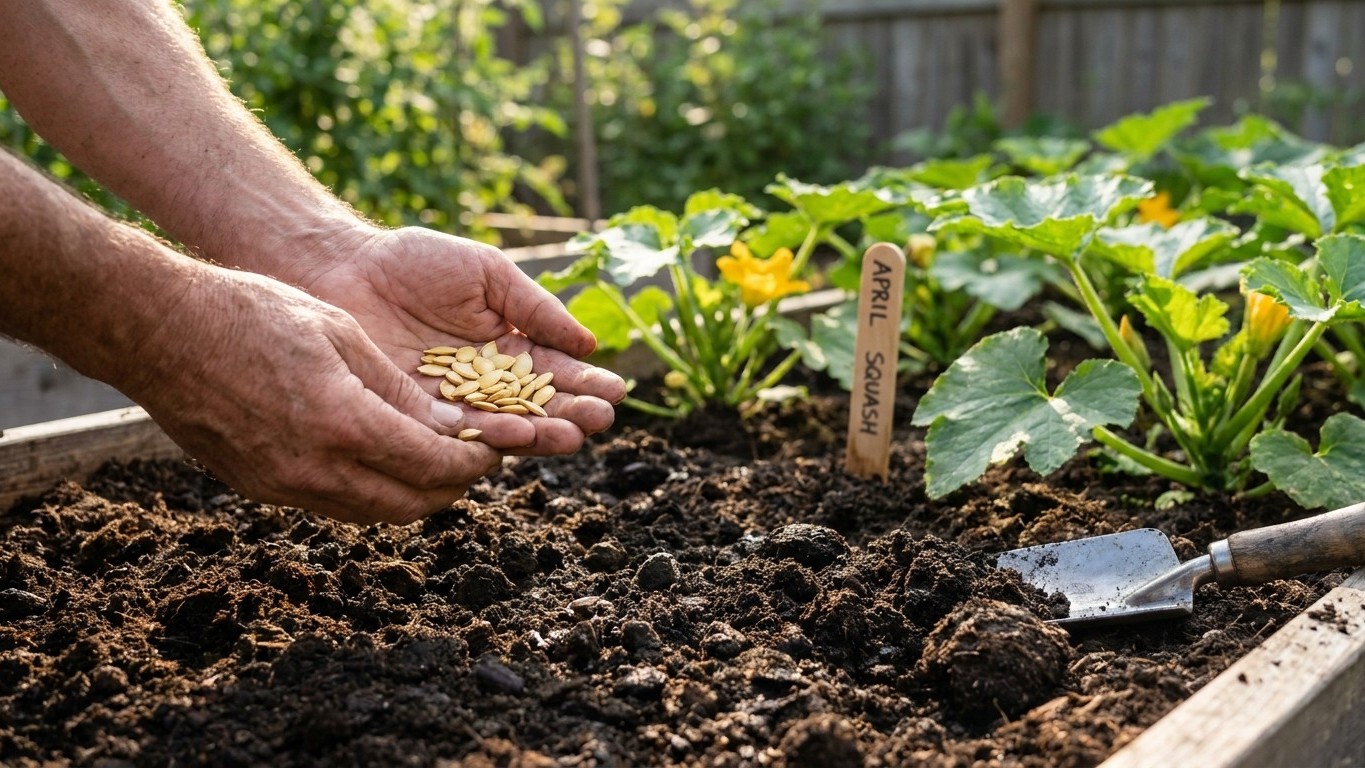

Summer squash goes in the ground in Vermont once the soil has warmed past frost risk, typically from mid-May through early June depending on where you garden. That window comes straight from the state’s last spring frost date, and it’s later than gardeners in southern New England expect. Soil temperature, not the calendar, is what actually decides the day.
The short answer for Vermont
NOAA’s 1991-2020 climate normals for the Burlington reference station put the last spring frost between April 30 and May 10, and the first fall frost between October 3 and October 13. Those are probability bands, not guarantees: a 30-70% chance of a 32F freeze falling on either side of that stretch. Summer squash seed rots in cold, wet soil and the seedlings die outright at 32F, so the safe direct-seed date sits a week to ten days after the last frost date, once soil has had time to climb past 60F at planting depth. For most of the Champlain Valley that lands sowing somewhere between May 15 and June 5.
That gives a season length, frost to frost, of roughly 146 to 166 days depending on which end of each band you land on. Summer squash needs 45 to 60 days from seed to first harvest depending on variety, so even the shorter end of that window leaves room for a full crop and a second succession sowing in late June if the first planting gets hit by squash vine borer or powdery mildew midseason. That’s the real advantage of Vermont’s frost window: it’s not generous, but it’s long enough to recover from one bad break.
Transplants bought or started indoors can go out a little earlier than direct-seeded plants, since they arrive with a head start on those 45 to 60 days. But summer squash resents root disturbance, so transplanting only makes sense if you started seed in biodegradable pots three to four weeks before your target planting date, not in trays that require pulling roots apart. Direct seeding after the soil has warmed remains the more reliable method for most home gardens in the state, and it avoids the risk of hardening off tender transplants into a late cold snap that the frost probability band hasn’t ruled out.
Soil type varies from plot to plot in Vermont, and drainage can run fast or slow. That’s a variable worth checking on your own plot before you commit to a planting date, since it changes how quickly the soil actually reaches that 60F threshold.
What will not work here
Slow-maturing summer squash varieties, the ones bred for 65-plus days to harvest, are a poor match for the shorter end of Vermont’s frost-free window. In the Green Mountains or the Northeast Kingdom, where the growing season runs well under the 146-to-166-day range measured at the Burlington reference station, a slow variety planted even right on schedule can still be caught by an early fall frost before it produces a meaningful harvest. Fast-maturing types bought specifically for a 45-to-50-day window give far more margin for error.
Weekly watering schedules, the kind that work fine in hotter, drier states, are the wrong habit to import here. Vermont’s summer rainfall averages about 11.9 inches across June, July and August, with June the wettest month at 4.26 inches and August the driest at 3.54. That’s a moderate, fairly reliable supply, not a drought pattern. The mistake gardeners make is treating that number as a green light to water on autopilot regardless of what’s actually fallen that week. Because days at or above 90F average only 5.4 a year here, evaporation demand is genuinely low compared to warmer states, and overwatering on top of already-adequate rainfall is a more realistic risk than underwatering, especially on clay soil that holds moisture for days after a storm.
Tight spacing is the other trap. Vermont summers carry enough humidity, especially near the lake and in low-lying valley gardens, that powdery mildew and downy mildew spread fast once squash leaves stay damp and crowded. Packing plants at the tighter end of a seed packet’s spacing range, a habit that might pass in a drier climate, invites mildew here well before frost would have ended the season anyway. Wider spacing with real airflow between plants matters more in a humid summer than it does in an arid one, and Vermont’s rainfall numbers say this is a humid-summer state, not a dry one.
Squash vine borer pressure also punishes gardeners who plant everything in one block on one date. A single sowing that gets hit mid-season leaves no backup, and given that the frost-free window here is long enough to support a second sowing, skipping that succession planting is leaving insurance on the table for no good reason.
What changes across Vermont
Vermont spans USDA hardiness zones 3b to 5b, a spread built on average annual extreme minimum temperature under the USDA Plant Hardiness Zone Map’s 2023 update. That’s a wide range for a small state, and it means there is no single planting date that fits Vermont the way there might be for a flatter, more uniform state. The frost dates cited above come from the Burlington reference station, which the NOAA data itself flags as sitting on Lake Champlain, the mildest corner of the state thanks to the lake’s moderating effect on spring and fall temperatures.
Move away from that lake shore, up into the Green Mountains or out into the Northeast Kingdom, and both the hardiness zone and the frost-free window shift toward the shorter, colder end of the range. A zone 3b or 4a garden at higher elevation can expect a last frost date meaningfully later than the Burlington band and a first fall frost meaningfully earlier, compressing the whole season on both ends at once. Gardeners in those areas should plan on shifting their direct-seed date later, often by two to three weeks past what the Champlain Valley numbers suggest, and lean harder toward the fastest-maturing summer squash varieties they can find rather than treating the state average as their local answer.
The USDA’s interactive hardiness zone map, searchable by ZIP code, is the tool for that. Anyone gardening outside the immediate Champlain Valley should check their own zone before locking in a date based on Burlington numbers.
Where to check this for your own county
The state-level numbers above are a starting point, not a substitute for county-level guidance. The University of Vermont Extension, the state’s land-grant university extension service, publishes planting calendars and variety trial results that are tuned to specific counties rather than to a single reference station on Lake Champlain.
Once there, two things are worth hunting down specifically. First, a county or regional planting calendar, if one exists for your area, since it will reflect local frost data rather than Burlington-only numbers. Second, variety trial results for summer squash conducted in Vermont conditions: UVM Extension and its associated research farms test vegetable varieties for performance in the state’s actual growing conditions, including disease pressure from powdery mildew and pest pressure from squash vine borer, both of which vary by region within the state.
A county-specific recommendation from extension staff who work with growers in your exact area will always beat a state-wide estimate built from one reference station’s climate normals. The state-level view is useful for understanding the general shape of Vermont’s season, frost timing, rainfall pattern and hardiness zone range, but not a replacement for local guidance from people who know your specific county’s soil, elevation and microclimate. If your garden sits anywhere outside the immediate Champlain Valley, that extension check is worth doing before you finalize a planting date.
If you follow the almanac, here is when to plant zucchini by the moon. It is a tradition, not a proven method.
Checking this against your own garden
Every date here is a normal built from thirty years of data at one station. Your own garden, this year, is what actually decides when to plant, and three simple checks tell you more than any calendar.
Feel the soil at planting depth, a couple of inches down, with your bare hand. If it feels cold to the touch, summer squash seed will sit and rot rather than germinate, no matter what the calendar says. Warm, slightly moist soil that feels comfortable to hold is the real signal to sow, and it can arrive earlier or later than the frost-date window depending on your particular spot, its slope, its sun exposure and whether it’s shaded by trees or a building through the morning.
Watch for the first male flowers once plants are established. Summer squash produces male blooms before female ones, and a healthy early flush of male flowers signals the plant has settled in and is building toward fruiting, a sign your local conditions are working in the plant’s favor. Female flowers, recognizable by the small bulge at the base that will become the fruit, following a week or two later is the real go-ahead that pollination and harvest season have begun.
Check the first true leaves, the ones that appear after the initial seed leaves and actually look like squash foliage. Fast, sturdy true-leaf growth points to good soil warmth and adequate light. Slow, pale, or stunted true leaves after a normal-length wait suggests the soil was colder than it felt, or the spot gets less sun than expected, information worth carrying into next year’s planting date more than any date printed here.