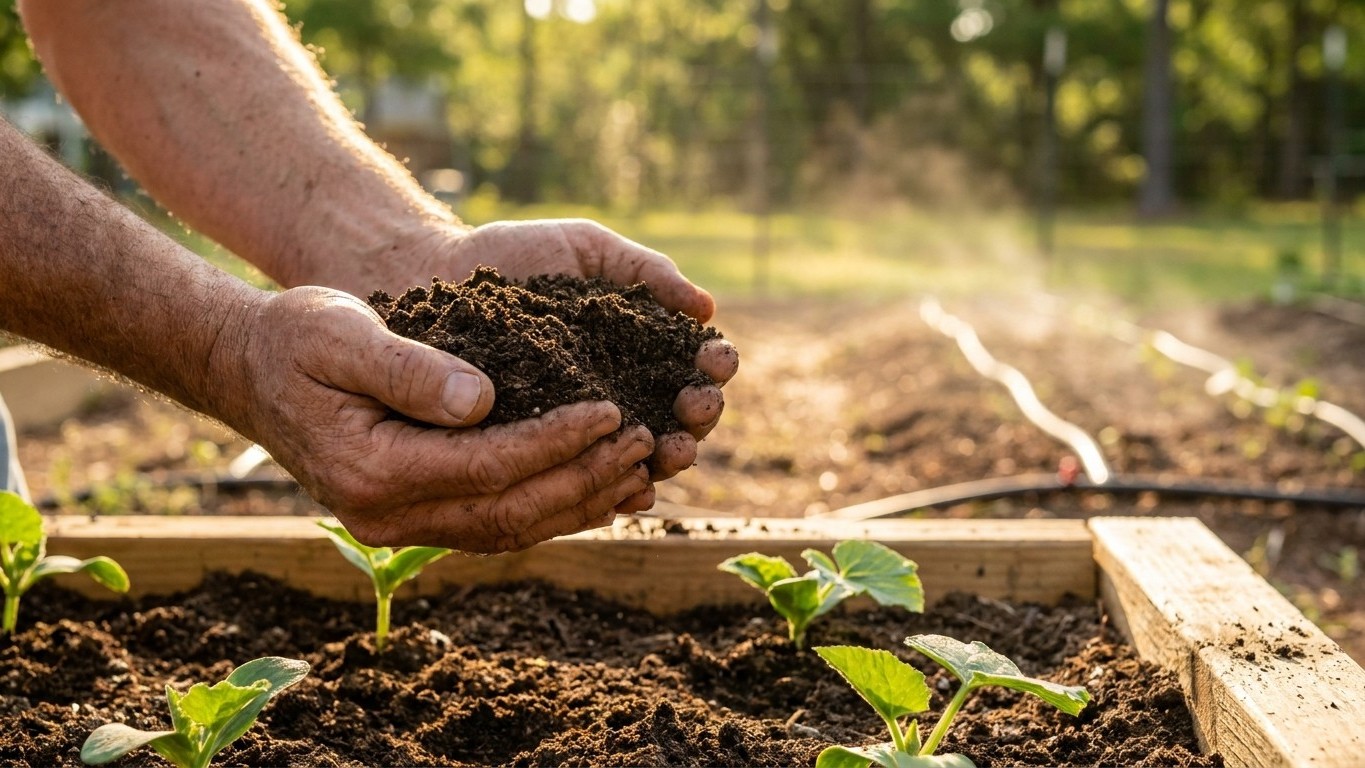

In most of Vermont, summer squash goes into the ground between late May and early June, once the soil has had a few warm weeks to shake off winter and the frost risk has genuinely passed rather than just eased. Burlington and the Champlain Valley get there first; the higher ground and the Northeast Kingdom wait longer.
When the soil is warm enough in Vermont
The last spring frost at the Burlington reference station (USW00014742) falls somewhere between April 30 and May 10, according to NOAA’s 1991-2020 Climate Normals. That’s a 30-70% probability band, not a guarantee stamped on the calendar. Frost can still show up after that window closes, just less often than before it.
Here’s the part gardeners miss: that date measures air frost, not soil temperature. Summer squash seeds barely germinate in cold ground, and transplants set into a chilly bed will sulk for two or three weeks rather than take off. The soil needs to hold in the mid-60s at planting depth, and that lag behind the last frost date can run another week or two, sometimes more on clay soils that warm slowly. Waiting for a stretch of genuinely warm days after the frost risk clears, rather than planting the calendar date itself, is what actually protects the crop.
Vermont’s hardiness zone spans 3b to 5b under the USDA system, built on average annual extreme minimum winter temperature. That’s a statewide range, not a single number, and it matters more for perennials than for a summer annual like squash. Still, it’s a useful shorthand for how much the state varies: the Champlain Valley around Burlington sits at the mild end, while the Green Mountains and the Northeast Kingdom run colder, with frost lingering longer in spring and arriving sooner in fall.
That regional split changes the practical answer to “when.” A gardener in Burlington working from the April 30 to May 10 window has real flexibility. Someone in the higher elevations of the Kingdom should treat that window as a floor, not a target, and expect to push planting back accordingly. Local microclimates (a south-facing slope, a spot sheltered from valley cold-air drainage) can shift things by another week in either direction, which is exactly the kind of detail a soil thermometer settles faster than any date on a chart.
None of this changes by variety selection. Summer squash types don’t differ much in cold tolerance at the seedling stage. The type of squash matters later, for disease pressure and season length, covered further down. What matters at planting time is simply this: warm soil, not just a passed frost date.
How long the season lasts here
Run the two frost windows together and Vermont’s frost-free season lands somewhere between roughly 146 and 166 days, depending on which end of each range applies. The shorter estimate pairs the latest spring frost date (May 10) with the earliest fall frost date (October 3); the longer one pairs the earliest spring date (April 30) with the latest fall date (October 13). Either way, that’s close to five months of growing room in the mild parts of the state, and less in the higher terrain where both ends of the season arrive earlier and later than at the Burlington station.
A window in that range is enough to make a second sowing worth considering, at least in the milder valleys. Summer squash matures fast enough that a planting made in late May or early June can be finishing up while a second round, sown in early to mid-July, comes into production for a fall harvest before the October frost risk climbs. That staggering also spreads out the inevitable slowdown that hits squash plants midsummer, when the first flush of fruit and the demands of a spreading vine start to outpace what an aging root system can support.
Where the window runs closer to the 146-day end, that margin shrinks fast. A July sowing needs roughly six to eight weeks of frost-free growing to produce anything worth harvesting, and in the shorter-season pockets of Vermont, that timeline bumps right up against the fall frost risk with little room for a cool, wet stretch to set things back further. In those spots, the first sowing effectively is the season, and the more useful move is starting it well, whether by direct seeding once soil is reliably warm or by Transplanting short-rooted starts to gain a week or two without the setback a squash plant suffers when its taproot gets disturbed.
Anyone weighing a second planting, or deciding whether transplants make sense given a shorter local window, will find the timing math laid out in more detail in our succession sowing guide, which walks through how to count backward from a fall frost date to a safe last sowing.
Heat and water in Vermont
Vermont logs an average of just 5.4 days a year at or above 90°F at the Burlington reference station. That’s a light heat load by national standards, and it changes the whole risk profile for summer squash here. In hotter territories, hot spells above the high 90s cause pollen to lose viability fast enough that female flowers open and fall without setting fruit. Vermont’s growers rarely see that problem. Blossom drop from heat stress is a minor concern in most of the state.
What replaces it is dampness. Vermont sees about 11.9 inches of rain across June, July and August, with August running driest at 3.54 inches and June wettest at 4.26 inches.
| Month | Average rainfall |
|---|---|
| June | 4.26 in. |
| July | 4.06 in. |
| August | 3.54 in. |
That’s a fairly even, well-distributed summer, closer to what a garden actually wants than a big rainstorm followed by weeks of nothing. But even rainfall paired with cool nights and low heat load is exactly the recipe for powdery mildew and downy mildew on squash leaves, which thrive in humidity without needing sustained heat to spread. A Vermont squash patch is far more likely to lose a season to fungal disease creeping across the leaves in August than to wilt from drought.
Watering still matters, particularly for young transplants and during any stretch when the rain skips a week, which happens even within a wet-summer average. Squash’s broad leaves pull a lot of moisture out of the soil, and a shallow root plate can’t always keep pace even when the seasonal totals look generous on paper. The practical response in Vermont isn’t heavy irrigation planning built around heat stress; it’s spacing plants for airflow, watering at the base rather than overhead to keep foliage dry, and checking soil moisture by hand rather than assuming the season’s rainfall total is doing the job on any given week.
Which summer squash suit Vermont
Reasoning from what the numbers actually say about this state, three things should drive the choice of type, and none of them is a heat problem.
The season length, running roughly 146 to 166 days depending on location, rewards early-maturing types in the shorter-season pockets of the state, particularly the Northeast Kingdom and higher elevations, where a slow-to-produce type risks running out of season before a second flush of fruit comes in. In the milder Champlain Valley, that pressure eases, and there’s enough room to grow a wider range of types, including some that take longer to start bearing.
The humidity picture, built on that steady 11.9 inches of summer rain landing on a low-heat, slow-drying garden, makes disease resistance the more useful selection criterion than anything related to heat tolerance. Types bred or selected for resistance to powdery mildew hold their leaves later into the season here, which matters more in Vermont than in a hotter, drier state where mildew pressure is lower to begin with.
This page won’t name a specific variety, and that’s a deliberate choice rather than an oversight. Which cultivars perform well is a question of what’s been trialled in Vermont’s actual growing conditions, a job for the University of Vermont Extension service, not a general guide. Extension trial results reflect real plantings in real Vermont soil across real seasons, something no article written from climate normals alone can replicate. Anyone choosing seed for a Vermont garden this year is better served checking that season’s UVM Extension recommendations for summer squash than relying on a name picked up secondhand from a seed catalog written for a different climate entirely.