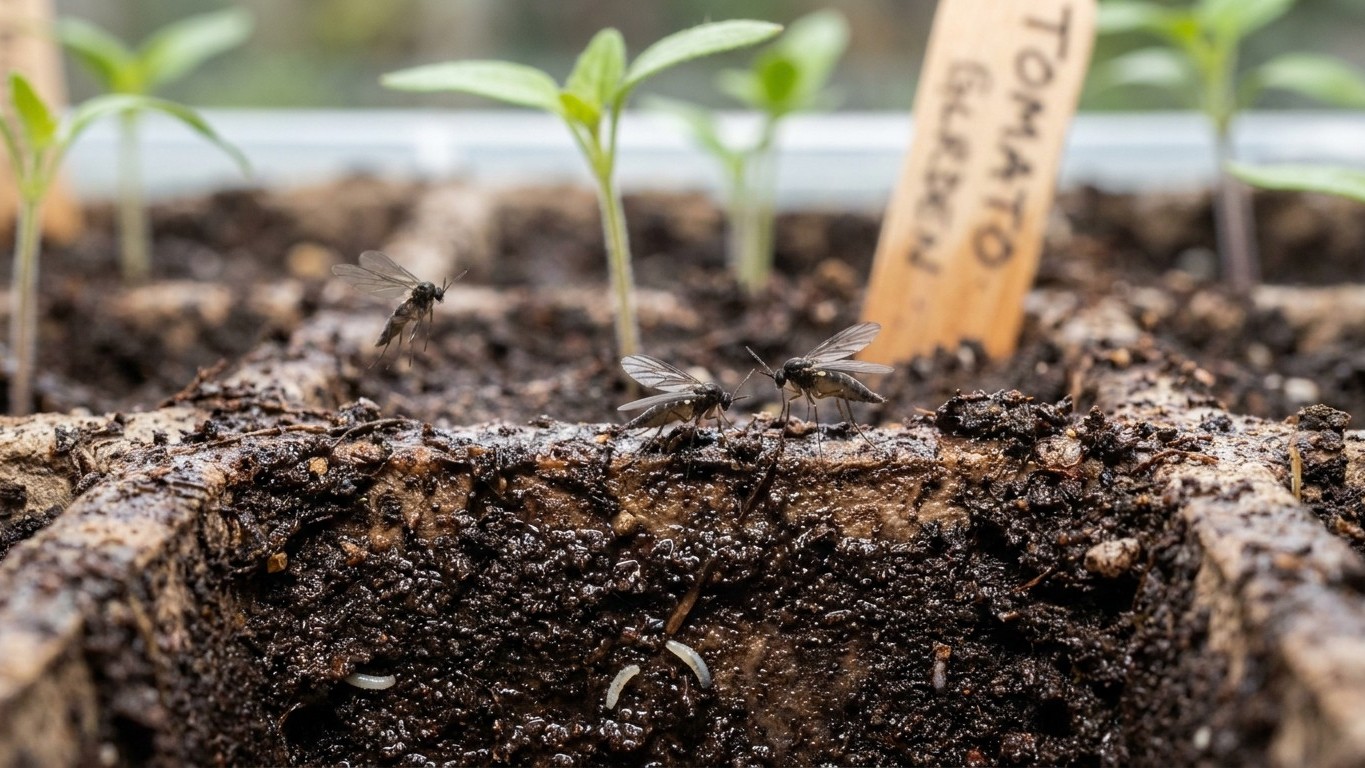

Dark-winged fungus gnats show up in Vermont soil and seedling trays once ground temperatures climb past the mid-50s, usually within a couple weeks of the last spring frost window. They target moist, organic-rich soil around roots and seedlings, not the leaves themselves, and the damage is done by the larval stage long before the adult gnats start swarming around your watering can. Sanitation and soil-drying beat any spray once larvae are established.
Reading the calendar from your last frost

Vermont’s last spring frost falls between April 30 and May 10, according to NOAA’s 1991-2020 Climate Normals for the Burlington station. That’s a normal built from three decades of data, not a promise for any single spring. Some years the ground stays cold into mid-May; other years it warms early and stays warm.
Dark-winged fungus gnats don’t check a calendar. They respond to soil warmth and moisture, so a mild April with wet, mucky beds can bring them out before the frost date even arrives, while a cold, dry spring pushes their appearance back a week or two past it. What matters to the insect is damp organic matter reaching the high 50s to low 60s Fahrenheit, conditions that show up fastest in raised beds and seed trays kept indoors or under cover.
Once seedlings go into the ground or into potting mix, gardeners typically see the first signs of larval feeding within two to three weeks, sometimes sooner in warm, wet setups. That window is what decides when a physical barrier actually earns its keep. A cover put on too early, before soil warms, does little. One left on too long traps humidity and can make the moist-soil conditions gnats prefer even more attractive. The practical move is to watch soil temperature and moisture rather than count days on a calendar, and to remember that Burlington sits in the mildest pocket of the state. Gardens in the Green Mountains or the Northeast Kingdom run on a shorter, later season, so the same insect shows up correspondingly later there.
What it attacks, and what the damage looks like
The first sign most gardeners notice isn’t a bug. It’s a seedling that wilts despite damp soil, or a transplant that simply stalls, its growth stunted for no obvious reason. Roots pulled up at that stage often look thin, chewed, or stripped of fine root hairs. In houseplants and greenhouse starts, the same pattern shows: yellowing lower leaves, slow decline, soil that looks fine on the surface but hides the real problem underneath.
Crops most affected
- Seedlings and transplants of lettuce, brassicas, and other cool-season crops started in trays or raised beds
- Container and greenhouse-grown vegetable starts kept consistently moist
- Houseplants and indoor seed-starting setups with rich, organic potting mix
- Root systems of young plants growing in soil high in decaying organic matter or compost
The adult gnat, that small dark fly hovering near the soil surface, is mostly a nuisance and a signal rather than the source of damage. It’s the larval stage, living in the top layer of soil, that does the actual feeding, chewing on root hairs, tender roots, and decaying plant matter. That distinction matters for treatment: anything aimed at adult gnats flying around a windowsill does nothing for larvae already established at the root zone. By the time a gardener notices wilting or stunted growth above ground, the larvae have typically been feeding for a stretch already, which is why prevention before that stage matters more than reaction after it.
How Vermont sits in this pest’s range

Within this site’s coverage, dark-winged fungus gnats are documented in two territories. That’s a narrow count, and it puts Vermont closer to an edge of where this pest’s presence is currently tracked here rather than in the middle of a widely mapped range. A wider count across many territories would mean the real story is timing, the same insect showing up earlier in warmer states and later in colder ones, with presence itself a near-given everywhere. With only two territories documented, presence isn’t yet established as a given across this site’s full footprint, so Vermont’s inclusion says as much about local reporting as about the insect’s actual spread.
For gardeners here, the practical local reference is University of Vermont Extension, which tracks this pest specifically for Vermont growing conditions rather than relying on regional averages pulled from elsewhere. That matters because soil temperature curves, greenhouse practices, and typical planting windows vary enough between, say, a Champlain Valley market garden and a Northeast Kingdom homestead that generic advice can miss the mark. No severity ranking or trend claim comes with the two-territory count. It simply means the data here is thinner than it is for more widely documented pests, and that a Vermont gardener is better served checking UVM Extension’s own guidance than assuming the insect behaves identically to how it’s described in states with longer growing seasons.
What actually works against it
The cheapest and most effective defense is also the simplest: let the soil surface dry out between waterings. Fungus gnat larvae need consistently moist organic matter to survive, and a dry top inch or two of soil breaks that cycle without any product or spray. This works before larvae establish and remains useful as ongoing maintenance, but it does nothing once larvae have already moved deeper into root tissue.
Clearing decaying plant debris and old potting mix removes the organic matter larvae feed on and breed in. Compost piles, dead leaves left in trays, and soggy mulch layered too thick against stems all create the exact damp, rotting conditions this insect needs. Rotating where seedlings are started each season, rather than reusing the same trays or bed sections without a break, interrupts a local buildup of larvae in soil that’s been repeatedly moist and organic-rich.
Row covers help during the early transplant window, physically blocking adult gnats from reaching the soil surface to lay eggs in the first place. The mechanism only works before eggs are laid, though. Once larvae are inside the stem or feeding on roots below the surface, a cover overhead does nothing, since the barrier was never meant to reach what’s already underground.
Hand-picking has limited use here since adult gnats fly rather than sit still, but yellow sticky cards near seedling trays can catch adults before they lay another generation of eggs, giving a rough read on how bad an infestation is getting. None of these measures reverse damage already done to root hairs. They’re aimed at breaking the cycle before it repeats, which is why timing, watching soil moisture and starting sanitation early, matters more than any single tactic on its own.
Common questions
Do dark-winged fungus gnats damage mature, established plants the same way they damage seedlings?
Mature plants with developed root systems tolerate some larval feeding without much visible effect, since their root mass isn’t as dependent on the fine root hairs young seedlings rely on. Damage is far more noticeable and more damaging in trays, new transplants, and container starts.
Can dark-winged fungus gnats survive a Vermont winter outdoors?
The facts available for this page don’t address overwintering behavior specifically. What’s established is that the insect responds to soil warmth and moisture in spring, which is why its outdoor appearance tracks the thaw rather than a fixed calendar date.
Is a soggy houseplant more at risk than an outdoor garden bed?
Consistently moist, organic-rich potting mix, the kind common in overwatered houseplants and indoor seed-starting setups, creates ideal breeding conditions. Letting the soil surface dry between waterings remains the single most useful check for indoor pots and outdoor beds alike.