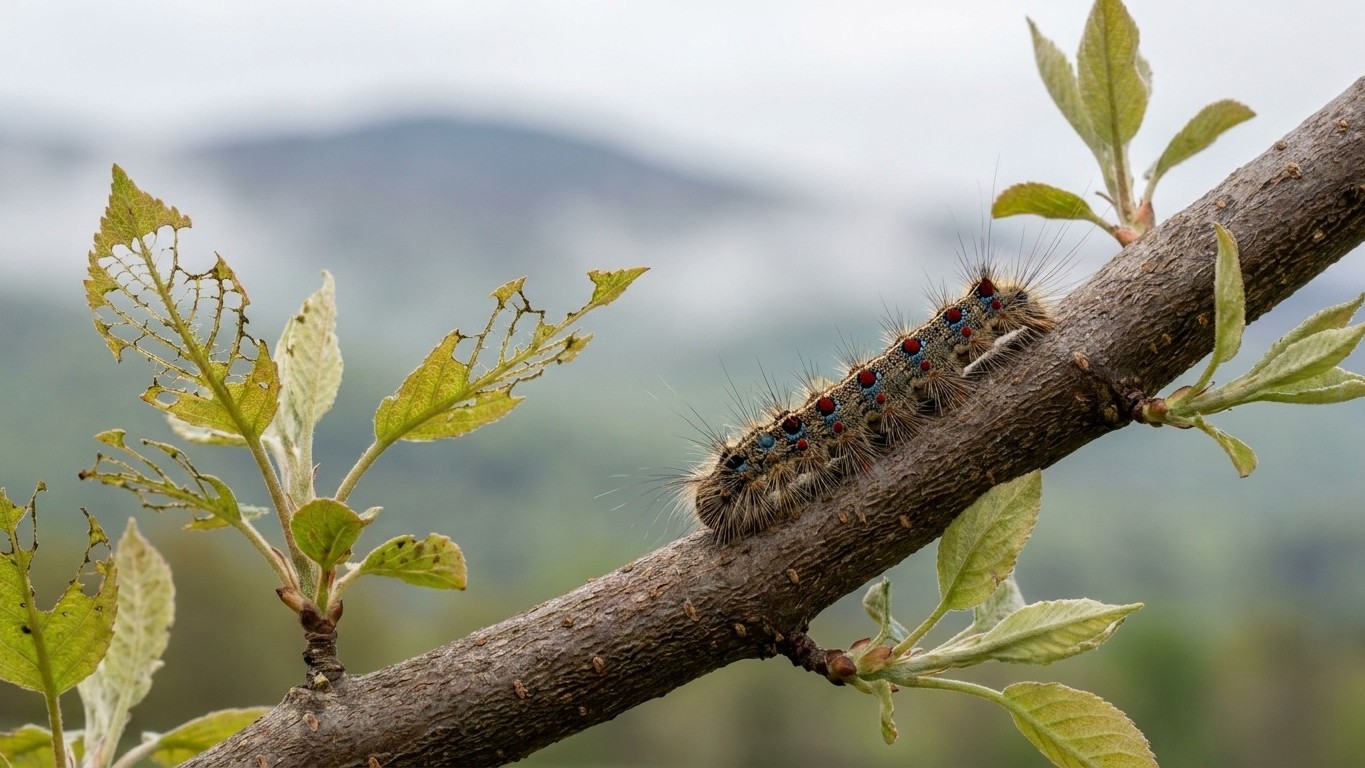

Spongy moth caterpillars start feeding right around the time hardwood trees leaf out in spring, which tracks close to Vermont’s last frost window of April 30 to May 10. But the insect answers to soil and bud temperature, not a calendar square, so an early thaw or a stubborn cold snap shifts the whole schedule by a week or more in either direction.
Reading the calendar from your last frost

Burlington’s climate normal puts the last spring frost between April 30 and May 10, based on 1991-2020 data from NOAA NCEI at station USW00014742. That’s a useful anchor, but it’s a probability band, not a promise. Burlington sits on Lake Champlain, which is the mildest pocket in the state. Move up into the Green Mountains or out to the Northeast Kingdom and the frost-free stretch runs noticeably shorter, sometimes by several weeks.
Spongy moth egg masses hatch as daytime temperatures climb consistently and buds begin to swell, which for most of Vermont lands somewhere near that same frost transition. Young larvae emerge small and pale, and they don’t do much visible harm right away. The damage builds gradually as the caterpillars molt through several growth stages, each one bigger and hungrier than the last. By the time a homeowner notices thinning canopy or leaves reduced to skeletons, the insect has usually been feeding for weeks already.
That gap matters for anyone trying to time a physical intervention like trunk banding. A date calculated by counting forward from a frost range only produces another range. It never produces a single day you can circle on the fridge calendar. Watch the trees instead of the calendar: bud swell and early leaf expansion are the real trigger, and they’ll tell you more than any date math will.
What it attacks, and what the damage looks like
The first sign most people notice isn’t a caterpillar at all. It’s a tree that looks thinner than it should in early summer, with a canopy that seems to fade from full green to patchy and ragged over just a few weeks. Look closer and the leaves show small, irregular holes at first, then larger chewed sections, and in heavy years whole branches stripped down to skeletonized veins or bare wood. Underneath a badly infested tree, you may also notice a steady rain of small dark pellets on decks, cars, and outdoor furniture. That’s frass, the caterpillars’ droppings, and it’s often the first clue people pick up on before they ever spot an insect.
Oak is the preferred host, but spongy moth caterpillars aren’t picky when populations run high. Aspen, birch, and apple trees are common secondary targets, and in outbreak years the insect will feed on dozens of other hardwood species out of sheer necessity as oak leaves run short. Evergreens are generally spared unless an infestation is severe and hardwood food sources nearby have already been stripped.
The damage is done entirely by the larval stage, the caterpillar itself, over roughly six to eight weeks of feeding before it pupates into a moth. That timing matters for anyone thinking about intervention. Adult moths don’t feed at all, and eggs are dormant, so any physical or mechanical control has to target either the egg masses before hatch or the larvae while they’re actively climbing and feeding. Once a tree is defoliated, there’s no treatment that restores those leaves for the season. A healthy tree can usually push out a second flush of leaves and recover, but a tree already stressed by drought or disease may not have the reserves to do that twice in one year.
Repeated defoliation adds up
One bad season rarely kills a mature, otherwise healthy tree. The real risk comes from repeated years of heavy feeding, stacked on top of drought stress or root damage, which is when mortality starts showing up in oak stands.
How Vermont sits in this pest’s range

This site currently documents spongy moth in 2 territories, and Vermont is one of them. With coverage that narrow, it’s worth being upfront: this isn’t a case where the pest is common in dozens of states and Vermont is simply one more entry on a long list. A count this small means Vermont sits near an edge of what’s been documented here, not squarely in the middle of a wide, well-mapped range.
That doesn’t mean the insect is rare here or newly arrived. It means the published, territory-specific guidance available for comparison is limited, and readers shouldn’t assume patterns from a heavily documented state necessarily apply to Vermont’s timing or severity. The local reference point for Vermont specifically is University of Vermont Extension, and that’s the source worth checking directly for updates on local activity, egg mass surveys, or seasonal advisories rather than relying on guidance written for a different climate zone entirely.
For homeowners, the practical takeaway is to treat any regional forecast or trend you read online with a grain of caution unless it specifically names Vermont conditions. A mild frost pattern in one part of the Northeast doesn’t tell you what’s happening in the Champlain Valley versus the higher elevations of the Green Mountains, and this pest’s behavior tracks local temperature swings closely enough that broad regional statements can miss the mark for a specific property.
What actually works against it
The cheapest and most effective step happens outside the growing season entirely, and the measures below are ordered from least to most costly.
- Scrape egg masses off tree trunks, outdoor furniture, firewood stacks, and vehicle undercarriages in fall or winter, destroying each one by scraping it into a container of soapy water, because this removes next year’s population before it ever becomes mobile, and it works well since eggs are stationary and visible against bark for months.
- Wrap a folded burlap band around the trunk once larvae hatch in spring, checking it daily and removing trapped caterpillars by hand into soapy water, because younger caterpillars climb into the canopy to feed during the day and many descend at night or during heat, so the band gives them a shaded spot to hide in and lets you interrupt the cycle before they reach full size and maximum appetite; this only works while larvae are still using the trunk as a daytime refuge, since once populations are large and dispersed high into a mature canopy, ground-level banding catches a shrinking fraction of the total feeding population.
- Clear leaf litter, loose bark, stacked firewood, and unused outdoor equipment near host trees in late summer and fall, because these all make convenient egg-laying sites, and cleaning them up reduces the surfaces available for the next generation.
- Move firewood only short distances rather than transporting it across counties, because this limits how far egg masses travel with people rather than on their own.
None of these measures do anything once larvae have finished feeding and pupated, or once a season’s defoliation has already happened. At that point the only realistic response is supporting the tree’s recovery: watering during dry spells and avoiding additional stress like heavy pruning until the canopy has had a chance to refill.
Common questions
Does one year of defoliation kill a tree?
Usually not on its own. A healthy oak or aspen can typically push a second flush of leaves and recover within the same season. Trees already weakened by drought, root damage, or repeated defoliation in prior years face a much higher risk.
When should egg masses be scraped off?
Fall through late winter, before hatch begins in spring. Egg masses are dormant and stationary during this window, which makes them the easiest life stage to physically remove and destroy.
Is spongy moth the same insect once called gypsy moth?
Yes, this is the same species under its current common name. The biology, life cycle, and control approach haven’t changed, only the name used to refer to it.