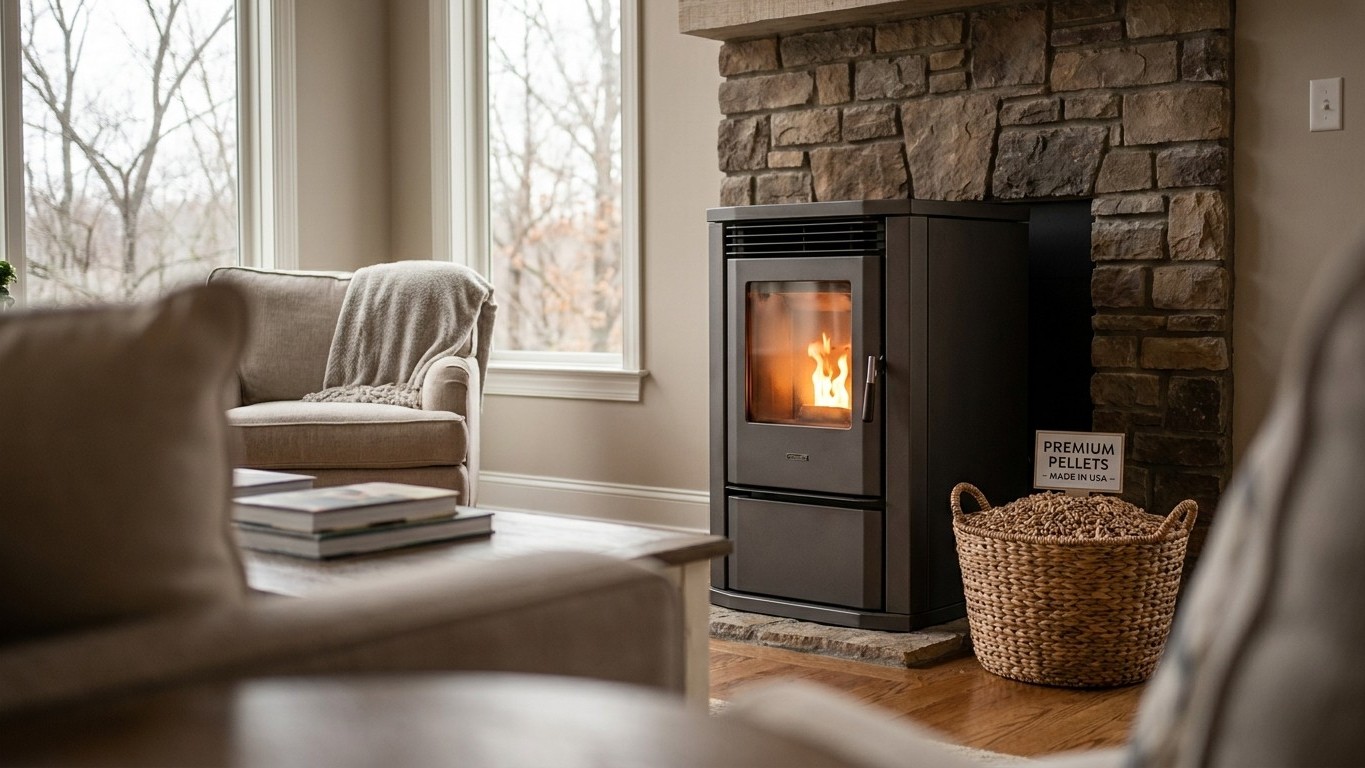

A pellet stove in Virginia is answering to about 3,424 heating degree days a year and a heating season that runs roughly seven months, from October through May. That combination, moderate cold spread over a long stretch, means the stove earns its keep as real supplemental heat for most of the state, though how many tons it burns and how you store them depends on where in Virginia you actually live.
How hard the winter works here

The number that matters is 3,424 heating degree days a year, measured at Oceana NAS in Virginia Beach under NOAA’s 1991-2020 Climate Normals. That figure isn’t a temperature. It’s the sum, day by day across the year, of how far the average temperature falls below 65°F. Double the degree days, roughly double the fuel a given house burns to stay warm. At 3,424, Virginia’s coastal climate sits in the moderate range nationally, well short of the brutal totals you’d see in the upper Midwest or northern New England, but far from the negligible numbers of the Deep South or Florida.
Depth versus length
What makes this figure interesting is how it’s distributed. January carries the heaviest load at 746 degree days, with December (631) and February (620) close behind. But the season doesn’t collapse quickly on either side: November already brings 415 degree days, and October adds another 152. That’s a long, gradual slope rather than a short sharp spike. A pellet stove here isn’t fighting a brief brutal snap the way it might in a place with a shorter, colder season. It’s running steadily, at moderate output, for the better part of seven months. That distinction matters when you’re sizing a stove or estimating fuel: a mild-but-long winter and a short-but-savage one can post similar annual totals while demanding completely different things from a heating appliance.
One station, not one state
Oceana NAS sits on the coastal plain, and coastal Virginia runs milder than the rest of the state. Push west into the Piedmont, and further into the Blue Ridge and the Appalachian counties, and degree-day totals climb noticeably higher. A household in Winchester or in the mountains around Wise County is heating through a colder, longer season than this reference figure describes. If you’re outside the Tidewater and Hampton Roads area, treat 3,424 as a floor, not your number, and look up normals closer to your own county before you size a stove or budget a winter’s worth of pellets.
How many tons a winter takes here
Nobody can hand you a tons-per-winter figure for your specific house, and any territorial page that tries is guessing. What you can do is work the math yourself, because the chain is straightforward once you know the pieces. A bag of pellets weighs 40 pounds. Fifty bags make a ton. How many tons you burn depends entirely on how much heat your house actually needs, which is exactly what the degree-day figure above is measuring for the region as a whole.
The math behind the estimate
Two houses on the same Virginia street, same square footage, can burn noticeably different amounts of fuel over an identical winter. The degree-day number tells you the climate’s demand; it says nothing about how well a particular house holds the heat once the stove makes it. That gap is where the real variation lives, and it’s wide enough that guessing before you’ve measured is close to useless.
What moves the number
- How well the house holds heat. Attic insulation, air sealing around windows and doors, and the age of the building envelope can swing fuel use by a factor of two between otherwise similar homes.
- Whether the stove is the only heat source or a supplement. A pellet stove running alongside a furnace or heat pump burns far less than one carrying the whole load through a Virginia winter.
- The setting it runs at. A stove left on a high or continuous setting through the coldest stretch (December through February, per the degree-day breakdown above) eats through pellets far faster than one dialed back and used for evenings and cold snaps.
The one number worth trusting is the one you generate yourself. Track exactly how many bags you buy and burn through your first winter, note how the stove was set and whether it carried the whole heating load or just took the edge off, and you’ll have a baseline specific to your house and your habits. That single measured season will beat every published estimate, because it accounts for your walls, your thermostat habits, and your actual weather rather than a regional average. For the broader mechanics of how pellet consumption is calculated, the national page on how many pellets a winter takes walks through the full method in more detail.
Buying and storing them in this climate
Virginia’s heating season starts building in October and runs through May, which means the buying window that actually protects you closes well before the cold arrives. Waiting until November, when the first real cold snap hits, is when regional demand spikes and shelves empty fastest. Pellets are also cheapest outside the heating season, so a homeowner who buys in late summer or early fall is paying less and avoiding the scramble that hits every retailer once temperatures drop.
Buy before October
Treat October, the month Virginia’s normal temperature first drops below the 65°F heating threshold, as the deadline rather than the starting gun. Buying ahead of that month means you’re shopping in a calmer market, and it gives you time to compare pricing across suppliers by the ton, which is the only unit that lets you compare fairly across brands and bag sizes.
Storage against Virginia humidity
Pellets are compressed sawdust held together by the wood’s own natural lignin, with no glue or binder. That construction makes them vulnerable to moisture in a specific way: dampness doesn’t just make them wet, it swells the wood fiber and breaks the pellet apart, turning a hopper’s worth of fuel into crumbled sawdust that won’t feed properly or burn efficiently. Coastal and eastern Virginia carry humid summers, and a garage or shed that isn’t climate-controlled can sweat condensation onto stacked bags even when it isn’t raining. A concrete garage floor is a particular risk point, since it can stay cool and damp long after the air around it feels dry. Elevating bags off the floor, keeping them off exterior walls, and storing them somewhere with real airflow matters more here than it would in a drier climate. For a full rundown of storage setups and how to judge pellet quality before you buy in bulk, see the national storage guide and the pellet quality page.
What a winter outage means here
A pellet stove is not a wood stove. It needs an electrical supply to run the auger that feeds fuel into the firebox and the fan that pushes heat into the room. Cut the power, and the stove goes cold no matter how full the hopper is. That’s the tradeoff for the convenience and steadier burn a pellet stove offers over a wood-burning one, and it’s worth knowing Before the First ice storm of the season, not during it.
The electrical constraint
How much that constraint matters depends on where Virginia’s degree-day figure puts you. At 3,424 degree days with a peak month around 746 in January, a multi-day outage during the coldest stretch of winter is a genuine heating emergency for a household relying on the stove as a primary source. In the shoulder months, October or April, the same outage is closer to an inconvenience: an evening without the stove’s heat, not a crisis.
What Virginia homes fall back on
Federal survey data on Virginia’s residential heating mix shows most households aren’t relying on a pellet stove alone in the first place. Furnaces are the main heating equipment in 56% of homes, and central heat pumps run another 27%, with steam or hot-water boilers in about 4%. On the fuel side, electricity powers 50% of primary heating, natural gas 36%, propane 5%, and fuel oil or kerosene 4%. That mix matters during an outage in a specific way: electric heat pumps and electric furnaces go down with the grid just like a pellet stove does, while a natural gas furnace typically keeps running on a small electrical draw for its blower and ignition, which is a different outage profile entirely. Rather than guessing at backup power sizing, check your specific stove’s electrical draw on its rating label and work from there. The national power-outage page covers backup options and what to look for in more depth.