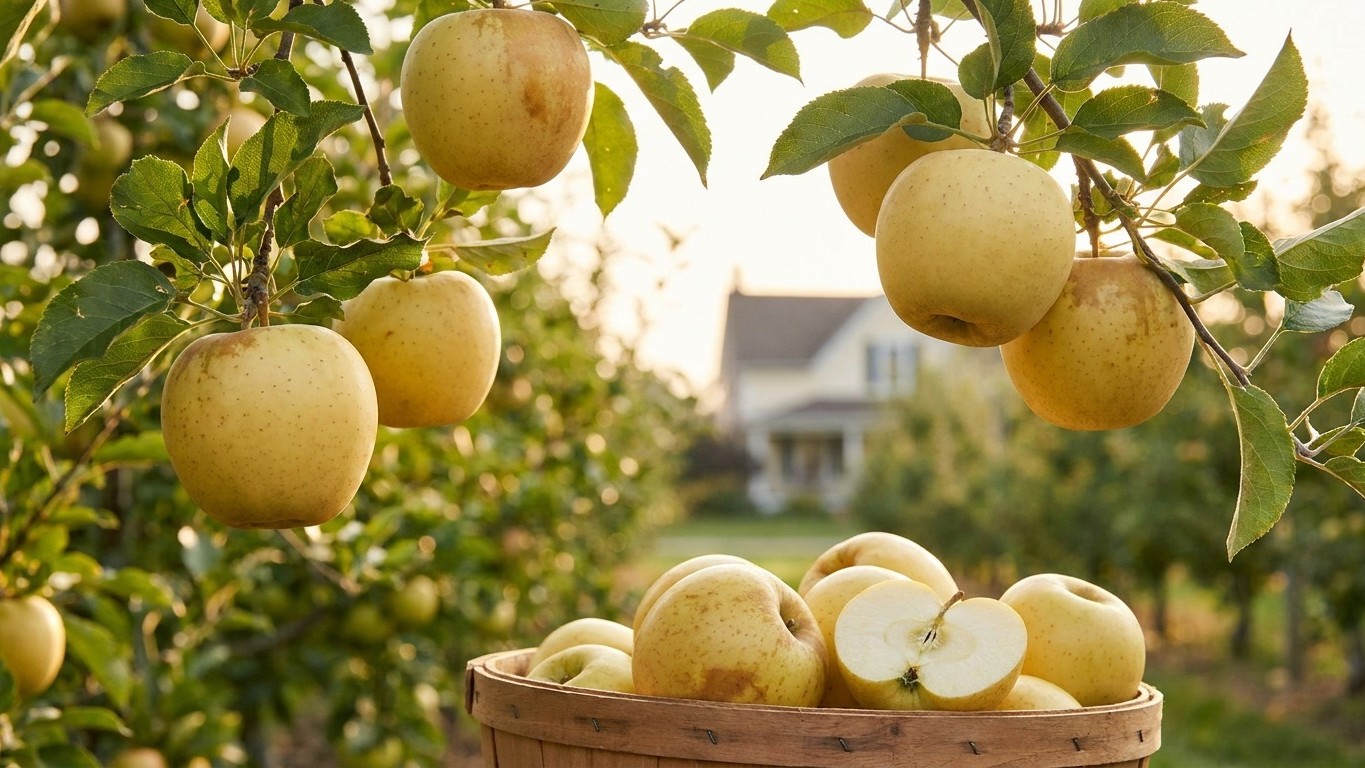

Apples in Virginia don’t ripen on a fixed date. They ripen when the tree says so, and that moment shifts by variety, by elevation, and by how far you are from the coast. The short version: earliest varieties come off the tree in August, the latest hang into October, and how long any batch keeps afterward depends far more on that variety’s chemistry than on anything you do in the kitchen.
When apples are ready to pick in Virginia
Growers don’t circle a date on the calendar. They read the fruit: does the background skin color shift from green to yellow, do the seeds turn brown instead of white, does the apple separate from the spur with a gentle twist instead of a tug. Those three signs matter more than the month, because the same variety can finish two or three weeks apart depending on where it’s planted.
What sets the calendar in the first place is frost. At the reference station used by NOAA (NAS Oceana, near Virginia Beach), the last spring freeze typically falls between March 20 and April 3, and the first fall freeze arrives between November 10 and November 24, based on the 1991-2020 Climate Normals. That’s the coastal end of the state, and it’s the mild end. Move inland to the Blue Ridge, or further southwest into the higher valleys, and both dates move against you: spring frost lingers weeks longer, fall frost arrives weeks sooner. The growing window that coastal Virginia enjoys simply doesn’t exist at elevation, and no orchard up there is picking on a Virginia Beach schedule.
Two different filters, not one
Hardiness and chill are separate questions, and conflating them is where a lot of backyard planting goes wrong. Hardiness asks whether the tree survives winter at all. At the Virginia Beach reference station, the coldest month’s average daily minimum runs 31.6°F, a winter mild enough that survival isn’t the binding constraint for the vast majority of apple varieties sold in the region. Chill asks something different: whether the tree accumulates enough cumulative cold to break dormancy evenly and flower on schedule rather than in a ragged, extended bloom that self-pollinates poorly.
Here’s the trade-off that mild coastal winters create, and it needs a straight answer rather than a shrug. A low-chill variety needs less accumulated cold to break dormancy, so it blooms early, sometimes right into that March 20 to April 3 frost window. That’s the opposite of what you want in a region where a late freeze is still a live possibility into early April. Because Virginia’s coastal winters aren’t so mild that standard-chill varieties fail to flower (31.6°F average minimum is not a low-chill climate the way coastal Florida is), there’s no real upside to choosing an early-blooming, low-chill tree here. The better bet, especially near the coast, is a variety that blooms on the later side, giving the frost window time to close before blossoms are exposed. Inland and at elevation, where spring frost lingers even longer, that same logic applies with even more force.
Which ones keep, and which must be eaten
Apple varieties split roughly into two camps once they’re off the tree, and the split has nothing to do with how they were grown and everything to do with their own chemistry. Early-season apples tend to be softer, higher in moisture, and lower in acid. They’re bred and enjoyed for eating out of hand within a few weeks, not for sitting in a box until winter. Late-season apples are the opposite: denser flesh, more acid, thicker skin, and a natural resistance to the kind of internal breakdown that turns a soft apple mealy within days.
This matters at harvest time because a grower (or a home gardener with one tree) needs to know which bin an apple belongs in before deciding how carefully to handle it. An early apple bruised in the picking bag is a minor loss; it was never going to store long anyway. A late apple bruised the same way has lost its main advantage, since bruised tissue breaks down and speeds spoilage in fruit that would otherwise hold for months.
A rough guide by timing
| Harvest timing (relative to frost dates) | Typical texture and acid | Keeping quality |
|---|---|---|
| Early season, well before first fall frost | Soft, juicy, low to moderate acid | Short-term; best eaten within a few weeks |
| Mid season | Firmer, balanced acid | Moderate; holds longer than early apples with proper cold storage |
| Late season, closer to the first fall frost window | Dense, high acid, thick skin | Long-term; the type suited to winter storage |
None of this is a promise about any single named variety, since Virginia Cooperative Extension is the right source for a list matched to a specific county and site. What holds everywhere in the state is the general rule: the apples that ripen closest to that first fall frost window (November 10 to November 24 at the coastal reference station, earlier inland) are almost always the ones built to last, and the apples that ripen in August almost never are.
Storing them through a Virginia winter
Good storage comes down to four things working together: cold, humidity, darkness, and airflow. A refrigerator crisper drawer handles small household quantities well enough, since it holds a steady cold temperature and enough humidity to keep skins from shriveling. For anything beyond a few dozen apples, growers typically move to a root cellar, an unheated basement corner, or an insulated garage, none of which need to be fancy but all of which need to stay reliably cold without dropping into a hard freeze that turns fruit to mush.
Where that’s easiest depends heavily on which part of Virginia you’re in. Near the coast, where the coldest month averages a 31.6°F daily minimum, an unheated but insulated space rarely drops far below freezing on its own, which makes casual outbuilding storage fairly forgiving. Inland and at elevation, in the Blue Ridge and the southwestern valleys, winter nights run considerably colder, and an uninsulated shed can freeze solid fruit and all. The fix isn’t complicated: add insulation, check a thermometer placed inside the storage container rather than trusting the room’s general feel, and move fruit indoors during the coldest stretches.
Ethylene is the other variable worth watching. Apples give it off naturally, and it speeds ripening in anything nearby, including other apples. A single overripe or damaged fruit in a storage box accelerates softening in everything around it, which is the practical reason to sort out bruised or soft apples before boxing the rest for the winter, and to check the box periodically rather than sealing it up and forgetting it until spring.
Virginia Cooperative Extension (ext.vt.edu) is the state’s land-grant extension service and the right place to check for county-specific storage guidance, since conditions in a Shenandoah Valley cellar and a Tidewater garage aren’t the same. Where a local extension publication doesn’t spell out a specific storage duration for a given variety, that’s worth taking as a gap rather than guessing at a number.
What goes wrong here
The most common failure in Virginia orchards traces straight back to that spring frost window. A tree that blooms early, whether because it’s naturally an early-flowering variety or because a warm February fooled it into breaking dormancy ahead of schedule, can lose its entire blossom set to a freeze landing anywhere in that March 20 to April 3 band near the coast, or later inland. No fruit forms afterward. There’s no fixing a lost bloom mid-season; the loss is simply the year’s harvest.
The second failure runs the opposite direction, and it hits growers in the Blue Ridge and southwestern counties hardest. Because the first fall frost arrives weeks earlier at elevation than it does near the coast, a late-season variety that needs the full stretch to mature can get caught by a killing freeze before it’s finished ripening. The same variety that stores beautifully near Virginia Beach can simply run out of season further west, which is a planting decision, not a storage one, and worth checking against Extension guidance before choosing a late variety for a high-elevation site.
The third failure happens after harvest, in storage itself. An unheated shed that feels cold enough in November can swing well below freezing during a January cold snap, especially away from the coast, and fruit stored there without a thermometer check can freeze without anyone noticing until the box is opened.
Common questions
What is the coldest part of Virginia for apple growing?
The facts here are anchored to the Virginia Beach coastal reference station, which is the mild end of the state. The Blue Ridge and the southwestern valleys run colder in both winter minimums and frost timing, with spring frost lingering weeks longer and fall frost arriving weeks sooner, though no single reference figure in these notes quantifies exactly how much colder those regions run.
Do Virginia’s mild winters mean I should plant low-chill apple varieties?
Not near the coast, and probably not anywhere in the state. A coldest-month average minimum of 31.6°F isn’t a low-chill climate, so standard-chill varieties flower reliably here. Low-chill varieties would only add risk, since they bloom earlier and land squarely inside the March 20 to April 3 spring frost window.
How can I tell an apple is ready to pick without a calendar date?
Check background skin color (shifting from green toward yellow), seed color (turning brown), and how easily the fruit separates from the branch with a gentle upward twist. These signs track the tree’s actual stage, which varies by variety and by site even within the same county.
Where can I get local guidance for my specific part of Virginia?
Virginia Cooperative Extension (ext.vt.edu) is the state’s land-grant extension service and publishes county-level guidance on variety selection and site conditions that these statewide notes can’t replace.