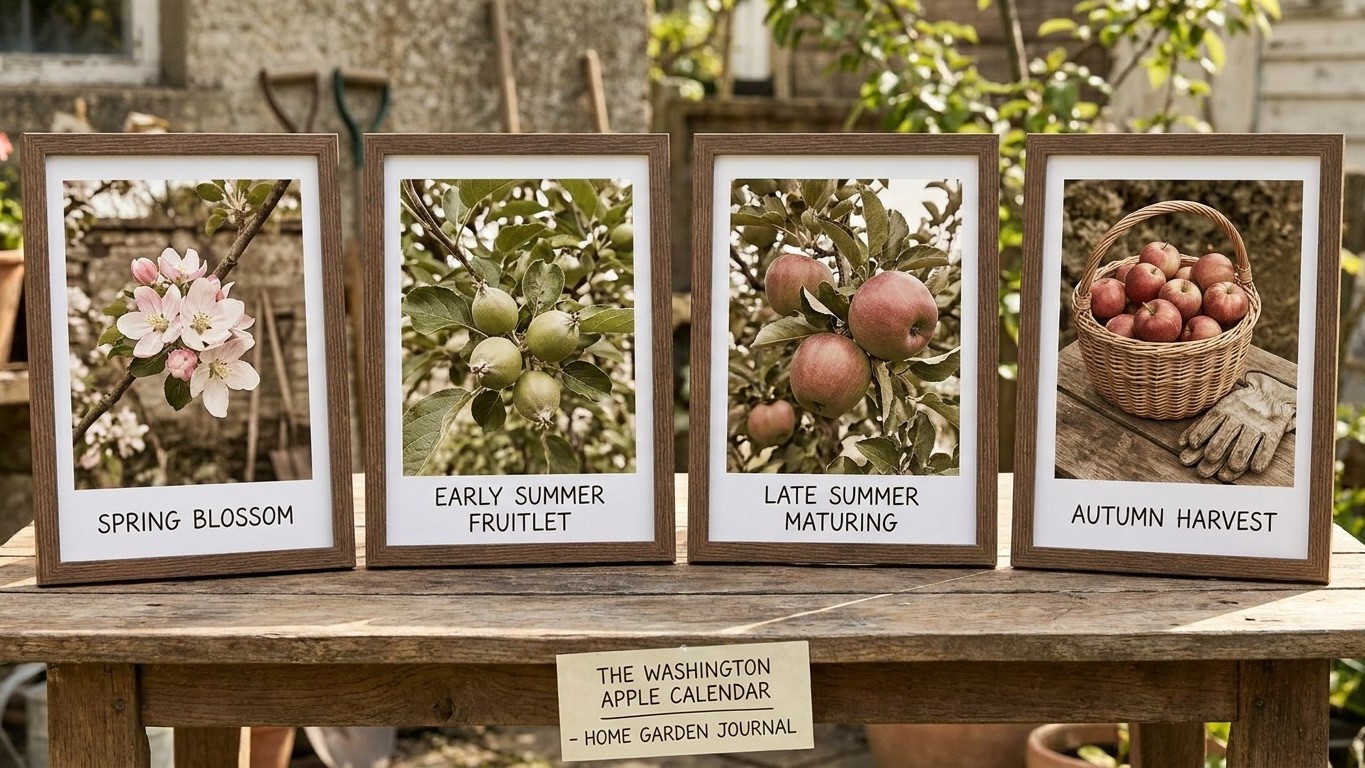

Seattle’s frost dates are the ones you’ll find attached to “Washington” in most calendars, and they’re real: last freeze between February 27 and March 18, first freeze in the second half of November. But that window belongs to Puget Sound, not to the orchards. East of the Cascades, in Yakima and Wenatchee and Okanogan, winters run colder and springs push bloom on a different schedule entirely. The stages are the same. The dates that trigger them are not.
The short answer for Washington
Near Seattle, NOAA’s 1991-2020 Climate Normals put the last spring freeze between February 27 and March 18, and the first fall freeze between November 13 and November 30. An apple tree doesn’t check a calendar. It moves through dormancy, green tip, pink, bloom, petal fall, fruit set and harvest at a pace set by heat and daylight, and each stage carries its own tolerance for cold. The practical rule for this state is to work backward from bloom, since bloom is the stage most exposed to a late freeze. A tree that pushes into pink and open flower before the tail end of that spring window is the one that risks losing its crop to a cold night. If you haven’t chosen a planting site yet, that step is covered in Growing Apples in Washington before any of these stages matter.
That answer holds for the mild, marine-influenced lowlands around Puget Sound, where the reference station sits. It does not hold for the state’s actual apple country. Most of Washington’s commercial orchards sit east of the Cascades in the Yakima, Wenatchee and Okanogan valleys, a high-desert climate with colder winters and hotter, drier summers than the coast. No figure in this piece describes that region’s frost dates, and a grower there should treat the Seattle numbers as a description of a different climate, not a substitute for their own. What decides your calendar is the stage the tree is showing, checked against your own county’s frost record, not a date copied from the coast.
Working through it

Each stage carries a different tolerance for cold, and that tolerance, not the month, is what should decide when you spray, thin or worry about a forecast freeze.
Dormancy

The tree is bare and the buds are tight, dark and scaled shut. This is the safest stage for cold, and it’s when dormant oil and copper sprays go on, timed for a dry, calm day rather than a particular week. In the Puget Sound lowlands this stage runs through the tail of NOAA’s spring freeze window, since a freeze here does no damage as long as the buds haven’t started to swell.
Green tip

A small bright green point pushes through the bud scales. Cold tolerance drops sharply from here. If a freeze inside NOAA’s February 27 to March 18 window catches the tree at green tip, damage is still unlikely at typical freeze severities, but it’s the point where a grower should stop assuming winter is finished.
Pink

The flower cluster swells and shows color before the petals open. This is the stage most growers watch hardest, because a hard freeze at pink can kill the flower parts inside a bud that still looks intact from the outside.
Bloom

Open white blossoms are the least frost-hardy stage the tree ever shows. A freeze during bloom can wipe out most of a season’s crop in one night. This is why the length and timing of the local spring freeze window, not a fixed date, is the number that matters. Near Seattle, bloom generally lands well clear of NOAA’s frost window, which is one reason the maritime lowlands can grow apples reliably despite a long, wet spring.
Petal fall

Petals brown and drop, and the small green ovary left behind is somewhat hardier than the open flower, though a sharp freeze can still abort it. This is when the first cover sprays for scab and codling moth typically begin, and it’s a reasonable point to do the first pass of hand thinning on varieties that set heavily.
Fruit set

Fruitlets the size of a pea to a marble are visibly hanging in clusters. Frost risk is essentially over for the season by this stage in the areas this page’s figures cover. Attention shifts to thinning, irrigation and the codling moth spray schedule.
Harvest
Timing here is read from the fruit, not the freeze calendar. Firmness, background color and a taste test tell you more than a date ever will, and picking should run stage by stage across a mixed planting of early, mid and late varieties, a decision covered in more depth in The Best Apple Varieties for Washington.
| Stage | Frost sensitivity | What happens |
|---|---|---|
| Dormancy | Very low | Dormant sprays go on |
| Green tip | Low, rising | Watch the forecast start |
| Pink | High | Most frost-watchful stage |
| Bloom | Highest | A freeze here can take the crop |
| Petal fall | Moderate | Cover sprays, first thinning |
| Fruit set | Low | Thinning, irrigation begin |
| Harvest | None | Timed by fruit, not frost |
What changes across Washington
The Puget Sound lowlands, where Seattle’s frost figures are recorded, run mild because the Sound and the Pacific hold heat through winter and slow the spring warm-up. Move inland, upslope or across the mountains and the picture changes fast.
West of the Cascades
Elevation is the first lever here. Foothill orchards on the west slope of the Cascades sit in colder air than the lowlands below them, and a bloom date that’s safe in a Seattle backyard can still get caught by a late frost a few hundred feet higher up the same valley. Cold air also pools in low ground. A hollow with no drainage for cold air holds a harder frost on a still night than a slope just above it, which is why orchard land has traditionally gone on slopes rather than valley floors wherever the choice exists. On the outer coast and around the San Juan Islands, the ocean’s moderating effect runs even stronger than at the Seattle station, holding frost dates in an even narrower, milder range.
East of the Cascades
Across the mountains the climate is a different animal. The Yakima, Wenatchee and Okanogan valleys sit in the rain shadow of the Cascades, with a continental pattern of cold winters and hot, dry summers, and this is where most of the state’s commercial apple acreage actually grows. None of the frost figures in this piece describe that region, and a grower there needs a station closer to home, not the Seattle numbers, to place bloom against risk. The Columbia River itself moderates the ground closest to its banks, which is one reason orchard land has historically clustered along the river rather than back from the water.
The mistakes this climate punishes
An early-blooming cultivar planted where the spring freeze window runs long is the classic loss. Gravenstein, a heritage apple long grown in the Pacific Northwest, blooms early relative to most modern varieties, and in a year when the last freeze near Seattle lands toward the late end of NOAA’s February 27 to March 18 window, an early bloomer can be caught in open flower while a later-blooming variety is still at pink or green tip. The fix isn’t to avoid Gravenstein, it’s to know its bloom habit and watch the forecast harder in years when spring is slow to warm.
A high-chill cultivar bred for continental winters can struggle in the mild lowlands. NOAA’s 1991-2020 Climate Normals put the mean daily minimum of Seattle’s coldest month at only 35.6°F, a mild reading that shows how little hard cold the maritime lowlands actually accumulate over a winter. A variety that needs a long, cold dormancy to break evenly can flower late, thin, or over an extended stretch instead of in one tight window, which complicates pollination and thinning alike. This is a chill problem, not a hardiness problem, a different filter from whether the tree survives the winter at all.
Feeding nitrogen too late in the season is the third one. A tree pushed into soft new growth in late summer hasn’t hardened that wood off by the time the first fall freeze arrives, and near Seattle that can land as early as November 13 on NOAA’s normals. Soft, late growth is the tissue most likely to be damaged, and the damage often doesn’t show until the following spring when that wood fails to leaf out evenly.
- Early-blooming cultivars need extra frost watching in a late spring
- High-chill varieties can flower unevenly in a mild lowland winter
- Late-summer nitrogen leaves wood soft going into the first fall freeze
Checking this against your county
Every figure above comes from one NOAA station near Seattle, and Washington’s climate changes too much across the Cascades and across elevation for one station to stand in for the whole state. Before you set a spray calendar or a thinning date, check your own county’s frost record and rootstock recommendations through WSU Extension, which maintains county offices across both sides of the state. An extension office in Yakima or Wenatchee will have a very different answer than one in King County, and that local figure should override anything general written here.
Common questions
Can apples even grow on the dry side of the state?
Yes, and the dry side is actually where most of Washington’s commercial apple crop comes from. The Yakima, Wenatchee and Okanogan valleys east of the Cascades grow the bulk of the state’s apples despite a colder, more continental winter and a hotter summer than the coast, and no figures in this piece describe their frost dates specifically, so a grower there should get local numbers from a WSU Extension office rather than the Seattle figures used above.
Do I need two different apple trees to get fruit?
Most apple varieties need pollen from a different variety blooming at the same time, so a single tree standing alone often sets little or no fruit. A nearby crabapple or a neighbor’s tree blooming in the same window can serve as the second variety if you don’t have room for two trees of your own.
My tree bloomed and then we got a frost warning. Is the crop gone?
Not necessarily. Open bloom is the least frost-hardy stage the tree shows, but a freeze that’s mild or short can still leave enough flowers undamaged to set a workable crop, especially on a tree carrying a heavy bloom to begin with. Check the flowers a day or two after the freeze. The center of an undamaged flower stays green, while a damaged one turns brown or black at the base.
I missed the dormant spray window. Now what?
Dormant oil and copper sprays are meant for the dormant stage, before green tip, and lose most of their value once the buds start to swell. If green tip has already shown, skip the dormant spray for the year rather than applying it late, and pick the timing back up at the standard cover sprays that start around petal fall.