
Virginia’s USDA zones run 5a to 8b (USDA Plant Hardiness Zone Map, 2023, based on 1991-2020 normals), which means the flowers that thrive on the coast are not always the ones that thrive in the mountains. Near Virginia Beach, NOAA’s 1991-2020 climate normals put the mean minimum of the coldest month at 31.6°F, a mild reading that lets a wider range of plants survive winter outdoors than farther inland. Before ordering anything, check the plant’s hardiness rating against your own county on the USDA map rather than against the state’s overall range.
What thrives in Virginia

A flower that does well in Virginia has to clear two separate hurdles: survive whatever winter throws at it, and shrug off a long, muggy summer. Because the USDA hardiness map puts Virginia across zones 5a to 8b, a plant rated hardy in Virginia Beach can die outright in the colder reaches of Highland County or the Blue Ridge. Gardeners just over the mountains face a narrower and consistently colder version of the same problem, covered in our guide to flowers that actually thrive in West Virginia.
Reading the zone map for your county
Match the plant tag’s zone number to your own county, not to the state’s overall range, because “Virginia” spans both mild Tidewater winters and genuinely cold ones farther west. A perennial rated to zone 7 is a safe bet along the coast, where NOAA’s 1991-2020 normals record that mild 31.6°F coldest-month minimum, but the same plant is a gamble in the Shenandoah Valley or southwest Virginia, where winters run measurably colder for longer stretches.
Heat, humidity, and drought resistance
Winter cold is only half the filter. NOAA’s 1991-2020 climate normals record 26.0 days a year at or above 90°F at the Virginia Beach reference station, and stations away from the coast’s moderating water often run hotter and more humid still through July and August. That combination, heat layered on top of humidity off the Chesapeake and the Piedmont’s rivers, kills plants bred for a dry western or Mediterranean climate before frost ever touches them. Powdery mildew and root rot from warm, soggy soil do more damage here than cold does to a well-sited plant.
The families that handle this combination best share a few traits: thick or waxy leaves that resist fungal spotting, roots that tolerate wet feet in spring without rotting, and a bloom habit that does not collapse on a 90°F afternoon. Daylily (Hemerocallis), coneflower (Echinacea), black-eyed Susan (Rudbeckia), garden phlox bred for mildew resistance, and salvia all fit that description and are grown from Virginia Beach to the Shenandoah Valley. That same coastal squeeze of heat and humidity shows up across the Chesapeake too, detailed in our guide to flowers that actually thrive in New Jersey.
Drought resistance matters more here than most gardeners expect, not because rainfall is scarce overall but because summer rain tends to arrive in short, heavy thunderstorms with dry spells between. A flower that needs steady, even moisture, sweet peas or delphiniums for example, spends the season lurching between too wet and too dry and rarely performs the way the seed packet promises. Ornamental grasses and Mediterranean natives like lavender need sharp drainage far more than rich soil, and heavy clay, common across the Piedmont, works against them unless the bed is raised or amended with grit.
Native plants worth the space
Once established, native flowers need less water, less fertilizer and less spraying than imported ornamentals, because they evolved alongside the region’s soil fungi, rainfall pattern and pest pressure rather than against them. Establishment still takes a full season or two, during which a native perennial needs regular water while its root system builds down, but after that the difference in upkeep is real.
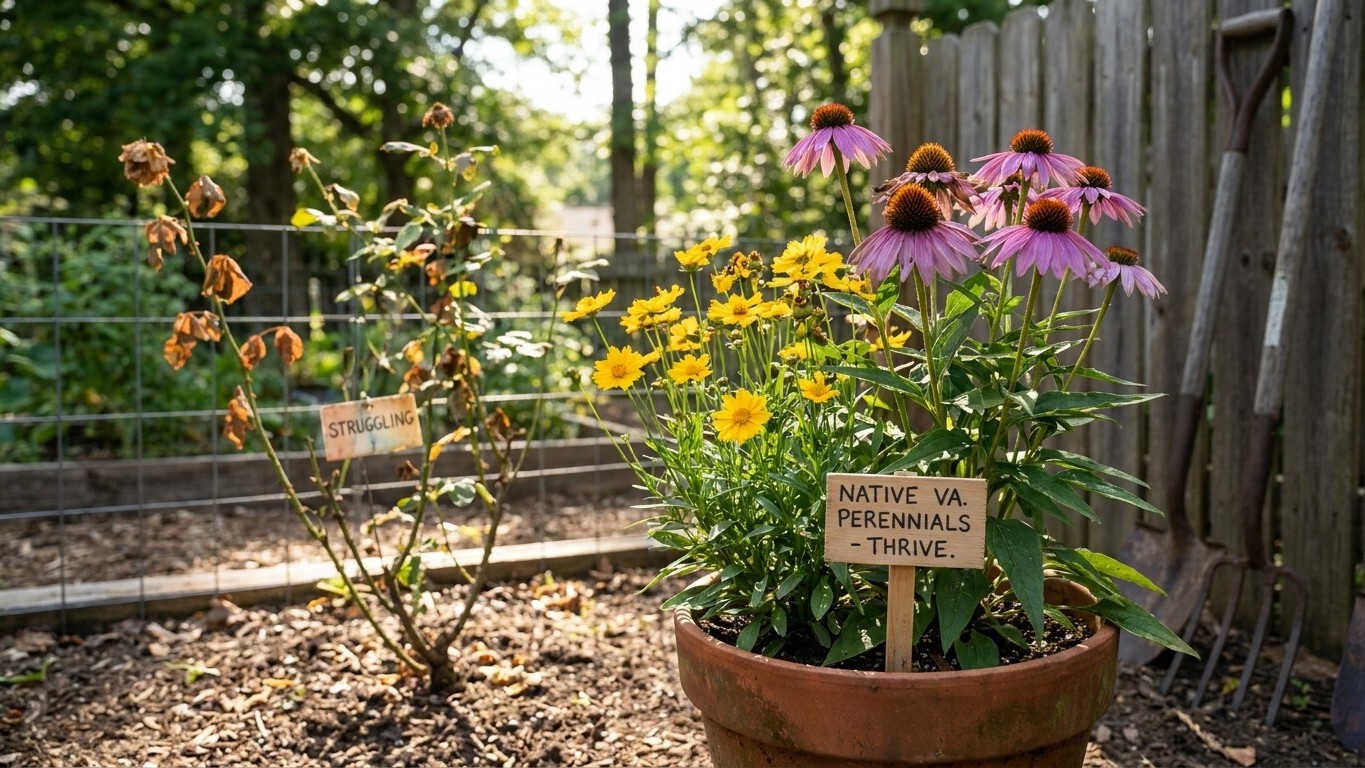
Plants native to the wider mid-Atlantic and eastern United States that perform reliably in Virginia gardens include purple coneflower (Echinacea purpurea), black-eyed Susan (Rudbeckia hirta), butterfly weed (Asclepias tuberosa), New England aster (Symphyotrichum novae-angliae), and wild bergamot (Monarda fistulosa). Joe Pye weed (Eutrochium purpureum) and cardinal flower (Lobelia cardinalis) tolerate the wetter, low-lying spots that ring so many Virginia yards near creeks and drainage swales, where imported perennials often rot at the crown.
Pollinators are the other reason to give natives real space, not just a border strip. Butterfly weed is a larval host for monarch caterpillars, not simply a nectar stop, and a stand of five or six plants does more for a local monarch population than a single specimen tucked among annuals. Bergamot and mountain mint (Pycnanthemum species) draw an unusually wide range of native bees, the small solitary species that do most of the actual pollination work in a vegetable or fruit garden, far more than honeybees do.
Working natives into an existing bed
A native planting does not have to look like a meadow. Coneflower and black-eyed Susan hold a tidy clump habit that fits a conventional border, and both take full sun and average, well-drained soil without complaint. Where a bed runs shadier, native columbine (Aquilegia canadensis) and woodland phlox (Phlox divaricata) fill the role that hostas and impatiens usually do, with the advantage of feeding early-season bees when little else is blooming.
- Full sun, dry to average soil: butterfly weed, coneflower, black-eyed Susan
- Full sun, moist soil: cardinal flower, Joe Pye weed, swamp milkweed
- Part shade: woodland phlox, native columbine, foamflower (Tiarella cordifolia)
One caution worth stating plainly: a plant sold as “native” at a big-box nursery is sometimes a cultivar bred for flower size or color that has lost some of the straight species’ value to pollinators. Buying from a nursery that specializes in regional natives, or through a native plant society sale, is usually the surer way to get the straight species.
Perennials that come back

A perennial’s reliability in Virginia comes down almost entirely to how its hardiness rating compares with the state’s winter minimum. NOAA’s 1991-2020 climate normals put the mean minimum of the coldest month at 31.6°F at the Virginia Beach reference station, a mild coastal reading. Move inland and that number drops fast, so a plant tag reading “hardy to zone 7” is a safe bet in Virginia Beach or Norfolk but a gamble in Roanoke or the Shenandoah Valley, where winters regularly reach into zone 6 and 5 territory.
Perennials that return reliably across most of the state include peony, daylily, garden phlox, black-eyed Susan, coneflower, hosta, and most hardy geraniums. These are generally rated to zone 5 or lower, meaning they tolerate Virginia’s coldest documented reaches without special winter protection.
Grown as annuals here, perennial elsewhere
Several popular garden flowers are true perennials only in warmer climates and get planted fresh each year in Virginia because they cannot survive the winter minimum. Lantana is perennial from about zone 9 south, but Virginia’s coldest-month minimum sits well below what its roots tolerate outdoors, so it is grown as an annual here or dug up and overwintered indoors. The same is true of many salvias bred in Mexico and Central America, of pentas, and of most tropical hibiscus. Gardeners in the mildest coastal pockets sometimes get a salvia through a light winter, but that is luck with a mild season, not a planting strategy to rely on.
Reading a plant tag correctly means checking its printed hardiness range against your own county’s typical winter minimum, not against the state’s overall 5a-8b span from the USDA map. A tag that says “zones 6-9” is telling you the plant survives winters no colder than zone 6. If your county regularly sees zone 5 conditions, that plant needs either a sheltered microclimate, heavy mulch, or replacement as an annual.
Mail-order catalogues complicate this further by testing plants in their own growing region and printing hardiness figures from that location. A cultivar rated hardy to zone 6 by a nursery in Ohio may behave differently against Virginia’s particular pattern of freeze-thaw cycles, where temperatures swing above freezing in January only to crash back down, a stress that kills marginally hardy perennials faster than steady cold does. On a borderline plant, treat the printed zone as the coldest it can handle under ideal snow cover, not a guarantee.
Putting a border together
A border reads as designed rather than scattered when it is built in layers, front to back, by mature height rather than by whatever looked good in a nursery cart. Put low, spreading plants like creeping phlox or dwarf coreopsis at the front edge, mid-height perennials such as coneflower, salvia, and daylily in the middle third, and taller anchors, Joe Pye weed, garden phlox, or ornamental grasses, at the back or center of an island bed. Height on the tag is measured at full maturity, usually two to three years in, not the size of the plant brought home from the nursery, so a border planted to look full in year one is usually overcrowded by year three.
Keeping something blooming from spring to frost
Succession means no single month carries the whole show and none goes empty. Spring bulbs and early perennials like columbine and creeping phlox open the season, coneflower, black-eyed Susan, phlox, and daylily carry June through August, and asters, sedum ‘Autumn Joy’, and goldenrod close it out into fall. NOAA’s 1991-2020 normals put the last spring freeze at the Virginia Beach reference station between March 20 and April 3, and the first fall freeze between November 10 and November 24, which gives coastal gardeners roughly seven months of open ground to plan bloom across. Gardeners farther inland and at higher elevation should expect a shorter window on both ends, since the Blue Ridge and southwest Virginia run weeks later in spring and earlier in fall.
Repeating a color or plant at intervals down the border does more for the overall look than adding a new variety every few feet. Three clumps of the same salvia spaced along a twenty-foot bed pull the eye through the whole planting, while three different salvias planted once each just look busy. Odd-numbered groupings, threes and fives, read more naturally than pairs or single specimens, a rule borrowed from perennial designers that holds up in an ordinary home border as well as in a public garden.
Finally, leave room. A perennial bought in a one-gallon pot is showing maybe a third of its mature spread, and the temptation to fill every gap at planting time is exactly what causes overcrowding, poor air circulation, and mildew two summers later, a real risk given how much of Virginia’s summer runs hot and humid. Mulch the bare soil between young plants for the first year or two rather than adding more plants to hide it. It disappears on its own as the perennials fill in, usually faster than most gardeners expect.
Local help
Virginia Cooperative Extension, run jointly by Virginia Tech and Virginia State University, publishes county-specific plant lists and runs a Master Gardener program in most counties that answers gardening questions for free. Calling your county’s extension office before ordering an unfamiliar plant is the single best way to catch a zone mismatch before it costs you a season. Find your local office through the Virginia Cooperative Extension website, and browse our other Virginia guides for related topics like vegetable planting dates and soil testing.
Common questions
Can I grow hydrangeas in Virginia?
Yes, though which type depends on where you garden. Panicle and smooth hydrangeas tolerate the state’s cold swings reliably from the coast to the mountains, while bigleaf hydrangea, the kind with the big blue or pink mophead blooms, often loses its flower buds to a late freeze in the colder inland counties even when the plant itself survives fine. If bigleaf hydrangea blooms poorly for you, the usual cause is a spring cold snap on the buds, not the wrong plant for the state.
Why do my perennials come back strong one year and barely show up the next?
The most common cause in Virginia is a freeze-thaw cycle rather than straight cold. A January warm spell that coaxes a plant partly out of dormancy, followed by a hard refreeze, damages roots that would have survived steady cold without trouble. Poor drainage makes it worse, since waterlogged soil around the crown freezes and thaws harder than well-drained soil does.
What flowers actually hold up against Virginia’s humidity without getting powdery mildew?
Garden phlox bred for mildew resistance, like ‘David’ and ‘Jeana’, along with coneflower, black-eyed Susan, and the Zahara series of zinnias, shrug off the humid stretch from July into September better than older varieties bred before mildew resistance was a breeding priority. Wider plant spacing than the tag suggests does as much for mildew control as the variety choice itself.
Is it better to plant perennials in spring or fall in Virginia?
Fall planting generally gives a perennial more time to build roots before summer heat arrives, since soil stays workable well past NOAA’s 1991-2020 normals for the first fall freeze at the Virginia Beach reference station, which falls between November 10 and November 24, later in the year than most gardeners assume. Spring planting works fine too, but a perennial put in the ground in spring has to establish roots and survive its first summer heat in the same season, which is a harder ask.
Related guides
- Flowers That Actually Thrive in Maryland, and the Ones That Struggle
- Flowers That Actually Thrive in West Virginia, and the Ones That Struggle
- Flowers That Actually Thrive in Arizona, and the Ones That Struggle