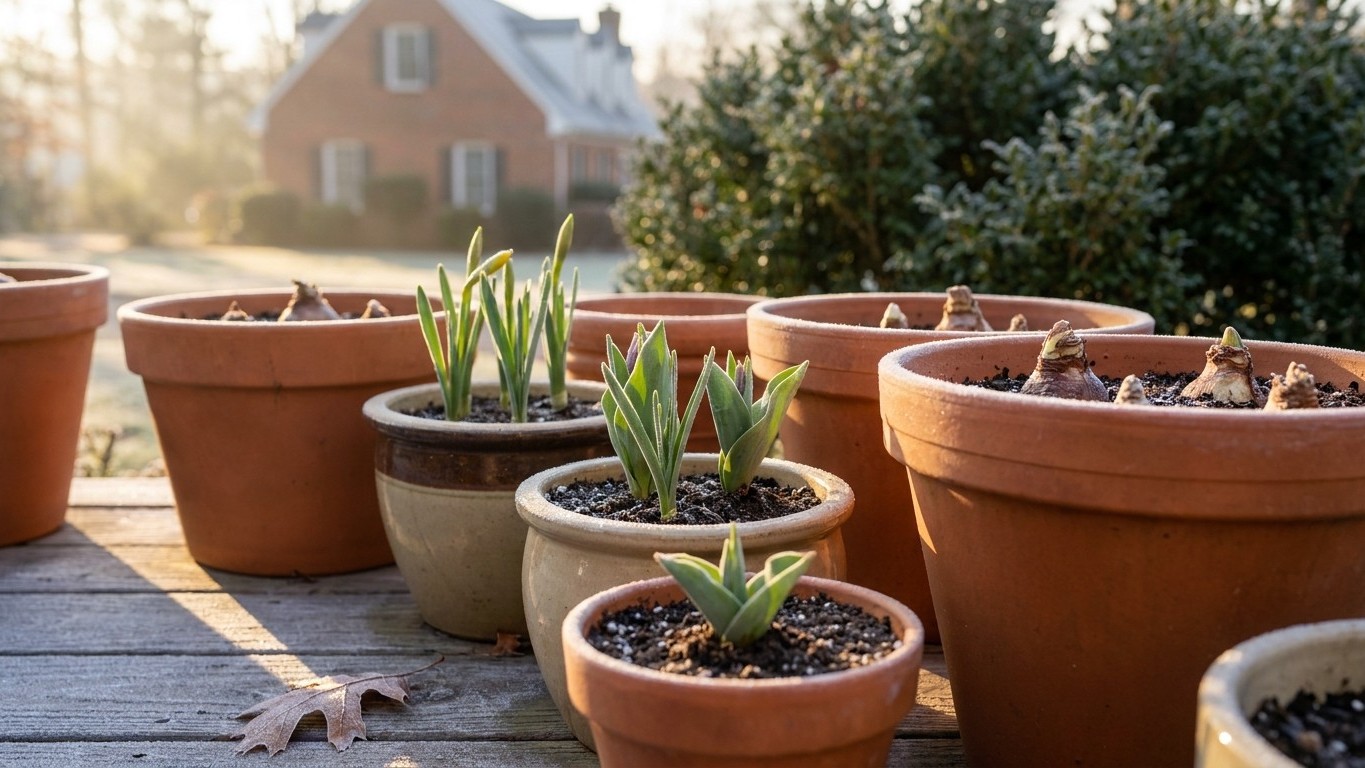

In Virginia, garden beds usually get enough winter cold on their own to bring spring bulbs into bloom without any help. Containers are a different story. A pot freezes through in ways garden soil never does, so the same crocus or hyacinth that thrives in the ground can die in a pot unless you size the container right, place it correctly, or move it indoors for part of the winter.
Why this matters in Virginia

The mean daily minimum temperature during Virginia’s coldest month sits at 31.6°F, based on NOAA NCEI Climate Normals from 1991-2020, measured at the reference station in Virginia Beach. That number matters more than the record low or the monthly average, because it’s what decides whether a bulb’s chilling requirement gets met year after year, not just in an unusually cold winter.
A spring bulb like a tulip or daffodil needs roughly 12 to 14 weeks below 45°F to break dormancy and set a flower bud. With a coldest-month mean minimum of 31.6°F, Virginia’s ground delivers that chill reliably in most winters. This isn’t a state where gardeners need to fake winter in a refrigerator just to get a garden bed of daffodils to bloom on schedule. The soil does the work by itself.
Containers change the equation entirely. Garden soil is insulated by its own mass and by the steady temperature of the earth a foot or two down, so even when the air freezes, root zones rarely do, at least not for long. A pot has none of that protection. Exposed on all sides, the soil in a container tracks the air temperature almost directly, so a run of nights near or below that 31.6°F average can freeze a pot solid, roots included, especially in a thin-walled or unglazed container. That’s the risk this territory poses to potted bulbs: not too little cold, but too much of it delivered too fast, with no buffer between the bulb and the air.
The USDA Plant Hardiness Zone Map, 2023 edition, based on 1991-2020 normals, places Virginia across a wide band, from zone 5a in the mountains to zone 8b along the coast. That’s too broad a range to plan a container planting around. The Virginia Beach reference station, sitting toward the milder end of that spread, is a more useful anchor for a dated recommendation than the statewide range, but a reader gardening near the Blue Ridge or in the Shenandoah Valley is working with several zones’ difference and should adjust the container rules below accordingly.
How to do it here
Because Virginia’s ground already meets the 12- to 14-week chilling window most spring bulbs need, the container question really comes down to two separate choices: whether you’re potting bulbs to force early bloom indoors, or potting them for a display you plan to leave outside where the ground would normally hold. Each has its own sequence, and skipping a step usually shows up as a specific, recognizable failure later.
- Pick the bulb and confirm its chilling requirement before potting it. Most tulips, daffodils, hyacinths, and crocus need the full 12 to 14 weeks below 45°F; paperwhite narcissus need none at all.
- For indoor forcing, pot the bulbs in a container with drainage holes, water lightly, then move the pot somewhere that holds steady between freezing and 45°F for the required weeks. An unheated garage that doesn’t drop below freezing works. A refrigerator’s produce or crisper drawer works too, as long as it stays away from ripening fruit: apples and other fruit release ethylene gas, and ethylene kills the flower bud forming inside the bulb before it ever gets a chance to open.
- Check the storage spot’s temperature with an actual thermometer, not by guesswork. A garage that dips below 32°F even briefly can damage the bulb outright; one that climbs consistently above 45°F won’t complete the chilling, and the plant will leaf out with no flower.
- For a container left outdoors all winter, the pot itself needs to be rated at least two USDA zones hardier than the bulb’s own hardiness listing, because a pot offers so little insulation. Given Virginia’s 5a-8b range, that means checking your specific location’s zone, not the state average, before assuming any pot will survive outside unprotected.
- Where the container isn’t rated hardy enough on its own, move it against a house wall, into an unheated shed, or into a garage, and pack mulch, straw, or fallen leaves around the sides and top. That mulch layer is doing the job garden soil would normally do without help.
- Bring forced bulbs into light and warmth only after the chilling period is fully complete, and do it gradually, a few days in a cool, bright spot before full sun and warmth, so the flower stem has time to elongate before the plant senses it’s time to bloom.
Which bulbs are worth it
Not every spring bulb rewards the extra work of a container. The ones that force reliably tend to share a short chilling requirement and a compact stem, so they finish before they have time to lean over or flop. Bulbs with a longer chill demand or a tall, heavy flower stalk are harder to keep upright in the confined root space of a pot, and often disappoint even when the chilling schedule was handled correctly.
Where a bulb was never going to survive Virginia’s climate as a perennial anyway, paperwhite narcissus being the clearest case, forcing costs nothing in the long run. You weren’t getting a second year out of it regardless, so treating it as a one-season indoor display isn’t a compromise. It’s the whole point of buying it.
- Crocus: short chill requirement, compact form, reliable both indoors and out
- Grape hyacinth (muscari): short stem, forces quickly, rarely topples
- Hyacinth: fast, fragrant, and dependable in a pot
- Iris reticulata: dwarf habit suits a small container well
- Paperwhite narcissus: needs no chilling at all, a one-season purchase either way
- Tall tulip varieties: heavy flower head on a long stem, prone to toppling in pots
- Large ornamental alliums: long chill requirement paired with height unsuited to container growing
- Fritillaria: finicky about moisture and chilling consistency, easily lost in a pot
- Camassia: tall, slow to establish, and better suited to open ground than a container
A pot’s limited soil depth also means bulbs go through cold and moisture swings faster than they would in the ground, which is part of why the finicky varieties on the second list struggle even when every step was followed correctly.
What goes wrong, and when you can still fix it
Leaves but no flower
This is the most common container failure, and it almost always means the chilling period ran short, whether the garage warmed up on a mild stretch or the pot came out of the fridge too soon. The flower bud only finishes forming inside the bulb after the full 12 to 14 weeks below 45°F; cut that short and the bulb has enough stored energy to push up leaves, but not to finish differentiating a flower. There’s no fix for this season’s display. The bulb itself is usually still alive, so the only real remedy is starting over next year with a longer, uninterrupted chilling period, checked with a thermometer instead of a guess.
A flower buried in the foliage
When the bloom opens on a stem too short to see above the leaves, the chilling was probably fine, but the bulb was moved into light and warmth too early or too abruptly. The flower stalk needs a few days in cool, bright, indirect conditions to elongate before full warmth triggers the bloom itself. This one can’t be fixed once it’s happened, since the stem has already set its length. What you can do is note the timing and give the next batch a longer transition between cold storage and a sunny windowsill.
Rot at the base of the bulb
Soft, discolored tissue at the base, sometimes with a sour smell, points to standing water rather than the cold. A container without drainage holes, or potting mix that stays soggy, keeps the bulb wet enough for rot organisms to take hold. This isn’t something you can nurse back this season; a rotted bulb is done. The fix applies only to the next planting: drainage holes, a pot elevated slightly off the ground or windowsill, and a mix that drains rather than holds water.