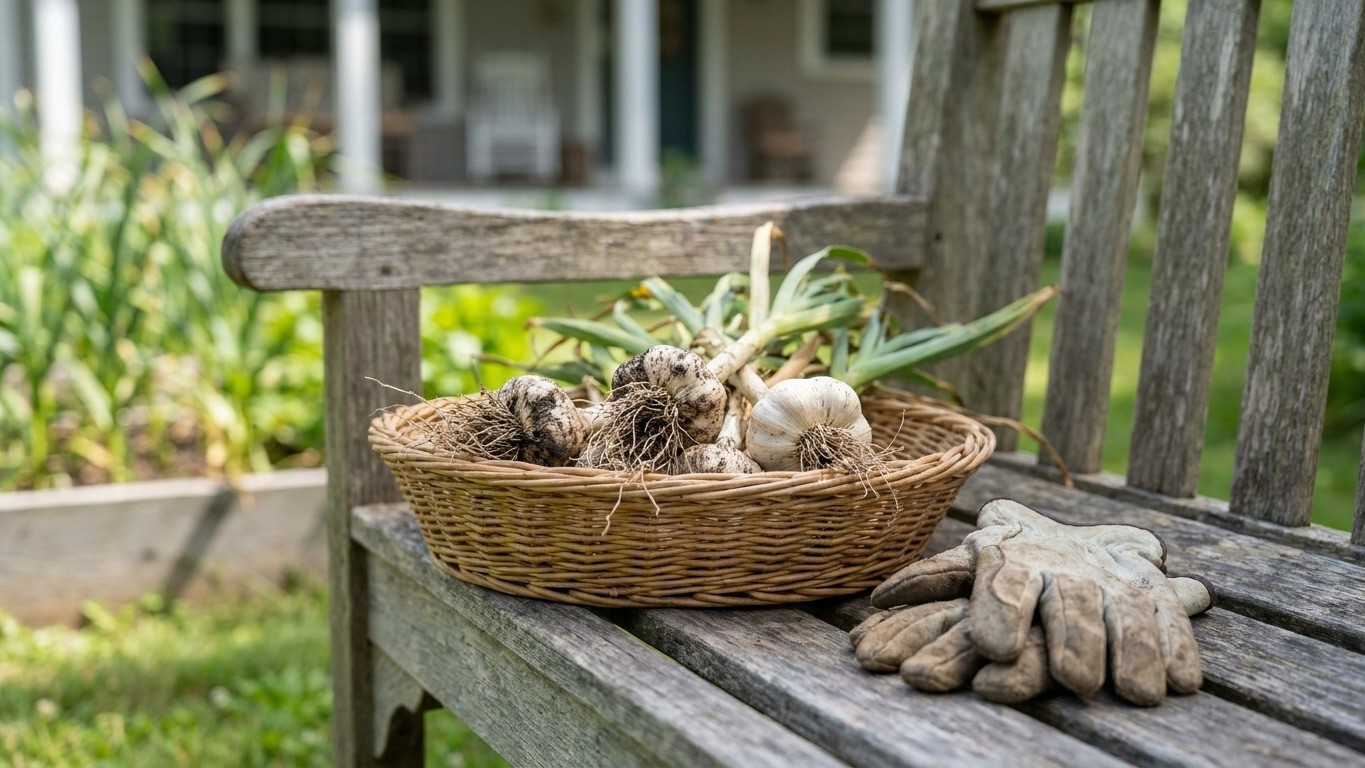

Garlic planted in Virginia in the fall comes out of the ground the following summer, usually when the lower leaves have browned and dried back while the top few stay green. That’s the visual cue growers rely on here, since no fixed calendar date works across the state. After lifting, bulbs need several weeks of curing in a dry, shaded, airy spot before they go into winter storage, where cool and dark conditions matter more than cold.
When garlic is ready to lift in Virginia
The clock on this crop actually starts in autumn, not summer. Cloves go into the ground weeks ahead of the season’s first hard freeze so roots can establish before the soil locks up. For coastal Virginia, NOAA’s 1991-2020 Climate Normals put the first fall frost at NAS Oceana, station USW00013769, somewhere between November 10 and November 24. That’s a midpoint drawn from three decades of data, not a guarantee. In one year out of two, the frost actually arrives later than that window suggests, so treating it as a hard deadline is a mistake.
Geography changes this picture fast. The Blue Ridge and southwest Virginia run on a different schedule entirely: fall frost shows up earlier there, and spring green-up lags weeks behind the coast. A grower in Wise County or Highland County is working with a shorter, later-starting season than someone near Virginia Beach, even though both are technically the same state.
What actually signals harvest time
Once spring growth resumes, the plant spends months building the bulb underground, and there’s no single date that applies statewide for when that process finishes. What growers watch instead is the foliage. As the bulb matures, the lowest leaves on the stalk begin to yellow and then brown, while the leaves higher up stay green a while longer. That staggered dieback, roughly the bottom third to half of the leaves showing brown, is the standard cue for pulling a test bulb or two to check.
Pulling too early means small, unfilled cloves wrapped in wrappers that haven’t set. Waiting too long risks the opposite problem: the bulb’s protective wrappers split open underground or in the soil, which shortens how long that bulb will keep once it’s stored. Since Virginia spans such different climate zones, from tidewater to mountain, the exact week this happens will vary by yard, and the leaf-based read is more reliable than counting days from any fixed date.
Curing it, and where to hang it here
Pulling the bulb is not the finish line. Fresh garlic straight out of the ground is wet, and the wrappers haven’t hardened into the papery layers that make a bulb keep through winter. Curing does that work, and it takes time, generally several weeks, not days.
The process itself is simple: bulbs (stalks and roots still attached, dirt knocked off but not washed) get spread out or hung in a single layer somewhere dry, shaded, and moving air. Direct sun during this stage can scald the bulbs, so a shed, covered porch, garage with the door cracked, or a barn with a fan running all work better than anywhere in open sunlight.
Why Virginia summers make this harder
Humidity is the real obstacle here, more than temperature. Garlic comes out of the ground right as Virginia’s summer humidity is climbing, and damp air slows curing dramatically. Bulbs left in a still, muggy space can start molding before they’ve dried down, especially in the Piedmont and coastal plain where July air holds a lot of moisture. Airflow matters as much as shade in this climate. A box fan pointed across hanging bundles, or bulbs laid on a mesh screen instead of piled on a solid surface, cuts down the time mold has to take hold.
Growers in the mountains and valleys of southwest Virginia generally deal with slightly drier summer air, which can make curing more forgiving there than along the coast or in the humid corridor around Richmond and Hampton Roads. Either way, the bulbs aren’t ready to move to storage until the outer wrappers feel papery and dry to the touch, and the roots have shriveled rather than staying fleshy. Cutting stalks too soon, before that dry-down is complete, invites the same mold risk that rushed curing does.
Storing it through a Virginia winter
Once cured, garlic wants the opposite conditions from curing: cool and dark instead of airy and shaded, though ventilation still matters. A pantry shelf, an unheated closet, or a cool basement corner all work, provided the space doesn’t swing warm. The kitchen counter is a bad long-term spot; warmth pushes bulbs to sprout early, which shortens how long they’ll last.
The refrigerator isn’t the answer either, despite being cool. Fridge humidity is generally too high for long-term bulk storage and tends to encourage sprouting or softening rather than preventing it. Mesh bags, loosely woven baskets, or braided bundles hung in a ventilated space all let air move around the bulbs, which matters because trapped moisture is what starts rot in storage, not cold air itself.
Where Virginia’s winter works against storage
Basements across much of the state run damp in winter, particularly in older homes without a dehumidifier or in houses near the coast where the water table sits high. That dampness is the main storage enemy here, more than any specific temperature threshold. A cool, dry space beats a cool, damp one every time, so if the only cool spot available is also humid, some growers do better keeping bulbs in a ventilated container in a slightly warmer but drier room instead.
However bulbs are stored, they don’t all last the same length. Bulbs with any bruising, cut stems, or soft spots from the harvest and curing process should get pulled out and used first, since those are the ones most likely to soften or mold mid-winter. Sorting through the stored crop every few weeks and pulling anything questionable keeps one bad bulb from spreading trouble to its neighbors in the same bag or braid.
What goes wrong here
Most storage failures trace back to curing that wasn’t finished, not to anything that happens later in the pantry. A bulb that goes into storage still slightly damp inside its wrappers is a bulb that molds by January, no matter how carefully it’s kept after that. Given how much Virginia’s summer humidity fights against fast curing, this is the single most common misstep, and it’s largely invisible until the storage crop starts failing weeks or months later.
Pests are a smaller factor for a crop that’s mostly protected underground and then cured indoors, but garlic and other alliums in Virginia gardens aren’t immune to the insects Virginia Cooperative Extension documents in the region. Among the pests the extension service lists for this territory are thrips and spider mites, Aphids, and Black cutworm, all of which can affect growing alliums before harvest even begins. None of these are unique to garlic, but a stand under pressure from any of them going into harvest is more likely to produce smaller, thinner-wrapped bulbs that don’t cure or store as well.
Timing mistakes cut both ways. Pulling bulbs before the lower leaves have browned means undersized cloves that won’t keep as long regardless of how well they’re cured afterward. Leaving bulbs in the ground too long past that point risks split wrappers, which is effectively an open door for soil moisture and rot organisms before curing has a chance to seal the bulb up. Between an early pull and a late one, most growers here find a slightly early harvest is the safer mistake, since it costs some size but rarely costs the whole bulb.
Common questions
Can I plant garlic in spring instead of fall in Virginia?
The pattern documented here is autumn planting followed by a summer harvest the next year, which lets the crop establish roots before winter dormancy. Spring planting isn’t covered by the sourced information for this territory.
How long does cured garlic actually keep once stored?
No specific storage-duration figure is published in the sources used for this article. What’s documented is that cool, dark, ventilated conditions extend how long bulbs stay usable, while warmth, dampness, and bruising shorten it.
Does the Blue Ridge really harvest at a different time than coastal Virginia?
Yes, and by a meaningful margin. The Blue Ridge and southwest Virginia see fall frost earlier and spring warm-up later than the coast, per NOAA NCEI’s climate normals for the region, which shifts the whole growing window rather than just the harvest date.
Is it normal for garlic to look sprouted before I even get it into storage?
Green sprouting inside a bulb usually points to storage that started too warm rather than anything wrong with the harvest itself. Moving bulbs to a cooler, darker spot as soon as curing finishes is the fix documented for this issue.