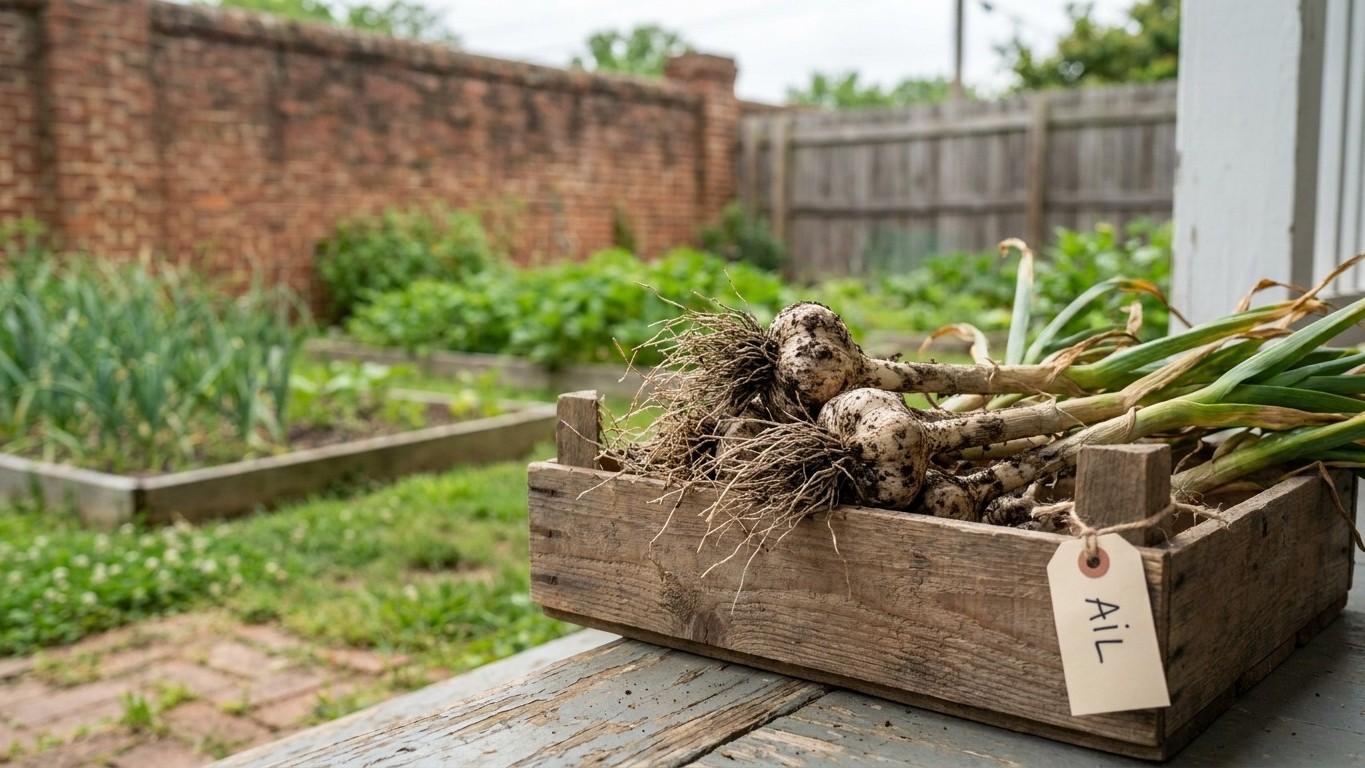

Yes — garlic gets all the cold it needs in Virginia, even at the coast. A clove has to sit through six to eight weeks below 40°F before it splits into a proper head, and Virginia’s mildest spot still delivers over four months of that kind of cold each winter, so inland and mountain gardens clear the bar with ease. The one thing to do now is get your cloves into the ground sometime between mid-October and early November, so they root before the ground locks up.
Will garlic get the cold it needs in Virginia

A garlic clove is not just a seed waiting to sprout. It has to sit through a stretch of cold before it will divide into the cluster of cloves you expect at harvest. Skip that cold and you lift a single round bulb that never split, which is edible but not what any grower planted for. This is the one variable that decides whether a season succeeds before you’ve even chosen a variety.
The 17.4 weeks below 40°F measured at the Virginia Beach station clears the six-to-eight-week minimum with room to spare, and that number comes from the mildest part of the state. Move inland toward the Piedmont, or up into the Blue Ridge and southwest Virginia, and winters run colder and longer, so the cold requirement is met there even more comfortably. Virginia Cooperative Extension is the body to check for anything specific to your county, but on the climate alone, there is no part of the state where garlic goes without its chill.
That leaves the two situations where a grower still needs a backup plan: an unusually mild winter in a sheltered microclimate, like a walled urban garden or a warm low pocket near the coast, or a small planting kept somewhere warmer than the open ground. In those cases the fix is straightforward. Refrigerate seed cloves for several weeks before planting to force the chilling artificially, or plant a softneck type, which tolerates a lighter winter and still forms a normal head even where the cold runs shorter. Nobody in Virginia needs to abandon garlic over cold. The state’s baseline climate does the work; the refrigeration trick is insurance, not a requirement.
When to put the cloves in
Anchor the planting date on the first fall frost, not on a month from a calendar. NOAA’s 1991-2020 climate normals put that first frost at the Virginia Beach reference station somewhere in the November 10 to November 24 window, a spread that centers loosely around mid-to-late November. Garlic wants to go in the ground early enough to grow roots before the soil locks up cold, but not so early that it pushes a lot of leaf growth that then sits exposed all winter.
Working back from that frost window, the mid-October to early-November planting range used for every variety in this guide to Garlic Varieties That Suit Virginia Winters — detailed in When to Plant Garlic in Virginia — puts cloves in the ground roughly two to six weeks ahead of the frost itself. That gap is enough time for root growth without inviting much top growth before winter shuts things down. Since Virginia Beach sits at the mild end of the state, treat this frost window as the latest-arriving version of fall cold in Virginia, not the earliest.
What moves the date around: elevation and distance from the coast are the two big factors here. A garden in the Blue Ridge or in the far southwest of the state sees its first frost weeks earlier than the coastal window above, so a grower there should plant on the early side of the mid-October to early-November range, not the late side. A garden right on the coast, in the same climate zone as the reference station, can lean later within that same window. There is no single safe date to circle on a calendar. Watch your own soil and your own frost history, and if you garden near the mountains, compare notes with a grower doing the same crop in a genuinely cold-winter state like the one covered in Growing Garlic in Washington: Planting Dates, Varieties and Winter Cold, where the frost calculus works the same way even though the numbers differ.
Which types suit Virginia
Hardneck and softneck garlic are not interchangeable, and the difference that matters here is winter. Hardneck varieties want a real cold season to perform well and reward it with bigger cloves and a stronger, more complex flavor, but they store for only a few months after curing. Softneck varieties tolerate a milder winter, braid well, and keep in storage for six months or longer, which is why grocery store garlic is almost always softneck.
Given the cold margin Virginia carries even at its mildest station, hardneck garlic is a safe choice statewide, not just in the mountains. That said, softneck still has a real advantage here for anyone who wants a crop that keeps into spring rather than getting used up by January. The choice comes down to storage life and flavor preference, not survival, which is unusual for a state this far south and worth taking advantage of.
Varieties to consider
| Variety | Type | Planting window in Virginia |
|---|---|---|
| Early Red Italian | Softneck | Mid October to early November |
| Inchelium Red | Softneck | Mid October to early November |
| Italian Late | Softneck | Mid October to early November |
| Lorz Italian | Softneck | Mid October to early November |
| Bavarian Purple | Hardneck | Mid October to early November |
| Blue Music | Hardneck | Mid October to early November |
| Chesnok Red | Hardneck | Mid October to early November |
| Duganski | Hardneck | Mid October to early November |
| Fall Festival | Hardneck | Mid October to early November |
| Georgian Crystal | Hardneck | Mid October to early November |
| Georgian Fire | Hardneck | Mid October to early November |
| German Red | Hardneck | Mid October to early November |
| German White | Hardneck | Mid October to early November |
| Ivan | Hardneck | Mid October to early November |
Catalogue days-to-maturity figures for these varieties are counted from planting under typical conditions and shift by a week or two depending on the season, so treat any specific harvest date from a seed catalogue as a starting estimate rather than a promise.
Soil and bed preparation
Garlic sits in the same patch of ground for eight or nine months, through freezes, thaws, and whatever rain the winter brings. Drainage matters more than fertility for the first stretch of that period, because a clove sitting in saturated, cold soil rots before any disease organism gets a chance to touch it. If water pools on a bed after a heavy rain and takes more than a few hours to disappear, that bed needs work before you plant, not after.
Raised beds or ridged rows solve most drainage problems outright, and they warm and drain faster in spring too. Work compost or aged manure into the top several inches before planting, both to loosen heavy clay and to give the roots something to grow into over winter. A soil test through your local extension office, taken well ahead of planting, tells you where pH and fertility actually stand rather than guessing.
Before you plant, check:
- Standing water after rain: reroute or raise the bed if it lingers
- Compaction: a shovel that won’t sink easily means the roots won’t either
- Old crop debris: clear it out, since it can carry disease into the new bed
- Weeds: a clean bed now means less hand-weeding around new shoots later
What the climate here favours, and what it does not
Garlic’s main soil-borne diseases each have a published temperature range they’re most active in, and Virginia’s growing-season air temperatures fall inside several of those ranges for real stretches of the year, according to the UC IPM Pest Management Guidelines for onion and garlic (UC ANR Publication 3453). Those thresholds are measured in soil, not air, and soil temperature lags behind air temperature and swings less through the day, so a month where the air mean sits inside a disease’s range is a tendency toward activity, not a diagnosis.
White rot, caused by Sclerotium cepivorum, has the widest published range of the group at 50 to 75°F, and Virginia’s air temperatures fall inside that band for six months of the growing season: September, October, November, April, May, and June, with one of those months landing right at the pathogen’s published optimum. Fusarium basal rot, caused by Fusarium oxysporum f. sp. cepae, occurs in the 59 to 90°F range and Virginia’s air temperatures sit inside it for five months, September, October, May, June, and July, again including one month at the optimum.
Pink root, caused by Setophoma terrestris, has a narrower published optimum of 75 to 85°F, which Virginia’s air temperature reaches for one month of the growing season, July. Southern blight, caused by Sclerotium rolfsii, wants a hotter 86 to 95°F optimum that no month here reaches on average, which means the disease runs less active in this climate, not that it’s off the table entirely. None of this means infection is coming. A monthly average inside a range still includes plenty of days above and below it, and every one of these pathogens spreads mainly through infected seed stock and contaminated soil, not through weather alone. Buying clean, certified seed garlic and rotating beds away from onions and garlic for a few years does more to keep these diseases out than any climate fact does.
Getting it through the winter
A layer of loose mulch, straw or shredded leaves work well, protects newly planted cloves from the freeze-thaw cycles that do more damage than steady cold ever does. Lay it down after the ground has cooled but before a hard freeze sets in, so the soil underneath isn’t insulated into staying warm and delaying the dormancy the clove needs.
The real danger over winter isn’t the cold itself, it’s frost heaving, where repeated freezing and thawing pushes a shallow-planted clove up and out of the soil, exposing it to drying wind and cold air it was never meant to face. A clove planted too shallow, or one in a bed that drains poorly and stays wet enough to heave, is far more likely to end up sitting half out of the ground by February than one set at proper depth in a well-drained bed. Mulch buffers the soil against those swings and reduces heaving considerably.
Come spring, pull back some of that mulch once green shoots start pushing through, so the new growth isn’t smothered, but don’t strip the bed bare right away. A partial layer left in place through the last cold snaps still moderates soil temperature and holds moisture, and it suppresses the first flush of spring weeds too. Growers in a much colder state, like the ones described in Growing Garlic in Minnesota: Planting Dates, Varieties and Winter Cold, need a heavier and earlier mulch layer than Virginia does, since the freeze-thaw cycles there are more frequent and more severe.
Harvest and curing here
Reading the leaves
Lift garlic by what the plant is telling you, not by a date on a calendar. The signal to watch is the lower leaves browning and drying while the upper leaves stay green. Pull too early and the head hasn’t finished filling out its cloves. Wait too long and the wrapper that protects each bulb starts to break down underground, leaving it exposed to soil moisture and rot right at the finish line.
Curing in a humid climate
Virginia’s summer humidity makes curing a slower, more careful job than it would be in a dry climate. Good airflow matters more than heat for curing garlic well here. Hang or lay the bulbs in a single layer somewhere shaded, dry, and breezy, ideally with a fan running if the air is still and heavy, and leave them until the necks are tight and the outer wrappers have gone papery. Skipping this step, or curing in a closed, humid space, is how a perfectly good harvest turns moldy in storage a few weeks after it looked safe.
Local help
County-level frost dates, soil test results, and planting advice specific to your part of Virginia are worth getting directly rather than estimating from a coastal reference station. Virginia Cooperative Extension is the place to start, whether you’re gardening near the coast, in the Piedmont, or up in the mountains where the whole planting calendar shifts earlier.
Common questions
Can I Plant Garlic in spring instead of fall in Virginia?
Garlic planted in spring almost never forms a proper head, because it misses the cold period it needs after planting to divide into cloves. Fall planting, in the mid-October to early-November window, is how this crop is grown here and everywhere else it’s grown well.
What happens if I plant my garlic too early?
Cloves planted well ahead of the mid-October to early-November window can push too much leaf growth before winter, and that top growth sits exposed through the cold months, sometimes getting damaged by hard freezes. The plant usually survives, but it wastes energy on growth that gets knocked back instead of storing it for spring.
Do I need to refrigerate garlic before planting in Virginia?
No, not under normal conditions. Virginia’s winters, even at the mild coastal end of the state, run well past the cold a clove needs to split, so refrigeration is only worth considering for an unusually warm microclimate or a small indoor-adjacent planting.
Why did my garlic come up as one big clove instead of a head?
That’s called a round, and it almost always means the clove didn’t get enough cold before or during its early growth, or it was planted too late in the season to establish properly before winter. It can also happen with undersized planting stock that never had the reserves to divide.
Should I cut the scapes on my hardneck garlic?
Cutting the scape, the curling flower stalk hardneck varieties send up, redirects the plant’s energy into bulb growth rather than that top structure. Most growers cut it once it curls, and it’s a good edible on its own, sautéed or used like a mild garlic-flavored green.