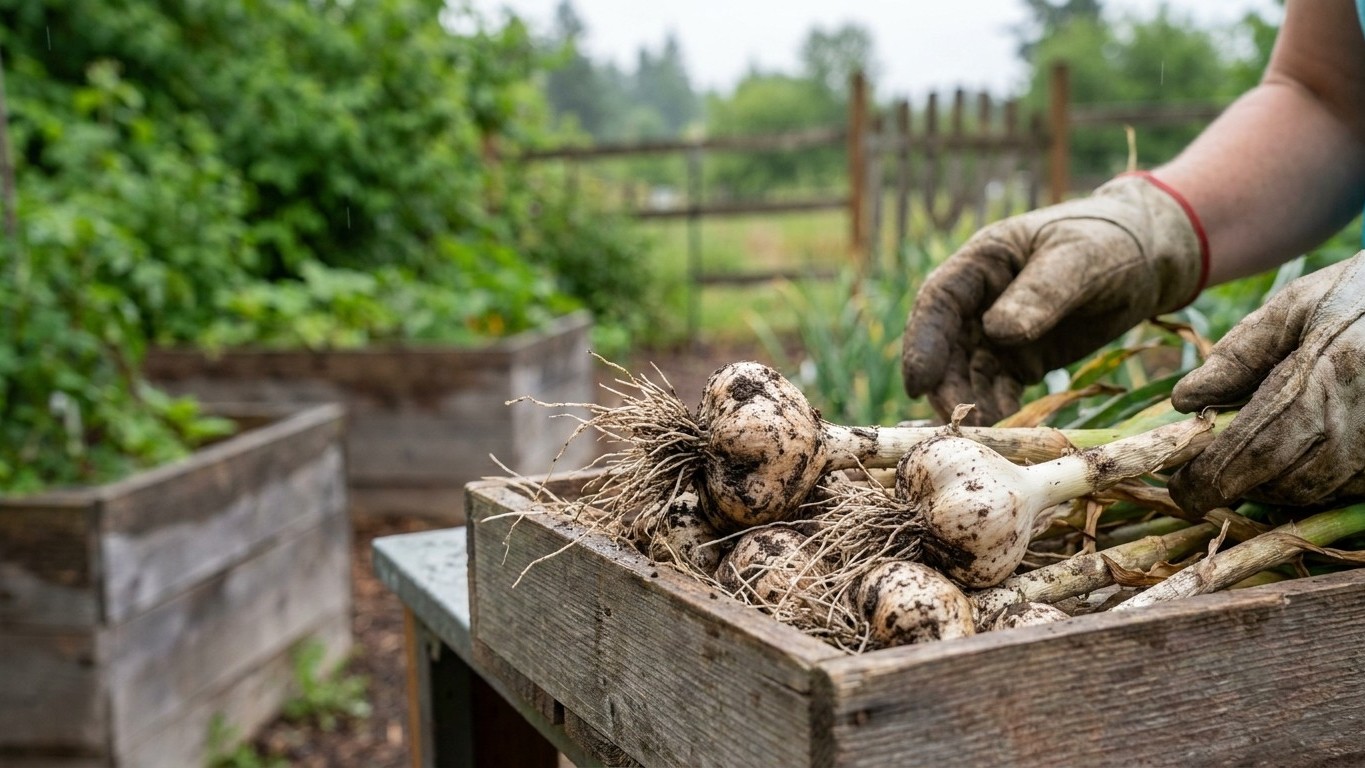

Late October to early November: that’s the window, and it holds whether you’re planting softneck Early Red Italian or hardneck Duganski. Not because of days to maturity, but because Washington’s first fall freeze near Seattle typically lands somewhere between November 13 and November 30, and getting cloves in the ground two to five weeks before that gives roots time to settle while the soil still works. The winter that follows carries far more cold than garlic actually needs to split into cloves.
The short answer for Washington

For most of the state, the planting window is late October to early November, and it doesn’t change by variety. Every cultivar in our directory, from softneck types like Early Red Italian to hardneck types like Duganski, shares that window because it isn’t set by days to maturity. It’s set by the fall frost and by how long the winter stays cold enough to split the bulb into cloves.
Near Seattle, NOAA’s 1991-2020 Climate Normals put the first fall freeze at November 13 to November 30, station USW00024233. That’s a midpoint drawn from thirty years of data, not a safe date to plant around: in roughly one year out of two, the season’s first freeze lands after November 30, and in the other half it lands before November 13. Planting late October to early November puts cloves in the ground two to five weeks ahead of that midpoint, enough time for roots to establish while the soil is still workable.
Washington’s winters supply plenty of cold once the crop is in the ground. University of Georgia Extension publication C854 puts garlic’s chilling requirement at six to eight weeks below 40°F to trigger clove division. Measured near Seattle, the growing season carries 17.4 weeks below that threshold, more than double what the crop needs. That margin is why timing here is forgiving compared to states with a short cold season: the real question in Washington isn’t whether it’ll get cold enough, it’s whether the garlic goes in early enough to root first.
| Variety | Type | Recommended planting window |
|---|---|---|
| Early Red Italian | Softneck | Late October to early November |
| Inchelium Red | Softneck | Late October to early November |
| Italian Late | Softneck | Late October to early November |
| Lorz Italian | Softneck | Late October to early November |
| Bavarian Purple | Hardneck | Late October to early November |
| Blue Music | Hardneck | Late October to early November |
| Chesnok Red | Hardneck | Late October to early November |
| Duganski | Hardneck | Late October to early November |
| Fall Festival | Hardneck | Late October to early November |
| Georgian Crystal | Hardneck | Late October to early November |
| Georgian Fire | Hardneck | Late October to early November |
| German Red | Hardneck | Late October to early November |
| German White | Hardneck | Late October to early November |
| Ivan | Hardneck | Late October to early November |
If you haven’t chosen a bed or worked in compost yet, back up to Growing Garlic in Washington before locking in a planting date, since site prep changes how much of that window you actually have to work with.
Working it out for your own garden
The Seattle numbers only apply as written if you garden near Puget Sound. To adapt them, start with your own area’s typical first fall freeze rather than assuming the Seattle range fits, because a maritime lowland and a mountain valley forty miles apart can differ by two weeks or more in when the ground first freezes hard.
The arithmetic, step by step
Work backward from your local freeze date the same way NOAA’s Seattle data lets you work backward from November 13 to November 30. Take the date your area typically sees its first freeze, then count back two to five weeks. That interval, not a fixed calendar date, is what puts cloves in the ground while soil is still soft enough to work and while enough autumn remains for roots to establish before the ground cools hard. For the exact counting method against your own frost date, see When to Plant Garlic in Washington: Counting Back From the First Frost.
Elevation is the biggest single factor within a county. Gaining a few hundred feet cools a site enough to push the local freeze date earlier, so a garden on a hillside above a valley floor should plan on planting roughly two weeks ahead of what the valley reading suggests. Large water bodies work the opposite way. A site close to a lake or to Puget Sound holds heat into the evening and can push the effective freeze date back by a similar margin, because water releases stored summer warmth slowly through fall.
Coastal exposure does both jobs at once. Sites right on the water rarely see the sharp early freezes that inland valleys get, but they also see wetter fall weather, which matters more for disease risk than for timing. If your garden sits in a low spot that collects cold air on clear nights, a frost pocket, treat your local freeze date as arriving earlier than a regional station would report, and plant on the early side of whatever window you calculate.
None of this changes the arithmetic, only the date you plug into it. Once you have a working freeze date for your own site, the same two-to-five-week head start that applies around Seattle sizes a planting window for wherever you actually garden.
What changes across Washington
The frost window above describes the Puget Sound lowlands, the mild, marine-influenced strip running from Seattle north through Whatcom County and south into Thurston County. Winters there rarely turn severe, and the growing season stays wet and cool well into spring.
Cross the Cascades and the climate changes completely. Eastern Washington is high desert, with colder winter lows and a shorter frost-free season than anything the Seattle data describes. A grower in the Columbia Basin or around Spokane is working with a different frost calendar entirely, and applying the Seattle window there risks planting weeks too late for a season that closes down faster once real cold sets in.
Interior valleys such as the Yakima Valley and the area around Wenatchee sit in the rain shadow of the Cascades, with drier summers and colder, clearer winter nights than the coast. Garlic planted there follows the same general logic, root before the ground freezes hard, but the local date to count back from has to come from a station in that valley, not from Puget Sound.
Elevation reshapes the picture again within each half of the state. Foothill towns on either side of the Cascades sit measurably colder than the valley floors below them, and a garden a thousand feet up can see its first hard frost well before a garden in the lowland a few miles away.
The Olympic Peninsula and the outer coast run a third pattern: heavy, prolonged fall rain rather than early cold. That doesn’t move the planting calendar much, but it raises the risk of waterlogged beds and clove rot before the crop has a chance to root, which matters more on the coast than the exact week you plant.
None of these differences are figures NOAA’s Seattle station can supply. They’re reasons to treat the Seattle window as a starting point, not a statewide answer, and to check a source that reports at the county level before committing a whole bed to a single date range.
The mistakes this climate punishes
Planting too late because the ground still feels workable
Western Washington’s soil often stays diggable well into November, and that’s exactly the trap. Waiting for a dry, sunny planting day can push cloves into the ground with only a week or two left before NOAA’s Seattle-area frost midpoint arrives, and in the half of years when the first freeze lands even earlier than November 13, procrastinators lose the head start their roots need entirely. Treat the late-October-to-early-November window as the day to plant, not the day to start thinking about planting.
Planting shallow into wet ground
A shallow clove in cool, saturated soil sits in the worst possible spot: too exposed to root quickly, too wet to avoid rot. In a climate with 17.4 weeks of cold to spare, there’s no need to rush a shallow planting to beat the freeze. Take the extra few minutes to set cloves at proper depth in a bed that drains, rather than treating depth as the variable to skimp on when you’re planting late.
Ignoring the disease risk that comes with a long, cool season
Washington’s wet falls, cool springs and mild summers set up a temperature pattern that favors white rot (Sclerotium cepivorum) for a large share of the year. UC IPM’s Pest Management Guidelines for onion and garlic, UC ANR Publication 3453, put the fungus’s active range at 50 to 75°F, and near Seattle the mean air temperature falls inside that band in six months of the growing season: September, October, April, May, June and July, with two of those months sitting right at the pathogen’s preferred temperature. That figure is air temperature, not the soil temperature the published range actually measures, and a monthly average inside the range doesn’t mean every day that month carries risk. Even so, a six-month overlap is a strong argument for buying clean seed stock and never planting garlic in the same bed two years running.
Fusarium basal rot follows a narrower slice of the season. Its 59 to 90°F range, per the same UC IPM guidelines, matches Washington’s air temperature in September plus June and July, the stretch when garlic is either just going into the ground or just coming out of it. That makes handling at planting and at curing the two moments worth the most care, and it’s worth remembering that one weather station near Seattle doesn’t describe conditions in every county.
- Don’t plant before the summer heat has left the soil, even if cloves are on hand early.
- Don’t skip mulch on exposed sites where frost heaving is common.
- Don’t replant cloves saved from a bed that showed stunted or yellowing plants the year before.
Checking this against your county
Everything above is anchored to a single weather station near Seattle. For a planting date sized to your own county rather than the Puget Sound lowlands, check county-level figures through WSU Extension, which reports frost and growing-season data for individual parts of the state. That’s especially worth doing if you garden east of the Cascades, at elevation, or anywhere the Seattle window above doesn’t match what your own garden sees most years.
A county-level source beats a single reference station every time a climate varies this much across a state. It costs nothing but a search on the extension site to confirm before you commit a whole bed to someone else’s numbers.
Common questions
Can I plant garlic in spring instead of fall in Washington?
You can, but expect smaller bulbs. Garlic needs the six to eight weeks of chilling below 40°F that University of Georgia Extension identifies for clove division, and fall planting lets Washington’s winter supply that cold before active growth starts. A spring-planted clove skips most of that chilling and often produces a smaller bulb, sometimes with a single round clove, by harvest.
What if I miss the late October to early November window?
Plant as soon as you can afterward rather than waiting for spring. Cloves set into the ground through most of November still have time to root near Seattle, since NOAA’s data puts the first freeze at November 13 to November 30 and roots keep growing in soil above freezing. The later you go past the window, the less established the roots will be heading into winter, so treat each extra week of delay as a real cost.
Do hardneck varieties need a colder winter than softneck ones here?
Not in Washington. Hardnecks like Chesnok Red and German Red generally want more winter chill than softnecks to perform well, but the state’s 17.4 weeks below 40°F clears even the higher end of most hardneck chilling needs. The choice between hardneck and softneck here comes down to flavor, clove size and storage habits, not whether your winter is cold enough.
Is Washington’s wet climate a problem for garlic?
Moisture matters more than cold here. The same cool, damp months that make Washington’s winters mild enough for garlic also fall inside the temperature range where white rot stays active, according to UC IPM’s guidelines for onion and garlic, so drainage and clean seed stock matter more in this climate than protecting the crop from cold.