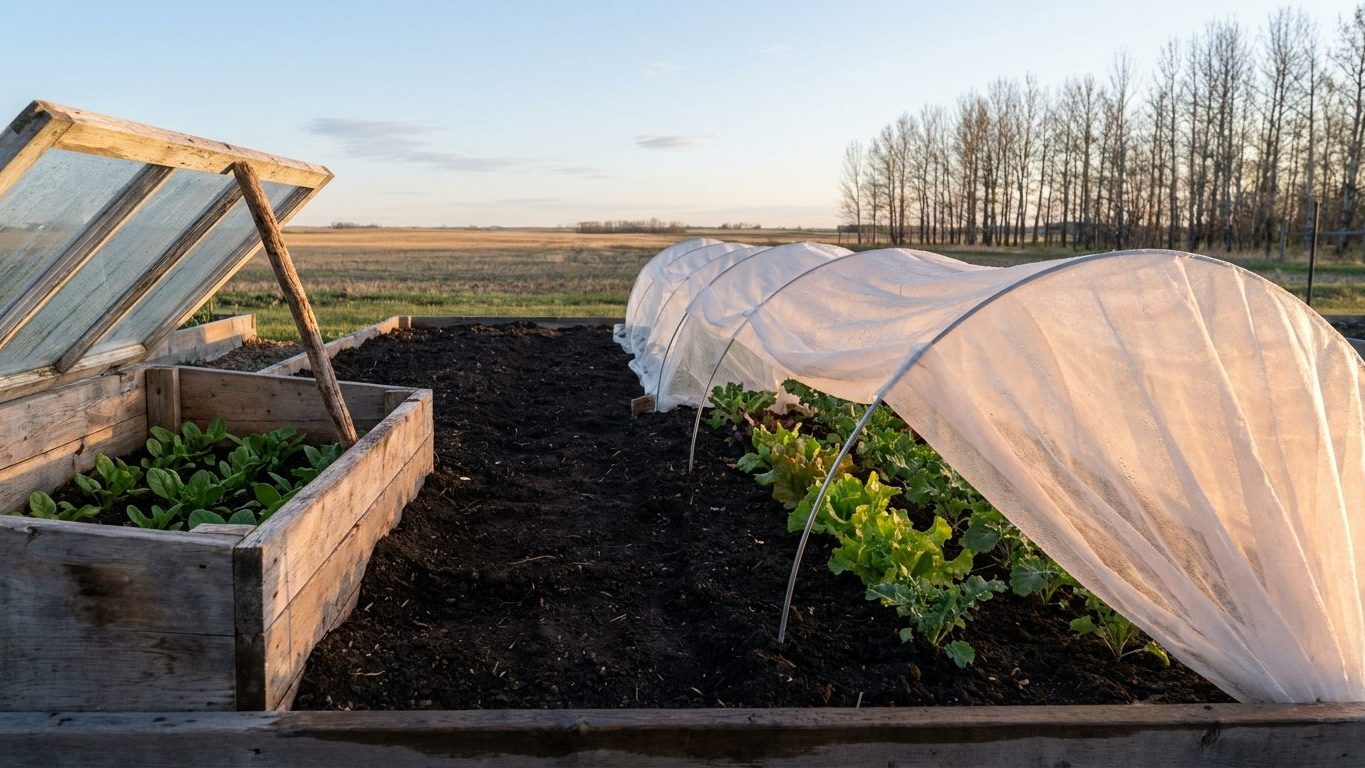

Low tunnels with row cover, cold frames, and a greenhouse or hoop house work in Northwest Territories, and raised beds with black plastic help in the cool soil. Anything that holds heat through a cold night earns its place. Anything that only shades the bed does little.
The short answer for Northwest Territories
Low tunnels, cold frames, and an unheated greenhouse or hoop house are the extenders that pay off here. Raised beds and black plastic mulch speed up the soil, which is often what holds spring back. Each one buys weeks, and a season this short has few weeks to spare.
The reference station at Yellowknife A (62.46 degrees north) has a mean last spring frost on May 25 and a mean first fall frost on September 18. Both dates are averages from Environment and Climate Change Canada’s 1981-2010 normals. Both are midpoints of a window. In one year out of two, frost comes later than May 25 in spring, and in one year out of two it arrives before September 18 in fall. Treat neither date as safe.
Which covers work best in spring?
A low tunnel (wire or plastic hoops with floating row cover or clear plastic over them) is the most flexible tool. It warms the soil under it ahead of planting, shelters seedlings from wind, and can go over a bed in an afternoon. Row cover gives light frost protection, enough for a mild frost and not for a hard freeze. Clear plastic holds more heat but can overheat on a sunny day, so vent the ends. Cold frames suit hardening off transplants and starting hardy greens early. A greenhouse or hoop house helps tomatoes and peppers finish reliably, since those crops need warm nights as well as warm days.
What helps in the fall?
The same tunnels and frames stretch the end of the season. Mature crops can sit under cover through the first frosts, and hardy greens, kale, and root crops hold on for extra weeks. Cover the bed before the first frost, not after it. Frost that has already blackened leaves is damage cover cannot undo. Keeping the timing of when to cover your garden in Northwest Territories in mind matters as much as the cover itself.
Day length helps. At this latitude, summer days are very long, so plants under cover get plenty of light. Heat is the limit, and that is why heat-holding structures beat shade cloth or thin screening. For the broader picture, see extending the growing season in Northwest Territories.
What will not work here
A single layer of row cover will not carry warm-season crops through the year. The mean last frost on May 25 is a midpoint, not a safe date, and the coldest month has a mean daily minimum of -29.5 °C (-21.1 °F). Nothing a home gardener can build from fabric and hoops outdoors holds back that kind of cold.
Unheated cold frames do not overwinter tender crops. Their job is to shelter hardy plants and young transplants in the shoulder seasons. In January a frame without added heat sits at roughly the outside temperature on a still night, and the plants inside freeze. Even hardy perennials in a frame need deep snow cover or heavy insulation, and a gardener who counts on the frame alone will lose them.
Late sowing is another trap. The mean first fall frost is September 18, and in half of all years it comes earlier. A fall crop sown late in the season will not finish, even under a tunnel, because growth slows sharply as days shorten and soil cools. Count back from mid-September, then add a margin for slow autumn growth.
Direct-sown heat lovers do not fit the numbers either. Melons, long-season squash, and sweet corn sown straight into cold ground will have little time to ripen before frost, even under cover. These are crops for a greenhouse, or crops to skip. Fast salad greens, radishes, and spinach are better outdoors.
Loose, unanchored covers fail in wind. Open ground at this latitude can be windy, and light fabric tossed off a bed during a cold night protects nothing. Bury the edges in soil, or weigh them with boards or rocks, and put the bed behind a fence or building where you can.
Finally, an early start without soil warming does not help. Seeds sown under cover in cold, wet soil sit and rot. Cover the bed ahead of time, and plant once the soil has warmed enough to be comfortable to the hand.
What changes across Northwest Territories
Northwest Territories is a very large place, and its gardens do not behave alike. The territory reaches far north, well beyond the latitude of Yellowknife. The 62.46 degrees north figure belongs to Yellowknife, and gardeners near the southern border or in the far north live on a different clock. There is no single answer for the whole territory.
Natural Resources Canada places Yellowknife in Canadian plant hardiness zone 1b, based on 1991-2020 normals. That is the Canadian system, built from seven climate variables, and it does not convert to a USDA zone. NRCan itself says there are no simple conversions between the two systems. Zones in other communities run higher or lower than Yellowknife’s, and the spread across the territory is wide. To find your own, look up your community on the Canada’s Plant Hardiness Site map, and do not assume it matches Yellowknife’s.
Reading the Yellowknife dates for your own garden means shifting them. Northern and upland districts run weeks behind the reference station, so the May 25 average is optimistic there, and the September 18 average arrives sooner. A gardener in those places should plan on a later spring start and an earlier fall deadline, and lean harder on structures that hold heat. Farther north, the season is shorter, which makes greenhouses and hoop houses the main option and open-bed tunnels a supplement.
Near the southern edge, the season runs longer and low tunnels will stretch it further. Even so, local conditions matter: a south-facing slope, a sheltered yard, a low spot where cold air pools. These can shift frost dates by as much as the difference between towns.
Where to check this for your own county
Start with the Government of the Northwest Territories agriculture services, which is the territory’s source for growing advice. The territory has no counties, so the local view comes from regional agriculture staff and from other growers in your community.
Look for two things there. The first is a planting calendar for your own area, with spring and fall dates set for your community instead of for Yellowknife. The second is the list of varieties that have been tried locally. A variety that does well in a southern garden may stall in a northern one, and local trial results save a season of guessing.
A recommendation for your own community beats a territory-wide one every time. Any territory-wide number, including the Yellowknife dates above, is a starting point. Those dates come from a single station and from 1981-2010 normals, which describe the climate of an earlier period. Springs and falls vary a lot from year to year, and a reasonable rule is to give yourself some margin on each end.
Local gardeners are a useful source as well. Community garden groups, greenhouse growers, and neighbors who have grown vegetables for years can tell you which beds thaw first and where the wind hits hardest. Ask them what they cover, when, and what they gave up on.
Checking this against your own garden
Your own observations outrank every date in this article. Three things are worth watching, and none needs a gadget.
- Soil warmth by feel. Push your hand into the bed, a few inches down, in the morning. If it feels cold and clammy, wait. A bed under plastic that feels noticeably warmer than the bed next to it tells you the cover is working. A bed that never warms, even under cover, is probably shaded or wet.
- First true leaves. Seedlings first show rounded seed leaves, then the first leaves with the plant’s real shape. If those leaves are slow to come, or turn purple or yellow, the bed is too cold for that crop. Healthy growth under a tunnel while uncovered seedlings sit still shows you how much shelter your site needs.
- First male flowers on squash or cucumbers. Male flowers open before female ones. If they arrive weeks later in one bed than another, you have found a cooler pocket in your yard, and that is where the earliest crops belong.
Keep notes. A few lines each year about when the soil felt workable, when the first frost hit, and which beds froze first will give you a better calendar than any average. Frost often settles first in the lowest corner of a yard, and the tunnel that covers that corner is the one that matters most.
Common questions
What is the single best season extender for Northwest Territories?
A low tunnel covered with row cover or clear plastic is the best first step. It is cheap, quick to set up, and works in both spring and fall. A greenhouse or hoop house comes next if you want tomatoes or peppers.
Can I plant on May 25 because it is the average last frost?
Not safely. May 25 is the mean last spring frost at Yellowknife A, so in one year out of two frost arrives later. Wait until the soil has warmed, keep a cover ready, and plant tender crops later in your area if you are in a northern or upland district.
Will row cover protect plants from a hard freeze?
Row cover handles a light frost. A hard freeze goes through it. Layer it over hoops, add a second cover on cold nights, or move potted plants indoors when a deep freeze is forecast.
Does Canadian hardiness zone 1b mean the same as a USDA zone?
No. Zone 1b is a Canadian zone built from seven climate variables, and it does not convert to a USDA zone. NRCan publishes the comparison and says there are no simple conversions. Look up your community on the Canadian map, and judge plants by Canadian ratings.