
Cabbage looper moths show up in Virginia gardens as early as May, with populations building through several overlapping generations until the first hard frost, usually October in most of the state. Damage tends to be worst from late July through September, when two or three generations are feeding at once on the same crucifer bed. There’s no single “looper season” date on the calendar; it’s a slow buildup tied to warm, humid weather.
The weeks to watch
Cabbage loopers don’t overwinter in Virginia. The moths migrate north from warmer states each spring, so the “start” of the season here depends on when that migration arrives and when local temperatures let eggs develop fast enough to matter. Virginia Cooperative Extension does not publish an exact flight-date window specifically for cabbage looper the way it does for some other crop pests, so the timing below follows the general pattern documented for this species across the mid-Atlantic rather than a Virginia-specific date range.
First generation: late spring into early summer
The earliest arrivals typically show up as scattered moths in May, laying eggs on young crucifer transplants. This first wave is usually light. Gardeners often miss it entirely because a handful of caterpillars on a few leaves doesn’t look like an infestation yet.
Second and third generations: mid to late summer
By July, the offspring of that first wave are laying their own eggs, and populations compound fast in warm weather. A second and often a third generation overlap by August, which is why late-summer cabbage, broccoli, and kale beds tend to take the heaviest hits. Feeding pressure usually tapers off once nights cool in late September or October, though it doesn’t stop cleanly on a set date, it just fades as temperatures drop below what the larvae need to develop.
Reading the calendar from your last frost
Cabbage loopers answer to soil and air temperature, not to a printed planting calendar, so the practical way to plan around them is to work forward from your own last spring frost date. In coastal Virginia, around Virginia Beach, that date falls between March 20 and April 3, based on NOAA’s 1991-2020 climate normals for the region. That’s a normal, not a guarantee; some years run earlier, some later, and the Blue Ridge and southwest Virginia sit weeks behind the coast in both directions.
- Mark your own last frost window (March 20 to April 3 for coastal Virginia; check your local extension office if you garden farther inland or at higher elevation).
- Count forward several weeks from your transplant date. Loopers rarely show visible feeding damage on brand-new transplants; the first chewed leaves usually appear once warm, humid weather sets in and the first generation’s eggs have had time to hatch and the larvae to grow large enough to matter.
That gap is also your practical window for row covers: put them on at transplanting, before the first moths find the bed, and plan to pull them once plants flower or grow too large to stay covered.
What it attacks, and what the damage looks like
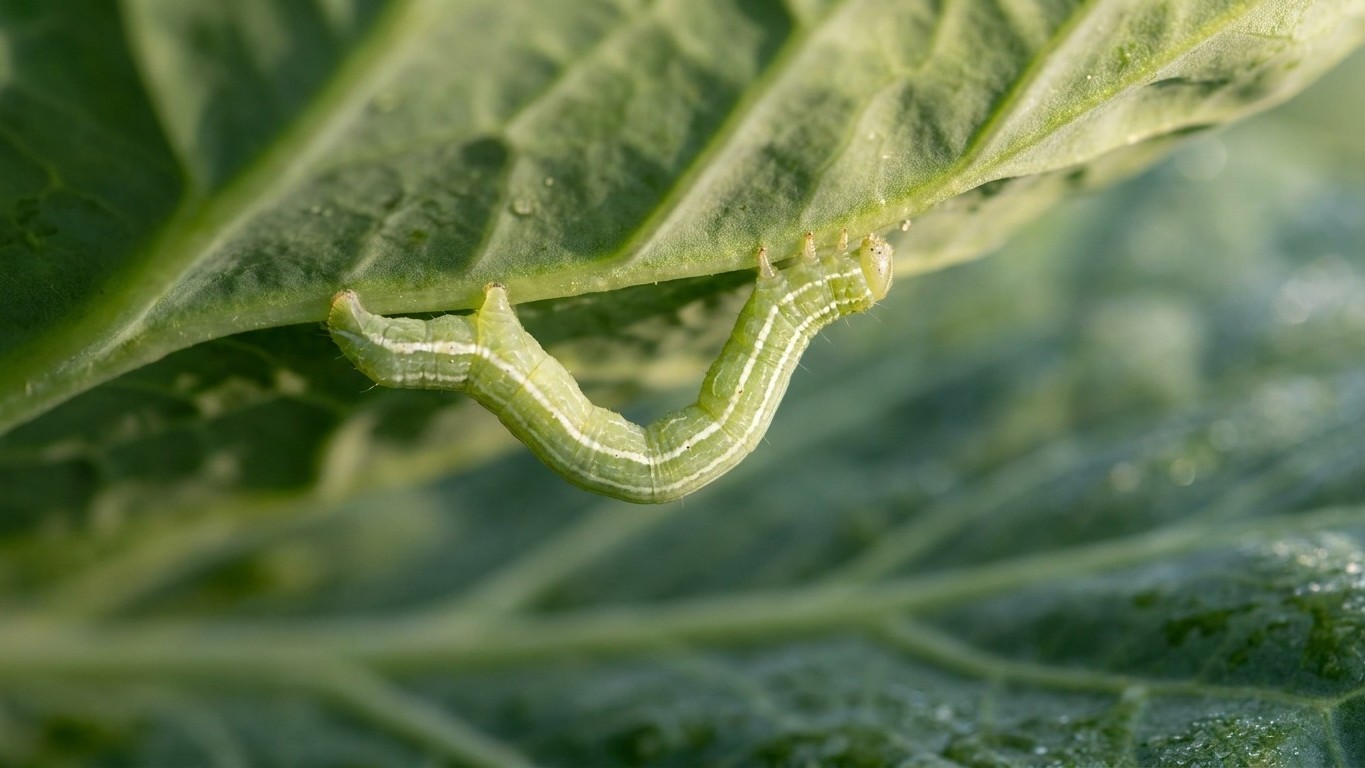
Most gardeners notice the damage before they ever spot the caterpillar. Leaves develop large, irregular holes with ragged edges, sometimes chewed down to just the veins in a lacy skeleton pattern. On cabbage and other heading crops, larvae will also bore into the developing head itself, leaving behind wet frass that fouls the whole vegetable, not just the outer leaves. The caterpillar responsible is pale green, smooth-bodied, and moves with a distinctive arching hump, the “looping” motion that gives the pest its name.
The larval stage does essentially all the damage; adult moths only feed on nectar and don’t harm plants directly. That matters for treatment timing, because once larvae have tunneled into a cabbage head, most surface-level controls stop being effective, and by the time you see heavy feeding, you’re usually looking at a mid-sized larva that’s already done a lot of the harm.
Crops most commonly attacked include:
- Cabbage
- Broccoli and cauliflower
- Collards and kale
- Lettuce
- Tomato, potato, and cucumber, less often, but not immune
How Virginia sits in this pest’s range
Cabbage looper is present across nearly the entire continental United States, so Virginia isn’t near any edge of its range, it’s squarely in the middle of it. What differs from one part of the country to another is mostly timing and the number of generations that squeeze into a season, not whether the pest shows up at all. A gardener in coastal Virginia can expect an earlier start and possibly an extra generation compared with someone in the mountains, simply because the growing season runs longer near the coast.
The only Virginia-specific climate data available for this analysis comes from the NAS Oceana weather station near Virginia Beach, representing the mild, coastal end of the state’s spring and fall timing. Inland and mountain gardeners should expect their own frost dates, and by extension their own pest timing, to run weeks behind what’s typical near the coast. No county-by-county severity ranking for cabbage looper is published for Virginia, so it’s more accurate to say the pest is a routine, statewide presence than to claim any one region gets hit harder than another.
What actually works against it
- Time your plantings to dodge peak pressure. Getting crucifers in the ground and past the seedling stage before the first generation’s moths arrive in late spring reduces how much of the season’s egg-laying your plants are exposed to.
- Use row covers from transplant until flowering. A physical barrier keeps moths from laying eggs on the leaves in the first place. It stops working the moment the cover comes off or the plant outgrows it, and it does nothing for larvae already inside the plant.
- Hand-pick visible caterpillars. Check the undersides of leaves regularly; loopers are easy to spot once you know the pale green, arching shape to look for. This works right up until larvae have tunneled into a cabbage head, at which point picking them off the surface no longer reaches them.
- Encourage natural predators. Parasitic wasps and other beneficial insects attack cabbage looper eggs and young larvae. Planting flowering herbs nearby to support those predators is a low-cost, long-term approach, though it won’t knock down an existing heavy infestation on its own.
- Rotate crops and clear debris after harvest. Since cabbage looper doesn’t overwinter in Virginia, rotation mostly helps by not concentrating food sources for the moths that do migrate in, and clearing old plant material removes places where late-season larvae might still be feeding or pupating.
Some gardeners report using reflective mulches or companion planting to confuse egg-laying moths. Trials on these methods have produced mixed results, so treat them as a possible add-on rather than a primary defense.
Common questions
Does cabbage looper overwinter in Virginia?
No. The species can’t survive Virginia winters in any life stage here; each year’s population arrives through spring migration from warmer regions farther south.
Can cabbage looper damage tomatoes or peppers, not just cabbage-family plants?
Occasionally. It strongly prefers crucifers like cabbage, broccoli, and kale, but it will feed on tomato, potato, and a few other crops when preferred hosts aren’t available or population pressure is high.
Is the damage worse in a garden near the coast than in the mountains?
The coast typically sees an earlier start to the season and potentially one more generation, since its frost-free period runs longer. That doesn’t necessarily mean more total damage, just a longer window during which it can occur.